So, I was at today's NHS demo. Somebody had to be - I was shocked by how many people weren't there. The streets were full of people who weren't there. And there was a pretty standard demo pitched up on the pavement outside the Department of Health at Richmond House, 97 Whitehall. Speeches. Depression. Workers' Liberty tried to sell me a paper. The last time I met that lot, they wanted to explain why the lesson of the Paris Commune was that you needed to be nastier to the Muslims. Anyway.
After a while some people from Occupy London and a couple of other orgs turned up to join in. Not long after this there was some sort of interaction with the police (I heard later that they asked us to leave the pavement), and as a result the demo moved onto the street and formed a block across it. Very quickly, a couple of carriers appeared from the Parliament Square side with TSG cops aboard (one of whom, presumably in charge, was out and about talking to the ordinary bill). After some parley - I don't know the details - they suddenly moved off towards Parliament Square. I expected them to re-appear behind us, but it didn't happen. Instead, traffic was diverted at each end of Whitehall.
So we stood and sat there, singing our songs and waving our banners. There was more police coming and going, but no real change. Occupy started to work through their standard occupying procedure of holding a meeting and getting a human microphone going.
About 1530, a police carrier appeared from the direction of Trafalgar Square and delivered a slack dozen TSG men, who formed a line across Whitehall between the levels of Richmond House and Downing Street. The demo, which had been facing towards Westminster, swung around to face them. At this point I was seriously worried that the next move would be a line moving up from Westminster to form a kettle. The police deployment was quite thin and extended, whether because this lot were the first to arrive or because they deliberately wanted to filter people through the line.
At 1536, I tweeted (so probably a little earlier), the demo started moving towards Trafalgar Square, partly pushing forwards and mostly moving around the flanks of the police line. (This is a fair characterisation, I think, as is this.) The police moved back towards Downing Street and then towards the Women's Monument, and there was some sort of outbreak of shouting on the Downing St side in front of the Cabinet Office, where a lot of people were trying to get by between the police line and the buildings. I passed by on the other side close to Alanbrooke's statue (my twitter feed says this was 1600). This is the widest point of Whitehall, and the police line now had demonstrators on both sides.
From this point on, the demo moved fairly quickly up Whitehall. Ahead, I saw a police 4x4, possibly a senior officer's vehicle, parked in the middle of the road, which suddenly moved off with squealing tyres. That sounds dramatic, but in truth the pace was little more than a brisk walk, and nothing violent had happened so far.
Approaching the top of Whitehall, a choke point where the street narrows before entering Trafalgar Square, I looked back and saw that beyond the demo, and the police, and the demonstrators who were on the other side of the police, many more police had arrived. I think I saw between five and eight carriers.
At the top of Whitehall, the demo started to pass into Trafalgar Square. I was one of the first in the retreat at this point. Due to the demo, and to an "event" in the Square, there was very heavy traffic on all the streets around it. As we emerged from Whitehall, the next vehicle to move forwards from the direction of the Strand and Northumberland Avenue was a police van, specifically one of the red Transit minibuses used by Met Diplomatic Protection and anti-terrorist branch units. (Wail Qasim identified them as such at 1606.) It was, for the record, in the traffic jam rather than parked off the street, and everyone was inside with the doors and windows shut.
One of the Occupiers immediately lay down in front of the van, I think to stop it or any traffic blocking the exit from Whitehall. Other demonstrators gathered around it. There was a hiatus as they realised that they had kettled the cops, and the cops realised that something unusual was going on. Then, one of them got out of the vehicle, with his H&K rifle slung, apparently intending to talk to the people. It can only have been at this point that the now-famous photo was taken. Like everyone else, as far as I can make out, my first thought was "Er, armed police?" (as my Twitter feed records at 1604).
Nothing very much happened. I was one carriageway from the van, and I don't remember that anyone raised their voice between the police or the protestors around their van. However, I presume they radioed for help, as the first TSG unit now caught up in a real hurry, eventually forming a line (very tight and concentrated this time) in front of the van.
People now began to gather on the mini-roundabout facing them, which seemed to me to practically invite the creation of a kettle around it as more and more police were still appearing. As a result, this didn't last and the demo moved on across the Square and into the Strand. By the level of Charing Cross, I had the impression that the demonstration had melted away, which struck me as a smart move. In fact, according to Twitter, some of us pressed on up Aldwych and encountered quite rough treatment from the police.
So that was my experience. Everyone seems to be furious that armed police were seen on the demo. I'm not sure that they were used, and I wouldn't want this to detract from getting after, for example, this bloke or this one.
However, I think the real reason for this is that the Met usually has a group of armed officers and their vans based at Charing Cross nick, as it's close to various ministries, the Palace of Westminster, Buckingham Palace, and some embassies that get armed police protection. The van could have either been coming from Charing Cross to start a shift, or perhaps on the way back via Northumberland Avenue. They didn't seem to be particularly aware something unusual was going on, and they were sitting in a van in a traffic jam rather than being deployed in any tactical fashion. My twitter feed records this view at 1608, as do some others.
Showing posts with label protest. Show all posts
Showing posts with label protest. Show all posts
Saturday, March 17, 2012
Sunday, August 14, 2011
technique of generalised mayhem without any particular direction
Over at Stable & Principled, I've been blogging about running out of policemen and how the Prime Minister doesn't seem to have any thoughts at all that weren't adequate-ish newspaper columns from about 2004. But how did we get to the stage of using up the Met and most of the wider police forces' reserves of manpower just like that? This isn't a "What does it all mean?" post, although inevitably we'll have one of them for you as well. It's more like a "How does it all work?" post.
In all, 2,347 people have been arrested nationally. This is only a rough lower bound on the numbers of people involved, as obviously not everyone got caught and some of the people arrested are innocent. At an arrest rate of one in 10, that would give a total of 23,000. 51% of the arrests were in London, or to be precise the Met's area of operations, which gives us the answer to one question at least - the police eventually quelled the riot by outnumbering the rioters, 16,000 cops versus an estimated 11,500 rioters. Obviously if you pick a different arrest rate fudge factor you'll get a different answer, but then at least we're using a model of sorts.
It's certainly interesting, though, that a fairly small crowd was able to exhaust the policing resources of most of the UK. If the 23,000 rioters had shown up in central London to march on Whitehall, even assuming they were willing to be as troublesome and violent as they were elsewhere, I think the Met would have handled it without breaking sweat and certainly without needing to summon the South Wales force as mutual aid. Even the most hayseed British police forces deal with crowds of 23,000 young men reputed to be ready for violence, every weekend, quite commonly several at the same time, without very much happening. They are lower division football matches. And to be frank, a 23,000 strong national demo is disappointing.
So what's up? One point is dispersion vs. concentration. Demonstrators want to occupy symbolic space and show their organisation by the very fact they could concentrate all these people. Casuals want to duff up the other mob. Therefore, the police problem is to either prevent them from getting to Parliament Square or the match, or else keep them segregated from other people while they are there. The police are on the tactical defensive, but the strategic offensive - if they stick it out they win.
Obviously, the demonstrators (or thugs) can't counter this by dispersing because that would defeat the point. They have to come to the Bill, and the Bill can then canalise them. Kettling is the ultimate expression of this thinking.
If the police have to look for the crowd, though, this is obviously going to be a much more labour-intensive exercise. You can't kettle several dozen groups of ten or so people spread over a dozen streets - the idea is absurd. You have to go looking for them. That in turn conditions what the crowd can do - it can't stage a classic mass demonstration - and favours people who are willing to just randomly destroy stuff that happens to be undefended, while the traditional mass demo favours a show of what you might call subversive respectability. The slow march of the Zulus, if you like.
Another important point was that there was no key identity-group here - it wasn't aligned with any one ethnic or religious group or geography and wasn't even totally young, and it didn't explicitly identify with a class either. Therefore, anyone who felt like it could join in, and did. This obviously helped it go national and also made a traditional (since the 80s) police tactic more difficult. How do you call community leaders to ask everyone to go home if you can't identify the community? From the other direction, how do you negotiate with authority if you can't identify a community?
(This is of course the final problem with the Big Society - its only organising principle is that it's a society and apparently it's big.)
I wonder if a lot of the violence was driven by the fact anyone could turn up, and therefore the only way to demonstrate that you really were one of the gang rather than a do-gooder or a fink or just some random spectator was to do something obviously illegal.
Also, did this kind of riot drop in between the classic modes of British policing? If someone commits a crime, there's investigative policing, if it's the right kind of crime and the right kind of victim. If the Chartists are marching on Westminster, line up on Westminster Bridge with shields and big sticks. And of course there's community policing if there's time between the other two for some cups of tea and old ladies, etc.
Investigation was rather irrelevant while it was going on, although of course it's not any more. And the heavy mob couldn't draw a shield wall around every shop in London. Neither could they find enough bodies to kettle every group of rioters, or find enough rioters in one place to kettle. It does look like the December 2010 student riots were a tactical learning-experience for a lot of people.
Finally, those BlackBerries. Not much to say here, except that the most important feature involved seems to have been the fact that BBM is multicast. You can message groups rather than only individuals. There are apps that let you emulate this with SMS, although the reply will only go to you.
As a general rule, BlackBerry Enterprise Server traffic should be hard to do anything to as the server, typically hosted by an organisation for its own purposes, generates its encryption keys when it's set up. It's not anything RIM or your operator has to know about. But this is of limited relevance - plenty of people run their own mail servers, but I've never heard of anyone who self hosts BlackBerry. The BlackBerry Internet Service, which is hosted by operators, certainly can be monitored by the operator as they own the server. UK operators would be covered by the Regulation of Investigatory Powers Act and might have to hand over logs from the BIS servers.
I don't know, however, if the BIS machine archives the content of what passes through it (which isn't required by RIPA anyway). Obviously, the traffic-analysis data of who messages who and when is potentially revealing.
From a network point of view, though, I doubt if snooping on the traffic in transit would be very useful. You'd know that someone was using a BlackBerry, as it would be opening Packet Data Profile connections through the network and querying the BlackBerry network DNS. But as they monitor messaging all the time, that isn't very useful information. Certainly nothing as useful as the BIS server log.
In all, 2,347 people have been arrested nationally. This is only a rough lower bound on the numbers of people involved, as obviously not everyone got caught and some of the people arrested are innocent. At an arrest rate of one in 10, that would give a total of 23,000. 51% of the arrests were in London, or to be precise the Met's area of operations, which gives us the answer to one question at least - the police eventually quelled the riot by outnumbering the rioters, 16,000 cops versus an estimated 11,500 rioters. Obviously if you pick a different arrest rate fudge factor you'll get a different answer, but then at least we're using a model of sorts.
It's certainly interesting, though, that a fairly small crowd was able to exhaust the policing resources of most of the UK. If the 23,000 rioters had shown up in central London to march on Whitehall, even assuming they were willing to be as troublesome and violent as they were elsewhere, I think the Met would have handled it without breaking sweat and certainly without needing to summon the South Wales force as mutual aid. Even the most hayseed British police forces deal with crowds of 23,000 young men reputed to be ready for violence, every weekend, quite commonly several at the same time, without very much happening. They are lower division football matches. And to be frank, a 23,000 strong national demo is disappointing.
So what's up? One point is dispersion vs. concentration. Demonstrators want to occupy symbolic space and show their organisation by the very fact they could concentrate all these people. Casuals want to duff up the other mob. Therefore, the police problem is to either prevent them from getting to Parliament Square or the match, or else keep them segregated from other people while they are there. The police are on the tactical defensive, but the strategic offensive - if they stick it out they win.
Obviously, the demonstrators (or thugs) can't counter this by dispersing because that would defeat the point. They have to come to the Bill, and the Bill can then canalise them. Kettling is the ultimate expression of this thinking.
If the police have to look for the crowd, though, this is obviously going to be a much more labour-intensive exercise. You can't kettle several dozen groups of ten or so people spread over a dozen streets - the idea is absurd. You have to go looking for them. That in turn conditions what the crowd can do - it can't stage a classic mass demonstration - and favours people who are willing to just randomly destroy stuff that happens to be undefended, while the traditional mass demo favours a show of what you might call subversive respectability. The slow march of the Zulus, if you like.
Another important point was that there was no key identity-group here - it wasn't aligned with any one ethnic or religious group or geography and wasn't even totally young, and it didn't explicitly identify with a class either. Therefore, anyone who felt like it could join in, and did. This obviously helped it go national and also made a traditional (since the 80s) police tactic more difficult. How do you call community leaders to ask everyone to go home if you can't identify the community? From the other direction, how do you negotiate with authority if you can't identify a community?
(This is of course the final problem with the Big Society - its only organising principle is that it's a society and apparently it's big.)
I wonder if a lot of the violence was driven by the fact anyone could turn up, and therefore the only way to demonstrate that you really were one of the gang rather than a do-gooder or a fink or just some random spectator was to do something obviously illegal.
Also, did this kind of riot drop in between the classic modes of British policing? If someone commits a crime, there's investigative policing, if it's the right kind of crime and the right kind of victim. If the Chartists are marching on Westminster, line up on Westminster Bridge with shields and big sticks. And of course there's community policing if there's time between the other two for some cups of tea and old ladies, etc.
Investigation was rather irrelevant while it was going on, although of course it's not any more. And the heavy mob couldn't draw a shield wall around every shop in London. Neither could they find enough bodies to kettle every group of rioters, or find enough rioters in one place to kettle. It does look like the December 2010 student riots were a tactical learning-experience for a lot of people.
Finally, those BlackBerries. Not much to say here, except that the most important feature involved seems to have been the fact that BBM is multicast. You can message groups rather than only individuals. There are apps that let you emulate this with SMS, although the reply will only go to you.
As a general rule, BlackBerry Enterprise Server traffic should be hard to do anything to as the server, typically hosted by an organisation for its own purposes, generates its encryption keys when it's set up. It's not anything RIM or your operator has to know about. But this is of limited relevance - plenty of people run their own mail servers, but I've never heard of anyone who self hosts BlackBerry. The BlackBerry Internet Service, which is hosted by operators, certainly can be monitored by the operator as they own the server. UK operators would be covered by the Regulation of Investigatory Powers Act and might have to hand over logs from the BIS servers.
I don't know, however, if the BIS machine archives the content of what passes through it (which isn't required by RIPA anyway). Obviously, the traffic-analysis data of who messages who and when is potentially revealing.
From a network point of view, though, I doubt if snooping on the traffic in transit would be very useful. You'd know that someone was using a BlackBerry, as it would be opening Packet Data Profile connections through the network and querying the BlackBerry network DNS. But as they monitor messaging all the time, that isn't very useful information. Certainly nothing as useful as the BIS server log.
Wednesday, July 06, 2011
Who controls Government ad spending?
The Government's Central Office of Information, essentially its in-house advertising agency, spent £193 million on advertising in the financial year 2009-2010. The year before, it spent £211 million, making it the UK's single biggest media buying desk.
Is it appropriate for the Government to be spending taxpayers' money propping up the deeply discredited News of the World and its mates in Rebekah Brooks' Augean stables? In the light of 10 Downing St's creepily close relationship with News International - hiring workplace bully Andy Coulson as press spokesman, meeting Rebekah Brooks under MP-constituent privilege to avoid public scrutiny - doesn't this spending constitute a worryingly inappropriate use of public resources?
I don't think so. Perhaps you don't either. Or perhaps you're cool with it. Either way, perhaps the top management team at the COI should be aware of your opinion. Fortunately, the COI's top management team is on their website! So I've loaded it into a Google spreadsheet for convenient reference.
Obviously, there's the CEO, Mark Lund. But think like a civil servant. Who's in control? Mark Cross is in charge of "communications planning for all campaigns" so it looks like he's a key node. The org chart bears that out - might be nice to get Graham Hooper, director of client service and strategy, too.
Don't be abusive. They are public servants after all. But do be firm.
Is it appropriate for the Government to be spending taxpayers' money propping up the deeply discredited News of the World and its mates in Rebekah Brooks' Augean stables? In the light of 10 Downing St's creepily close relationship with News International - hiring workplace bully Andy Coulson as press spokesman, meeting Rebekah Brooks under MP-constituent privilege to avoid public scrutiny - doesn't this spending constitute a worryingly inappropriate use of public resources?
I don't think so. Perhaps you don't either. Or perhaps you're cool with it. Either way, perhaps the top management team at the COI should be aware of your opinion. Fortunately, the COI's top management team is on their website! So I've loaded it into a Google spreadsheet for convenient reference.
Obviously, there's the CEO, Mark Lund. But think like a civil servant. Who's in control? Mark Cross is in charge of "communications planning for all campaigns" so it looks like he's a key node. The org chart bears that out - might be nice to get Graham Hooper, director of client service and strategy, too.
Don't be abusive. They are public servants after all. But do be firm.
Monday, June 20, 2011
There is no crisis, dammit
From yesterday's Obscurer, a story:
Did the senior union source really? Probably he said the bit that was directly quoted, but I doubt anyone senior in a union would talk about a burgeoning public-sector pensions bill. Because there is no such thing. No. There is no crisis.
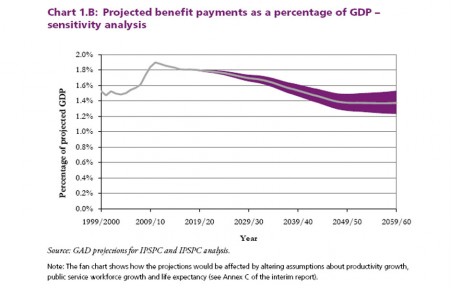
It is not, in fact, burgeoning. It is shrinking. Wilting. It falls year on year for the next forty odd years in the worst case scenario. This is not the work of subversive Bolshevik infiltrators, either, but of the government's own actuaries.
From today's Grauniad, here's Lord "Not the Judge" Hutton himself.
Well, the problem is going away. Strikes or no strikes.
Hutton can't plead ignorance. It's in his own report. Iain Duncan Smith commissioned it but he's not read it either:
It's precedented alright - the precedent is now. It goes down from now on if we do nothing. Doing nothing fixes the problem.
Now, I don't expect very much from the pundit-wanker types like Patrick "Unseasonably Mild" Wintour or Toby "Toby" Helm. They're beyond help. But Allegra Stratton is usually worth reading in the Grauniad because she's a reporter rather than a pundit wanker political editor. However, even she didn't find it worthwhile to read the report or even just to look at a couple of blogs, or if she did she didn't think it newsworthy that this whole row is being sold to the public on false pretences, in total and absolute denial of the facts.
In the opinion of the people whose business it is to pay them, public sector pensions will cost less every year from here on in.
Surely, if you're writing a story about a labour-management dispute over pensions, it's incumbent on you to say something about the state of the pension scheme involved? It's as if the Islington Gazette covered Friday night stabbings without mentioning the location, the motive, or even that a knife was used. But national press journalism seems to inject people with some sort of morally fattening and neutralising hormone. And this is the Guardian!
Shall we take it to the bridge? Yeah? Yeah!
There are reasons, of course.
Pensions: the public sector is in denial, from Saturday's Money supplement. Oddly there isn't a Poverty supplement.
Well, they oughter as they probably don't get any employer contributions.
Sadly, the Grauniad's hack doesn't mention them at all at any point and you have to rely on one Ken Chu, an NHS sysadmin, who gets randomly voxpopped to raise this issue. But the paper has bigger fish to fry. Scottish Widows' "head of pensions market development" - yes, really - has to get his sales-driven "research" in the media somehow. No doubt the nice lady from SW will be striding along the beach in next week's glossy for a sizable payment.
To finish, and repeat:
There is no crisis and everyone in the newspapers is lying to you, personally, quite deliberately.
A senior union source told The Observer that it was clear Alexander had jumped the gun as the Treasury attempted to show it was taking a hard line on the burgeoning pensions bill.
"Danny Alexander has been reined in by the Cabinet Office," said a union source. "What he did was inflammatory and showed no sense of the seriousness of these issues for people's lives."
Did the senior union source really? Probably he said the bit that was directly quoted, but I doubt anyone senior in a union would talk about a burgeoning public-sector pensions bill. Because there is no such thing. No. There is no crisis.
It is not, in fact, burgeoning. It is shrinking. Wilting. It falls year on year for the next forty odd years in the worst case scenario. This is not the work of subversive Bolshevik infiltrators, either, but of the government's own actuaries.
From today's Grauniad, here's Lord "Not the Judge" Hutton himself.
"It's an uncomfortable truth, but I'm afraid it's the reality, that the world is changing around us and people are living for much longer, and we have not been paying for those extra years of pensions – the taxpayer has. Strikes won't make this problem go away, we have to act now. If we don't act now, it's our kids who are going to pick up the tab, and it's not right."
Well, the problem is going away. Strikes or no strikes.
Hutton can't plead ignorance. It's in his own report. Iain Duncan Smith commissioned it but he's not read it either:
He is expected to say: "We're heading towards an unprecedented burden being placed on the next generation who will have to pay for their parents' retirement on top of paying for the national debt. It's not fair. This bill will address the realities of our increasing longevity by sharing the costs between the generations. We will stand by the 2018 and 2020 timetable."
It's precedented alright - the precedent is now. It goes down from now on if we do nothing. Doing nothing fixes the problem.
Now, I don't expect very much from the pundit-wanker types like Patrick "Unseasonably Mild" Wintour or Toby "Toby" Helm. They're beyond help. But Allegra Stratton is usually worth reading in the Grauniad because she's a reporter rather than a pundit wanker political editor. However, even she didn't find it worthwhile to read the report or even just to look at a couple of blogs, or if she did she didn't think it newsworthy that this whole row is being sold to the public on false pretences, in total and absolute denial of the facts.
In the opinion of the people whose business it is to pay them, public sector pensions will cost less every year from here on in.
Surely, if you're writing a story about a labour-management dispute over pensions, it's incumbent on you to say something about the state of the pension scheme involved? It's as if the Islington Gazette covered Friday night stabbings without mentioning the location, the motive, or even that a knife was used. But national press journalism seems to inject people with some sort of morally fattening and neutralising hormone. And this is the Guardian!
Shall we take it to the bridge? Yeah? Yeah!
There are reasons, of course.
Pensions: the public sector is in denial, from Saturday's Money supplement. Oddly there isn't a Poverty supplement.
Ian Naismith, head of pensions market development for Scottish Widows, said although more people were saving adequate amounts towards retirement in the public sector, and the changes will still leave them with reasonable pensions, those in the private sector who are saving towards retirement are contributing a bigger proportion of their earnings — 9.7% compared to 9.3%.
Well, they oughter as they probably don't get any employer contributions.
Sadly, the Grauniad's hack doesn't mention them at all at any point and you have to rely on one Ken Chu, an NHS sysadmin, who gets randomly voxpopped to raise this issue. But the paper has bigger fish to fry. Scottish Widows' "head of pensions market development" - yes, really - has to get his sales-driven "research" in the media somehow. No doubt the nice lady from SW will be striding along the beach in next week's glossy for a sizable payment.
To finish, and repeat:
There is no crisis and everyone in the newspapers is lying to you, personally, quite deliberately.
Sunday, May 22, 2011
OpenTech washup, and an amended result
So it was OpenTech weekend. I wasn't presenting anything (although I'm kicking myself for not having done a talk on Tropo and Phono) but of course I was there. This year's was, I think, a bit better than last year's - the schedule filled up late on, and there were a couple of really good workshop sessions. As usual, it was also the drinking conference with a code problem (the bar was full by the end of the first session).
Things to note: everyone loves Google Refine, and I really enjoyed the Refine HOWTO session, which was also the one where the presenter asked if anyone present had ever written a screen-scraper and 60-odd hands reached for the sky. Basically, it lets you slurp up any even vaguely tabular data and identify transformations you need to clean it up - for example, identifying particular items, data formats, or duplicates - and then apply them to the whole thing automatically. You can write your own functions for it in several languages and have the application call them as part of the process. Removing cruft from data is always incredibly time consuming and annoying, so it's no wonder everyone likes the idea of a sensible way of automating it. There's been some discussion on the ScraperWiki mailing list about integrating Refine into SW in order to provide a data-scrubbing capability and I wouldn't be surprised if it goes ahead.
Tim Ireland's presentation on the political uses of search-engine optimisation was typically sharp and typically amusing - I especially liked his point that the more specific a search term, the less likely it is to lead the searcher to a big newspaper website. Also, he made the excellent point that mass audiences and target audiences are substitutes for each other, and the ultimate target audience is one person - the MP (or whoever) themselves.
The Sukey workshop was very cool - much discussion about propagating data by SMS in a peer-to-peer topology, on the basis that everyone has a bucket of inclusive SMS messages and this beats paying through the nose for Clickatell or MBlox to send out bulk alerts. They are facing a surprisingly common mobile tech issue, which is that when you go mobile, most of the efficient push-notification technologies you can use on the Internet stop being efficient. If you want to use XMPP or SIP messaging, your problem is that the users' phones have to maintain an active data connection and/or recreate one as soon after an interruption as possible. Mobile networks analogise an Internet connection to a phone call - the terminal requests a PDP (Packet Data Profile) data call from the network - and as a result, the radio in the phone stays in an active state as long as the "call" is going on, whether any data is being transferred or not.
This is the inverse of the way they handle incoming messages or phone calls - in that situation, the radio goes into a low power standby mode until the network side signals it on a special paging channel. At the moment, there's no cross-platform way to do this for incoming Internet packets, although there are some device-specific ways of getting around it at a higher level of abstraction. Hence the interest of using SMS (or indeed MMS).
Their other main problem is the integrity of their data - even without deliberate disinformation, there's plenty of scope for drivel, duplicates, cockups etc to get propagated, and a risk of a feedback loop in which the crap gets pushed out to users, they send it to other people, and it gets sucked up from Twitter or whatever back into the system. This intersects badly with their use cases - it strikes me, and I said as much, that moderation is a task that requires a QWERTY keyboard, a decent-sized monitor, and a shirt-sleeve working environment. You can't skim-read through piles of comments on a 3" mobile phone screen in the rain, nor can you edit them on a greasy touchscreen, and you certainly can't do either while looking out that you don't get hit over the head by the cops.
Fortunately, there is no shortage of armchair revolutionaries on the web who could actually contribute something by reviewing batches of updates, and once you have reasonably large buckets of good stuff and crap you can use Bayesian filtering to automate part of the process.
Francis Davey's OneClickOrgs project is coming along nicely - it automates the process of creating an organisation with legal personality and a constitution and what not, and they're looking at making it able to set up co-ops and other types of organisation.
I didn't know that OpenStreetMap is available through multiple different tile servers, so you can make use of Mapquest's CDN to serve out free mapping.
OpenCorporates is trying to make a database of all the world's companies (they're already getting on for four million), and the biggest problem they have is working out how to represent inter-company relationships, which have the annoying property that they are a directed graph but not a directed acylic graph - it's perfectly possible and indeed common for company X to own part of company Y which owns part of company X, perhaps through the intermediary of company Z.
OpenTech's precursor, Notcon, was heavier on the hardware/electronics side than OT usually is, but this year there were quite a few hardware projects. However, I missed the one that actually included a cat.
What else? LinkedGov is a bit like ScraperWiki but with civil servants and a grant from the Technology Strategy Board. Francis Maude is keen. Kumbaya is an encrypted, P2P online backup application which has the feature that you only have to store data from people you trust. (Oh yes, and apparently nobody did any of this stuff two years ago. Time to hit the big brown bullshit button.)
As always, the day after is a bit of an enthusiasm killer. I've spent part of today trying to implement monthly results for my lobby metrics project and it looks like it's much harder than I was expecting. Basically, NetworkX is fundamentally node-oriented and the dates of meetings are edge properties, so you can't just subgraph nodes with a given date. This may mean I'll have to rethink the whole implementation. Bugger.
I'm also increasingly tempted to scrape the competition's meetings database into ScraperWiki as there doesn't seem to be any way of getting at it without the HTML wrapping. Oddly, although they've got the Department of Health's horrible PDFs scraped, they haven't got the Scottish Office although it's relatively easy, so it looks like this wouldn't be a 100% solution. However, their data cleaning has been much more effective - not surprising as I haven't really been trying. This has some consequences - I've only just noticed that I've hugely underestimated Oliver Letwin's gatekeepership, which should be 1.89 rather than 1.05. Along with his network degree of 2.67 (the eight highest) this suggests that he should be a highly desirable target for any lobbying you might want to do.
Things to note: everyone loves Google Refine, and I really enjoyed the Refine HOWTO session, which was also the one where the presenter asked if anyone present had ever written a screen-scraper and 60-odd hands reached for the sky. Basically, it lets you slurp up any even vaguely tabular data and identify transformations you need to clean it up - for example, identifying particular items, data formats, or duplicates - and then apply them to the whole thing automatically. You can write your own functions for it in several languages and have the application call them as part of the process. Removing cruft from data is always incredibly time consuming and annoying, so it's no wonder everyone likes the idea of a sensible way of automating it. There's been some discussion on the ScraperWiki mailing list about integrating Refine into SW in order to provide a data-scrubbing capability and I wouldn't be surprised if it goes ahead.
Tim Ireland's presentation on the political uses of search-engine optimisation was typically sharp and typically amusing - I especially liked his point that the more specific a search term, the less likely it is to lead the searcher to a big newspaper website. Also, he made the excellent point that mass audiences and target audiences are substitutes for each other, and the ultimate target audience is one person - the MP (or whoever) themselves.
The Sukey workshop was very cool - much discussion about propagating data by SMS in a peer-to-peer topology, on the basis that everyone has a bucket of inclusive SMS messages and this beats paying through the nose for Clickatell or MBlox to send out bulk alerts. They are facing a surprisingly common mobile tech issue, which is that when you go mobile, most of the efficient push-notification technologies you can use on the Internet stop being efficient. If you want to use XMPP or SIP messaging, your problem is that the users' phones have to maintain an active data connection and/or recreate one as soon after an interruption as possible. Mobile networks analogise an Internet connection to a phone call - the terminal requests a PDP (Packet Data Profile) data call from the network - and as a result, the radio in the phone stays in an active state as long as the "call" is going on, whether any data is being transferred or not.
This is the inverse of the way they handle incoming messages or phone calls - in that situation, the radio goes into a low power standby mode until the network side signals it on a special paging channel. At the moment, there's no cross-platform way to do this for incoming Internet packets, although there are some device-specific ways of getting around it at a higher level of abstraction. Hence the interest of using SMS (or indeed MMS).
Their other main problem is the integrity of their data - even without deliberate disinformation, there's plenty of scope for drivel, duplicates, cockups etc to get propagated, and a risk of a feedback loop in which the crap gets pushed out to users, they send it to other people, and it gets sucked up from Twitter or whatever back into the system. This intersects badly with their use cases - it strikes me, and I said as much, that moderation is a task that requires a QWERTY keyboard, a decent-sized monitor, and a shirt-sleeve working environment. You can't skim-read through piles of comments on a 3" mobile phone screen in the rain, nor can you edit them on a greasy touchscreen, and you certainly can't do either while looking out that you don't get hit over the head by the cops.
Fortunately, there is no shortage of armchair revolutionaries on the web who could actually contribute something by reviewing batches of updates, and once you have reasonably large buckets of good stuff and crap you can use Bayesian filtering to automate part of the process.
Francis Davey's OneClickOrgs project is coming along nicely - it automates the process of creating an organisation with legal personality and a constitution and what not, and they're looking at making it able to set up co-ops and other types of organisation.
I didn't know that OpenStreetMap is available through multiple different tile servers, so you can make use of Mapquest's CDN to serve out free mapping.
OpenCorporates is trying to make a database of all the world's companies (they're already getting on for four million), and the biggest problem they have is working out how to represent inter-company relationships, which have the annoying property that they are a directed graph but not a directed acylic graph - it's perfectly possible and indeed common for company X to own part of company Y which owns part of company X, perhaps through the intermediary of company Z.
OpenTech's precursor, Notcon, was heavier on the hardware/electronics side than OT usually is, but this year there were quite a few hardware projects. However, I missed the one that actually included a cat.
What else? LinkedGov is a bit like ScraperWiki but with civil servants and a grant from the Technology Strategy Board. Francis Maude is keen. Kumbaya is an encrypted, P2P online backup application which has the feature that you only have to store data from people you trust. (Oh yes, and apparently nobody did any of this stuff two years ago. Time to hit the big brown bullshit button.)
As always, the day after is a bit of an enthusiasm killer. I've spent part of today trying to implement monthly results for my lobby metrics project and it looks like it's much harder than I was expecting. Basically, NetworkX is fundamentally node-oriented and the dates of meetings are edge properties, so you can't just subgraph nodes with a given date. This may mean I'll have to rethink the whole implementation. Bugger.
I'm also increasingly tempted to scrape the competition's meetings database into ScraperWiki as there doesn't seem to be any way of getting at it without the HTML wrapping. Oddly, although they've got the Department of Health's horrible PDFs scraped, they haven't got the Scottish Office although it's relatively easy, so it looks like this wouldn't be a 100% solution. However, their data cleaning has been much more effective - not surprising as I haven't really been trying. This has some consequences - I've only just noticed that I've hugely underestimated Oliver Letwin's gatekeepership, which should be 1.89 rather than 1.05. Along with his network degree of 2.67 (the eight highest) this suggests that he should be a highly desirable target for any lobbying you might want to do.
Saturday, March 26, 2011
march
I'll be out tomorrow. Obviously. Setting off from Archway tube at 1015. Anyway, updates will be at the twitter feed.
Monday, February 07, 2011
From the noisy phase to the quiet phase
Is it meaningful to say that the Egyptian revolution is calming down, or petering out? I ask because a common flaw of the reporting on it has been to treat the basic dynamics of mobilisation as if they were signs of huge political shifts behind the curtain. It's obviously true that both revolutionaries and reactionaries need to sleep and eat. When the revolutionaries want to, they have no great difficulty in putting over a million people on the streets in Cairo and probably a bit more again elsewhere in Egypt. These are peak efforts. Idiot management-speakers like to talk about maintaining peak performance, but they are idiots: the word peak implies a supreme effort that cannot be maintained continuously. People have to eat and sleep, they have families, they have jobs, although many millions of Egyptians have been taking part in the revolution silently by essentially going on strike. Even revolutionaries have to maintain their barricades, update their blogs, and hold meetings to decide what to do next.
The result of this is that there's been a sort of media cycle - one day the papers are full of pictures from the latest day of rage, the next it's all about people grandly speculating on what happens next, and the regime's spokesmen explaining how they intend to preserve the substance of the regime. Perhaps they talk about that on the other days, but nobody is listening. Or perhaps they believe it, when they wake up and hear that there are only tens of thousands of rebels in Tahrir Square rather than hundreds of thousands. Then, the next callout of the demonstrators resets the clock again.
Today, we seem to be in one of the ebb-tide phases. So it's a good moment for a bit of speculating. What is important, in these terms, is that the government doesn't seem to be regaining much ground in between waves of protest. Instead, there seems to be a ratchet in operation - each wave extracts a new concession. Mubarak sacked his government. And appointed a vice president. Then he promised not to stand again. Then talks were opened with the opposition. Then the military accepted to talk directly with the opposition, independently. Then the NDP hierarchy was purged. Then Suleiman renounced becoming president himself. And the regime's own peak effort - Wednesday's thug raid - was dramatic and violent at the time, but with hindsight was nowhere near enough in terms of numbers to change anything. Arguably, it wrecked the government's remaining legitimacy and only demonstrated its lack of mass support.
The fear is that this is no ratchet, but a sort of retreat into the Russian hinterland, a trap. On the other hand, it's a common pattern in the end of dictatorship, a sort of political Cheyne-Stokes breathing. You may think you are saving the structural realities of power and giving away the forms, but how will those realities stand up without the Emergency Law and the special constitutional amendments and the practice of having political prisoners and the ban on opposition parties and the censorship of the press? After all, there must be a reason, rooted in the structural realities of power, why you wanted them in the first place. If owning hotels was enough to sustain a tyranny, there'd be no need for Central Security or private thugs on camels or sententious TV broadcasts or bulk SMS messages with faked originating numbers.
Revolutions come with years, like New Order remixes used to. Prague '89. Paris '68. Probably the most relevant ones now are the Polish ones - Solidarity feat. Jaruzelski '81 and '89. The first one was a lot like what everyone fears for Egypt and also quite a lot like the official preferences of our governments. There was violence, but not as much as there could have been, and a safe military dictator won. He, in turn, turned to a religious and conservative pseudo-opposition to give his rule some foundation. The second was more optimistic but less spectacular. In 1989, the end of communism in Poland involved far more negotiating than it did street-fighting, and it involved putting up with Jaruzelski sticking around for the rest of his term as a sop to the powers that be, or rather the powers that were.
Egypt is already some way beyond 1981 - there is something like a round table, and the officially designated military strongman is getting very close to the exit, having disclaimed supreme power for himself. Probably the communists of 1989 thought they were cunningly playing for time. Suleiman has a far more ruthless reputation, though; the big issue is whether he can be trusted or better, constrained from trying to either crush the opposition between here and whenever the election date is set or else to start a civil war like the Algerian generals of 1991.
One argument has been that there would be a fake revolution, leaving the security state in charge, as Jamie Kenny put it. I think this is now out of date. Similarly, although they are now talking to the Muslim Brotherhood, I think my own prediction is also out of date. We're past the point where a few Brothers in the government would convince anyone. In fact, Jamie and I saw our predictions first validated and then rendered irrelevant within a week.
Looking ahead, it's worth remembering that 1989 took time to deliver. After the original moment of success, there was a long and uncertain haul of getting rid of specific individual bastards, changing laws, moving editors around the State TV and inspectors around the police force. I think we're now into this phase. Some people seem to agree, from very different points on the spectrum. Changing the union confederation and the university professors' club is very much to the point, whether you're thinking 1989 and maintaining enough forward momentum to protect the revolution or 1917 and the second wave.
I think I'd rather have that man on my side.
The result of this is that there's been a sort of media cycle - one day the papers are full of pictures from the latest day of rage, the next it's all about people grandly speculating on what happens next, and the regime's spokesmen explaining how they intend to preserve the substance of the regime. Perhaps they talk about that on the other days, but nobody is listening. Or perhaps they believe it, when they wake up and hear that there are only tens of thousands of rebels in Tahrir Square rather than hundreds of thousands. Then, the next callout of the demonstrators resets the clock again.
Today, we seem to be in one of the ebb-tide phases. So it's a good moment for a bit of speculating. What is important, in these terms, is that the government doesn't seem to be regaining much ground in between waves of protest. Instead, there seems to be a ratchet in operation - each wave extracts a new concession. Mubarak sacked his government. And appointed a vice president. Then he promised not to stand again. Then talks were opened with the opposition. Then the military accepted to talk directly with the opposition, independently. Then the NDP hierarchy was purged. Then Suleiman renounced becoming president himself. And the regime's own peak effort - Wednesday's thug raid - was dramatic and violent at the time, but with hindsight was nowhere near enough in terms of numbers to change anything. Arguably, it wrecked the government's remaining legitimacy and only demonstrated its lack of mass support.
The fear is that this is no ratchet, but a sort of retreat into the Russian hinterland, a trap. On the other hand, it's a common pattern in the end of dictatorship, a sort of political Cheyne-Stokes breathing. You may think you are saving the structural realities of power and giving away the forms, but how will those realities stand up without the Emergency Law and the special constitutional amendments and the practice of having political prisoners and the ban on opposition parties and the censorship of the press? After all, there must be a reason, rooted in the structural realities of power, why you wanted them in the first place. If owning hotels was enough to sustain a tyranny, there'd be no need for Central Security or private thugs on camels or sententious TV broadcasts or bulk SMS messages with faked originating numbers.
Revolutions come with years, like New Order remixes used to. Prague '89. Paris '68. Probably the most relevant ones now are the Polish ones - Solidarity feat. Jaruzelski '81 and '89. The first one was a lot like what everyone fears for Egypt and also quite a lot like the official preferences of our governments. There was violence, but not as much as there could have been, and a safe military dictator won. He, in turn, turned to a religious and conservative pseudo-opposition to give his rule some foundation. The second was more optimistic but less spectacular. In 1989, the end of communism in Poland involved far more negotiating than it did street-fighting, and it involved putting up with Jaruzelski sticking around for the rest of his term as a sop to the powers that be, or rather the powers that were.
Egypt is already some way beyond 1981 - there is something like a round table, and the officially designated military strongman is getting very close to the exit, having disclaimed supreme power for himself. Probably the communists of 1989 thought they were cunningly playing for time. Suleiman has a far more ruthless reputation, though; the big issue is whether he can be trusted or better, constrained from trying to either crush the opposition between here and whenever the election date is set or else to start a civil war like the Algerian generals of 1991.
One argument has been that there would be a fake revolution, leaving the security state in charge, as Jamie Kenny put it. I think this is now out of date. Similarly, although they are now talking to the Muslim Brotherhood, I think my own prediction is also out of date. We're past the point where a few Brothers in the government would convince anyone. In fact, Jamie and I saw our predictions first validated and then rendered irrelevant within a week.
Looking ahead, it's worth remembering that 1989 took time to deliver. After the original moment of success, there was a long and uncertain haul of getting rid of specific individual bastards, changing laws, moving editors around the State TV and inspectors around the police force. I think we're now into this phase. Some people seem to agree, from very different points on the spectrum. Changing the union confederation and the university professors' club is very much to the point, whether you're thinking 1989 and maintaining enough forward momentum to protect the revolution or 1917 and the second wave.
Take it easy ya Ahmad. Every revolution in history always has this carnival-like side. The insurrection will come later. #Jan25
I think I'd rather have that man on my side.
Saturday, December 04, 2010
False dichotomy watch
We've seen plenty of this sort of stuff before:
Well, if your benchmark of effectiveness is the NUS... Mere snark, though. This particular Internet prairie fire does seem to be spreading nicely and doing more than tweeting. However, whenever someone starts going on like this, I do tend to suspect what they mean is "...more flexible and effective than organisations with people with funny accents who are train drivers an stuff".
I've said before, though, that I suspect that a lot of this network organising is structurally suited to negativity. Look at the 'baggers, for example. The classic examples political science types use, like open-source software projects, tend to be very different to the implementations in politics - rather than trying to recruit masses of people, they're usually driven by a hard core of the obsessed, or of people whose job it is. Order is difficult, mayhem is easy. Specifically, you can contribute significantly to mayhem by putting in an hour here or there.
On the other hand, though, it's not as if we're likely to run out of rage. This is 'bagger lesson one. Negative tactics and the expression of inchoate rage are not without value. Nigel Stanley gets it right - it's a false dichotomy. Getrennt marschieren, vereint schlagen, and we'll all get there in the end.
These networks such as the UnCut movement or the student movement with outstanding micro-organisations such as the UCL Occupation (which has received over 60,000 hits on its blog in a little under a week) who have so dynamically organised yesterday, today and going forward will inevitably be more flexible and effective than organisations with generic ‘leaderships’ such as major businesses, the police or even the National Union of Students.
Well, if your benchmark of effectiveness is the NUS... Mere snark, though. This particular Internet prairie fire does seem to be spreading nicely and doing more than tweeting. However, whenever someone starts going on like this, I do tend to suspect what they mean is "...more flexible and effective than organisations with people with funny accents who are train drivers an stuff".
I've said before, though, that I suspect that a lot of this network organising is structurally suited to negativity. Look at the 'baggers, for example. The classic examples political science types use, like open-source software projects, tend to be very different to the implementations in politics - rather than trying to recruit masses of people, they're usually driven by a hard core of the obsessed, or of people whose job it is. Order is difficult, mayhem is easy. Specifically, you can contribute significantly to mayhem by putting in an hour here or there.
On the other hand, though, it's not as if we're likely to run out of rage. This is 'bagger lesson one. Negative tactics and the expression of inchoate rage are not without value. Nigel Stanley gets it right - it's a false dichotomy. Getrennt marschieren, vereint schlagen, and we'll all get there in the end.
Sunday, November 21, 2010
public service announcement
Sometimes, somebody does a web site listing protests against the cuts so you don't have to.
Sunday, July 04, 2010
clarity found
Ordinary Pakistanis appear to have a very clear idea of their country's problems.
I don't know about the first one of those, but you can't have a demo without someone getting het up about Israel. Classical information theory states that therefore we can filter that out without losing any information.
Angry protesters at the site of the bombing raised slogans against Israel, the US, the Taliban and the ultra-orthodox strain of Wahhabi Islam.
I don't know about the first one of those, but you can't have a demo without someone getting het up about Israel. Classical information theory states that therefore we can filter that out without losing any information.
Sunday, May 09, 2010
I don't know what they mean by that...
I'm actually quite pleased with our little demo. I wasn't particularly enthusiastic when we assembled in Trafalgar Square, where various speeches were made of which not one word was audible (note to the various orgs involved: I'd happily spring for some batteries for the loud hailer. I mean, my student union would have got that right, to say nothing of the SWP...). And Morrismen kept invading our space.
I originally thought this was some regrettable, Lucky Jim example of sandal-socks liberalism. Actually no; I'm informed by Tom from Boriswatch that this is actually our mayor's idea of culture, and actual taxpayers' money is being paid out to them. Perhaps it's a sort of defensible-space gambit to make it harder to protest there.
Eventually, Billy Bragg - for it is he! - suggested from the platform that we march to Smith Square and picket the Local Government Association building, where the Lib Dem MPs were meeting. This basically turned the demo around, and at least it stopped him singing; off we went down Whitehall, snarling up the traffic, calling on the recently expanded camp around Brian Haw's pad, hurling abuse at the Sky News media-slum in College Green, flanked by policemen radioing each other to work out where we were heading.
Smith Square is not roomy; this is why those TV pictures of Tories celebrating outside Central Office always looked like more of a party than they probably were. So the crowd looked bigger and the shouting was louder. And, well, we stuck around yelling until Nick Clegg came out to speak. Again, I couldn't hear a word, and we actually found out what he said via Twitter on Tom's BlackBerry. Which made sense, as a major aim of the demo was to get onto the TV streams and RSS feeds the MPs would no doubt be obsessively monitoring.
It wasn't a big demo, but it was targeted - the LGA building was already staked out by a huge media presence, with the steps of the church opposite festooned with camera crews, reporters buzzing around like flies round shit, and a big ambush of photographers and more TV cams on the LGA's steps.
This was crucial - as we were arriving during the meeting, there would be nothing for them to report on or film other than the outside of a decentish Queen Anne block, which is better architecture than it is telly. All it took was for the camera gang on the steps to swivel through 180 degrees to get a perfect angry-mob shot, while the ones on the church had a reverse angle view of a crowd apparently besieging the building. Cropping in to emphasise the speakers would tend to compress the scene, giving the impression of a more dramatic confrontation.
The results? Well, we got far more news than I expected; and we seem to have traumatised Kay Burley.
[youtube=http://www.youtube.com/watch?v=KExTelt3MkE&hl=en_GB&fs=1&]
The expression on her face at the beginning is priceless. How dare they! This wasn't on the autocue! There's more here; later in the day, I was with Boriswatch and his charming son, Alfie, who seems to be training as a Dickensian pickpocket (he relieved his father of a £10 note with positively Sicilian panache), in the Westminster Arms, which offers its customers two TV screens, one locked on Sky News and the other to BBC News-24. With a bit of neck-craning, you could just about watch both simultaneously in a sort of split brain media experiment - what was telling was that there was more Shannon-information in the BBC feed, far less repetition, the BBC didn't deliberately misquote Nick Clegg in all its on-screen graphics, and the BBC didn't insist on informing me every three minutes that Mohamed Al-Fayed had sold a rather unfashionable department store.
Seriously - yesterday of all days, Al-Fayed's sale of Harrods was in the top three stories on Sky News for at least two hours. And, as a hint, Nick Clegg didn't say the Tories had a "right to govern", which they repeatedly asserted as a direct quote; he said that the largest party had the right to be consulted about a coalition first, which is far from the same thing.
I originally thought this was some regrettable, Lucky Jim example of sandal-socks liberalism. Actually no; I'm informed by Tom from Boriswatch that this is actually our mayor's idea of culture, and actual taxpayers' money is being paid out to them. Perhaps it's a sort of defensible-space gambit to make it harder to protest there.
Eventually, Billy Bragg - for it is he! - suggested from the platform that we march to Smith Square and picket the Local Government Association building, where the Lib Dem MPs were meeting. This basically turned the demo around, and at least it stopped him singing; off we went down Whitehall, snarling up the traffic, calling on the recently expanded camp around Brian Haw's pad, hurling abuse at the Sky News media-slum in College Green, flanked by policemen radioing each other to work out where we were heading.
Smith Square is not roomy; this is why those TV pictures of Tories celebrating outside Central Office always looked like more of a party than they probably were. So the crowd looked bigger and the shouting was louder. And, well, we stuck around yelling until Nick Clegg came out to speak. Again, I couldn't hear a word, and we actually found out what he said via Twitter on Tom's BlackBerry. Which made sense, as a major aim of the demo was to get onto the TV streams and RSS feeds the MPs would no doubt be obsessively monitoring.
It wasn't a big demo, but it was targeted - the LGA building was already staked out by a huge media presence, with the steps of the church opposite festooned with camera crews, reporters buzzing around like flies round shit, and a big ambush of photographers and more TV cams on the LGA's steps.
This was crucial - as we were arriving during the meeting, there would be nothing for them to report on or film other than the outside of a decentish Queen Anne block, which is better architecture than it is telly. All it took was for the camera gang on the steps to swivel through 180 degrees to get a perfect angry-mob shot, while the ones on the church had a reverse angle view of a crowd apparently besieging the building. Cropping in to emphasise the speakers would tend to compress the scene, giving the impression of a more dramatic confrontation.
The results? Well, we got far more news than I expected; and we seem to have traumatised Kay Burley.
[youtube=http://www.youtube.com/watch?v=KExTelt3MkE&hl=en_GB&fs=1&]
The expression on her face at the beginning is priceless. How dare they! This wasn't on the autocue! There's more here; later in the day, I was with Boriswatch and his charming son, Alfie, who seems to be training as a Dickensian pickpocket (he relieved his father of a £10 note with positively Sicilian panache), in the Westminster Arms, which offers its customers two TV screens, one locked on Sky News and the other to BBC News-24. With a bit of neck-craning, you could just about watch both simultaneously in a sort of split brain media experiment - what was telling was that there was more Shannon-information in the BBC feed, far less repetition, the BBC didn't deliberately misquote Nick Clegg in all its on-screen graphics, and the BBC didn't insist on informing me every three minutes that Mohamed Al-Fayed had sold a rather unfashionable department store.
Seriously - yesterday of all days, Al-Fayed's sale of Harrods was in the top three stories on Sky News for at least two hours. And, as a hint, Nick Clegg didn't say the Tories had a "right to govern", which they repeatedly asserted as a direct quote; he said that the largest party had the right to be consulted about a coalition first, which is far from the same thing.
Saturday, November 28, 2009
Links And Ties
The affair of the stolen HadCRU e-mail should tell us a couple of things. The first is that this is why you should worry about privacy. If you do enough naive traffic analysis, not only will you find a pattern - people communicate in patterns - but you'll be able to find something that you can misrepresent. This is the inevitable outcome of pareidolia, the false positive problem, and the infinite possibilities that open up when you don't have to show your working out.
It's a methodology that is common to cranks who stare at the patterns in their heads, to stupid politicians who don't understand or don't want to understand the maths of false positives, and to spooks, red-baiters, and other political thugs who understand them all too well. Viz:
Give me a representative 62MB of your archived e-mail and I'll give you a reason to really hate me.
Secondly, it's about expectations. The scientists involved are condemned for, among other things, being angry about a crappy denier paper getting published in Climate Research and strategising together about how best to protest it. We are expected, in other words, to be shocked that they aren't like the liberal in the joke who is too even-handed to take his own side in a knife fight.
The purpose of the exercise, of course, is to get people sacked if they aren't like that - to impose this stereotype. This is why George Monbiot is wildly wrong. You can't appease the authoritarians; weakness provokes them still further. (Mark Lynas is right, by the way.)
Thirdly, it's based on epic stupidity. The famous "hiding the decline" actually consists of including the actual observed temperatures in a group of parallel data series, rather than, say, removing the anomalous ones. The series in question, Keith Briffa's Yamal tree-ring proxy for temperature, tracks with the observations from the beginning of observed data to the postwar era, and with other proxies before the observation era. Then, for reasons we don't understand, it diverges. Nobody makes any secret of this: they published it in Nature! But you'd have to be incredibly stupid to pick the diverging proxy series over the observed temperatures. (If you want detail, try here.)
Actually, one explanation is that Yamal is in northern Siberia, one of the fastest-warming parts of the planet, and the trees may not be able to respond quickly enough to more warmth. Hilariously, it's also one of the biggest gas fields on the planet.
Fourthly, it's pathetically trivial. If, in fact, the e-mails showed that literally every paper on climate published since whenever was drivel, it wouldn't matter a damn unless the fundamental laws of nature were vastly different. A mixture of gases containing more carbon dioxide absorbs more infra-red radiation than one with less - it's a trivial lab demonstration. And something that absorbs more heat than it radiates will get hotter. It's Newtonian thermodynamics.
And fifthly, Eric Raymond is not the son of God - he's a very naughty boy, who appears to have missed that the code he keeps ranting about is commented-out of the program and never used. (And the less said about this HOWNOTTO and the associated queeny snit, the better.)
Anyway, far from wanting anyone to resign, I'm going to write to the UEA vice-chancellor for research, Trevor Davies, and compliment him on standing up to the red-baiters so far. And I recommend you do too, before he goes floppy.
If anything at UEA wants investigating, it's their IT security practices.
It's a methodology that is common to cranks who stare at the patterns in their heads, to stupid politicians who don't understand or don't want to understand the maths of false positives, and to spooks, red-baiters, and other political thugs who understand them all too well. Viz:
I don't quite understand the HP Sauce concept of 'links' either. Pretty much everyone in the world is damned as an extremist if you take the idea of 'links' as far as they do.
Give me a representative 62MB of your archived e-mail and I'll give you a reason to really hate me.
Secondly, it's about expectations. The scientists involved are condemned for, among other things, being angry about a crappy denier paper getting published in Climate Research and strategising together about how best to protest it. We are expected, in other words, to be shocked that they aren't like the liberal in the joke who is too even-handed to take his own side in a knife fight.
The purpose of the exercise, of course, is to get people sacked if they aren't like that - to impose this stereotype. This is why George Monbiot is wildly wrong. You can't appease the authoritarians; weakness provokes them still further. (Mark Lynas is right, by the way.)
Thirdly, it's based on epic stupidity. The famous "hiding the decline" actually consists of including the actual observed temperatures in a group of parallel data series, rather than, say, removing the anomalous ones. The series in question, Keith Briffa's Yamal tree-ring proxy for temperature, tracks with the observations from the beginning of observed data to the postwar era, and with other proxies before the observation era. Then, for reasons we don't understand, it diverges. Nobody makes any secret of this: they published it in Nature! But you'd have to be incredibly stupid to pick the diverging proxy series over the observed temperatures. (If you want detail, try here.)
Actually, one explanation is that Yamal is in northern Siberia, one of the fastest-warming parts of the planet, and the trees may not be able to respond quickly enough to more warmth. Hilariously, it's also one of the biggest gas fields on the planet.
Fourthly, it's pathetically trivial. If, in fact, the e-mails showed that literally every paper on climate published since whenever was drivel, it wouldn't matter a damn unless the fundamental laws of nature were vastly different. A mixture of gases containing more carbon dioxide absorbs more infra-red radiation than one with less - it's a trivial lab demonstration. And something that absorbs more heat than it radiates will get hotter. It's Newtonian thermodynamics.
And fifthly, Eric Raymond is not the son of God - he's a very naughty boy, who appears to have missed that the code he keeps ranting about is commented-out of the program and never used. (And the less said about this HOWNOTTO and the associated queeny snit, the better.)
Anyway, far from wanting anyone to resign, I'm going to write to the UEA vice-chancellor for research, Trevor Davies, and compliment him on standing up to the red-baiters so far. And I recommend you do too, before he goes floppy.
If anything at UEA wants investigating, it's their IT security practices.
Thursday, September 03, 2009
No Future in the Cath Kidston Favela
I have some problems with "10:10", the latest timebound big media campaign. The first one is symbols and aesthetics. They are handing out tags made of aluminium alloy cut out of a retired B737 down at Hurn. This is meant to be recycling, and wonderfully symbolic.
No. A superbly engineered artefact has been reduced to trinkets that will very likely go into landfill. Couldn't they have made the bits into wind turbine blades, or solar stoves, or bicycle frames if you must, or even just wiggly tin roofing? Or something, at least? Instead, it's a poster example of what Bill McKibben calls "downcycling". And, of course, it's the wrong bloody problem anyway; we could shut down aviation tomorrow and not meet the 10:10 goal, but lose fast international travel anywhere but a smallish chunk of Western Europe.
Another example; the climate campers apparently held a course on running a 12v power supply for a sound system, driven by someone pedalling. Well...engineering FAIL. If the only possible source of power is pedalling a bloody bike, wouldn't it be better to keep the bike and the calories for transport? Would a stereo be a high priority then? Wouldn't it be better to use the wind, the water, or the fire with a Sterling engine? In context, solar PV would be way out of the question. (I was pretty impressed by the edit your own sousveillance vids one, though.)
Not so sure about content, either. The Guardian is of course a biased source here; but they only found one person who wanted to build anything. An architect, of course. The front page coverage made me want to give up and buy a huge car; here's blonde Daisy, 16 and mugging for 14, suggesting we "grow veg on the balcony". Darling. Couldn't they have found Keisha-Tigrette from Tottenham who wants to KILL OIL IN THE EAR? I think they probably couldn't, and we'll get to that later.
As with most British media green pushes, there's little sign of any interest in anything physical or lasting. Not an inch of rockwool. Everything is about changing your behaviour, and specifically micro-behaviour - what you buy, or turning off lights, not how you work or where you live or how society works. Worse, it's a demand for entirely free-floating behavioural change - nobody seems to be suggesting any way of monitoring or measuring the change, or any incentives. This isn't going to work. And, again, it's all consumer guff.
The problem with consumer guff is that it's a limited way of approaching the problem. It's arguable whether or not investment is the defining value in the macro-economy - it's pretty clear that it's crucial to the climate/energy position. It is defined by the stuff we build. And further, without any mechanism to keep up to it, nothing is more evanescent than promises to do better. It doesn't even take backsliding to break them; what if you lose your job, and have to move somewhere where you need to commute 40 miles to work? Alas poor 10% saved by being nicer.
It's tough, however, to suck insulation out of the walls; this is one of the reasons I'm keen on retrofits as an alternative to winter fuel payments. The Tories can't take them away once they're done.
My third problem is this: where is the optimism? Everyone's talking about demog-friendly nostalgia for rationing that the demographic in question doesn't remember. That's not a sacrifice; woodbines, box at the Empire, sixpence, yadda yadda. Nobody is saying: Let's do BETTER this time. Let's build something BIGGER and SHINY and DRAMATIC and FANTASTIC and OUTRAGEOUS that doesn't just meet a 10% target but SMASHES it.
Where is the future in all this? What kind of a future is it? How are we meant to be full of confidence and aggression without it?
Actually there are some other options, chiefly RAGE and HATRED. No sign of them, either; but identifying an enemy is the oldest motivator in the book. There's no sign of a stinking mob hunting British Gas fatcats or an army of Rosie the Riveters basting Vladimir Putin like a turkey with their sealant guns. Why the hell not? We have enemies - why not make the most of them. I bet Keisha would be delighted to have King Abdullah and the CEO of Exxon burned in effigy, or perhaps just burned...after the block gets superinsulated.
Unfortunately, we're relying on self-righteousness as the driving emotion; not optimism (shorthand: lust), not greed, not rage, not hatred. Mind you, it is clearly an infinitely renewable resource, just like stupidity.
And while I'm on the point, where are the workers in this? Who's monitoring what exactly the council, or the diddly-dee semi-privatised thingy organisation, does when they refurbish the estate? Does anyone care about the "fuel poor" if they can't offer them a cash handout just before the elections?
There is, actually, a powerful response to some of this. That is: 10:10 looks a bit like a vacuous PR stunt because it's a PR stunt. The aim is to influence the deliberatiwoos in Copenhagen. Superistical. Das ist gut so. But this done, treaty signed, etc, we've got to go implement. With the North Sea gas running down, we've got to do that quicksmart anyway.
So, you ask, where are my positive proposals? The D-word? Well, I'm interested to hear what anyone else thinks about a campaign for an answer to climate and energy issues that points forward, that leans left, and that isn't based on whose-kid-are-you media bullshit. I'm planning to squirt sealant into every corner of my own place before this winter, too.
No. A superbly engineered artefact has been reduced to trinkets that will very likely go into landfill. Couldn't they have made the bits into wind turbine blades, or solar stoves, or bicycle frames if you must, or even just wiggly tin roofing? Or something, at least? Instead, it's a poster example of what Bill McKibben calls "downcycling". And, of course, it's the wrong bloody problem anyway; we could shut down aviation tomorrow and not meet the 10:10 goal, but lose fast international travel anywhere but a smallish chunk of Western Europe.
Another example; the climate campers apparently held a course on running a 12v power supply for a sound system, driven by someone pedalling. Well...engineering FAIL. If the only possible source of power is pedalling a bloody bike, wouldn't it be better to keep the bike and the calories for transport? Would a stereo be a high priority then? Wouldn't it be better to use the wind, the water, or the fire with a Sterling engine? In context, solar PV would be way out of the question. (I was pretty impressed by the edit your own sousveillance vids one, though.)
Not so sure about content, either. The Guardian is of course a biased source here; but they only found one person who wanted to build anything. An architect, of course. The front page coverage made me want to give up and buy a huge car; here's blonde Daisy, 16 and mugging for 14, suggesting we "grow veg on the balcony". Darling. Couldn't they have found Keisha-Tigrette from Tottenham who wants to KILL OIL IN THE EAR? I think they probably couldn't, and we'll get to that later.
As with most British media green pushes, there's little sign of any interest in anything physical or lasting. Not an inch of rockwool. Everything is about changing your behaviour, and specifically micro-behaviour - what you buy, or turning off lights, not how you work or where you live or how society works. Worse, it's a demand for entirely free-floating behavioural change - nobody seems to be suggesting any way of monitoring or measuring the change, or any incentives. This isn't going to work. And, again, it's all consumer guff.
The problem with consumer guff is that it's a limited way of approaching the problem. It's arguable whether or not investment is the defining value in the macro-economy - it's pretty clear that it's crucial to the climate/energy position. It is defined by the stuff we build. And further, without any mechanism to keep up to it, nothing is more evanescent than promises to do better. It doesn't even take backsliding to break them; what if you lose your job, and have to move somewhere where you need to commute 40 miles to work? Alas poor 10% saved by being nicer.
It's tough, however, to suck insulation out of the walls; this is one of the reasons I'm keen on retrofits as an alternative to winter fuel payments. The Tories can't take them away once they're done.
My third problem is this: where is the optimism? Everyone's talking about demog-friendly nostalgia for rationing that the demographic in question doesn't remember. That's not a sacrifice; woodbines, box at the Empire, sixpence, yadda yadda. Nobody is saying: Let's do BETTER this time. Let's build something BIGGER and SHINY and DRAMATIC and FANTASTIC and OUTRAGEOUS that doesn't just meet a 10% target but SMASHES it.
Where is the future in all this? What kind of a future is it? How are we meant to be full of confidence and aggression without it?
Actually there are some other options, chiefly RAGE and HATRED. No sign of them, either; but identifying an enemy is the oldest motivator in the book. There's no sign of a stinking mob hunting British Gas fatcats or an army of Rosie the Riveters basting Vladimir Putin like a turkey with their sealant guns. Why the hell not? We have enemies - why not make the most of them. I bet Keisha would be delighted to have King Abdullah and the CEO of Exxon burned in effigy, or perhaps just burned...after the block gets superinsulated.
Unfortunately, we're relying on self-righteousness as the driving emotion; not optimism (shorthand: lust), not greed, not rage, not hatred. Mind you, it is clearly an infinitely renewable resource, just like stupidity.
And while I'm on the point, where are the workers in this? Who's monitoring what exactly the council, or the diddly-dee semi-privatised thingy organisation, does when they refurbish the estate? Does anyone care about the "fuel poor" if they can't offer them a cash handout just before the elections?
There is, actually, a powerful response to some of this. That is: 10:10 looks a bit like a vacuous PR stunt because it's a PR stunt. The aim is to influence the deliberatiwoos in Copenhagen. Superistical. Das ist gut so. But this done, treaty signed, etc, we've got to go implement. With the North Sea gas running down, we've got to do that quicksmart anyway.
So, you ask, where are my positive proposals? The D-word? Well, I'm interested to hear what anyone else thinks about a campaign for an answer to climate and energy issues that points forward, that leans left, and that isn't based on whose-kid-are-you media bullshit. I'm planning to squirt sealant into every corner of my own place before this winter, too.
Sunday, August 09, 2009
first mover advantage
If it's possible to get Americans to start a string of minor riots in order not to have at least $80bn worth of national healthcare, surely it must be possible to start a good row about whatever it is the Conservatives have in store for us? We stand to lose at least that and more. I ask in the light of this post at Bickerstaffe Record, which suggests, not stupidly, that making an Aunt Sally of the credit rating agencies might be a good idea for a demo.
After all, it's very true that they played a key role in the great crash, and before that in the post-dotcom Enron/telecoms fraudfest. As Eavis & McLean point out in The Smartest Guys in the Room, the rating agencies were in the best possible position to work out just how much debt Enron had hidden down rabbit holes and in other people's wheely bins - because every time Enron pulled another fancy dan financing, they had the ratings agencies rate the bonds that came out of it.
And, strategically, this is always going to be a problem, because unlike all other forms of credit risk assessment, the agencies make their money from the party issuing the debt, so it's always in their interest to be optimistic. (Similarities with this little beauty of a deal are entirely appropriate.) When they are dealing with private clients, that is; if it's Argentina or Britain involved, they just go ahead and shoot. John Quiggin has an excellent post on their failure and their role in pushing PFI in Australia.
But I have my doubts that any such action will change their opinion; in fact, it wouldn't be the aim of such an action. The point would be rather to render their opinion less relevant and alter the conditions under which it is formed. However, I have just ordered the domain name standardispoor.com, and I welcome suggestions for what we might do with it.
More broadly, what worries me is that the Tories will pull some horror out of their back pocket in the financial year 2010-2011, and by the time it's passing through the House, we'll just have started getting angry. This is one of the historical lessons of On Roads; if you really want to stop something, you need to start earlier than you think.
This is why, by the way, projects like FreeOurBills are important. If there's no point protesting about a road project after it gets into the national programme, the answer is to shorten the feedback loop and react quicker. This is much more interesting and important - real citizen technology - than Twittering for Iran, DDOSing low value Russian Web sites, or any of the other manifestations of the fake version.
So this is one of the few good features of open primaries I can think of; they provide an opportunity to put together an organisation early in the game, which is roughly how Obama dunnit. In a parliamentary system, though, this is much less important.
Shouldn't we be getting our lists together now, rather than waiting for the Tories? I agree that this implies giving up on the elections, but then, who wouldn't, and who doesn't suspect that a surviving Labour government wouldn't be just as bad?
After all, it's very true that they played a key role in the great crash, and before that in the post-dotcom Enron/telecoms fraudfest. As Eavis & McLean point out in The Smartest Guys in the Room, the rating agencies were in the best possible position to work out just how much debt Enron had hidden down rabbit holes and in other people's wheely bins - because every time Enron pulled another fancy dan financing, they had the ratings agencies rate the bonds that came out of it.
We rate every deal. It could be structured by cows and we would rate it.
And, strategically, this is always going to be a problem, because unlike all other forms of credit risk assessment, the agencies make their money from the party issuing the debt, so it's always in their interest to be optimistic. (Similarities with this little beauty of a deal are entirely appropriate.) When they are dealing with private clients, that is; if it's Argentina or Britain involved, they just go ahead and shoot. John Quiggin has an excellent post on their failure and their role in pushing PFI in Australia.
But I have my doubts that any such action will change their opinion; in fact, it wouldn't be the aim of such an action. The point would be rather to render their opinion less relevant and alter the conditions under which it is formed. However, I have just ordered the domain name standardispoor.com, and I welcome suggestions for what we might do with it.
More broadly, what worries me is that the Tories will pull some horror out of their back pocket in the financial year 2010-2011, and by the time it's passing through the House, we'll just have started getting angry. This is one of the historical lessons of On Roads; if you really want to stop something, you need to start earlier than you think.
This is why, by the way, projects like FreeOurBills are important. If there's no point protesting about a road project after it gets into the national programme, the answer is to shorten the feedback loop and react quicker. This is much more interesting and important - real citizen technology - than Twittering for Iran, DDOSing low value Russian Web sites, or any of the other manifestations of the fake version.
So this is one of the few good features of open primaries I can think of; they provide an opportunity to put together an organisation early in the game, which is roughly how Obama dunnit. In a parliamentary system, though, this is much less important.
Shouldn't we be getting our lists together now, rather than waiting for the Tories? I agree that this implies giving up on the elections, but then, who wouldn't, and who doesn't suspect that a surviving Labour government wouldn't be just as bad?
Sunday, June 28, 2009
yet more roads
Another On Roads thing is the special role of the North; indeed, as he points out, it's the construction of the M62 that made the North of England a sensible geographical construct rather than an awkward stereotype that uneasily combined Lancashire and Yorkshire.
And so much early motorway building started up north; you have the role of tireless boosters and chief engineers James Drake in Lancashire and Stuart Lovell in West Yorkshire, the A580 East Lancs Road (the very first), the Preston bypass, the Manchester and Leeds urban motorways, and the epic engineering drama of the M62 itself. As its chief engineer put it, "for seven years we ate mud, walked in mud, sat in mud and were aware of mud, and there was mud in the sandwiches".
This would have far-reaching consequences; not so long ago, I recall some journalist or other saying that they were very surprised, on going to Yorkshire to report the miners' strike, to find all these huge roads leading everywhere. They would, of course, be a major theatre of that conflict, and a few years later, the rave/drugs wars as well. Later still, both the protestors and the Sheffield-based professional climbers hired to get them out of trees would go that way.
Can it be true that my mother and I ran the length of our local bypass, twice, wearing donkey jackets, boots, hi-viz vests, and carrying shovels? I rather think it is. It was a fearsomely hot day, and I don't think we were even formally protesting, although, in a sense, what else were we doing?
Which reminds me; one of the very first road protests in the UK, against the Westway in the late 60s, or rather in favour of playgrounds under it, was started by someone who'd been reading about Guy Debord and was looking for something to start a row about.
And so much early motorway building started up north; you have the role of tireless boosters and chief engineers James Drake in Lancashire and Stuart Lovell in West Yorkshire, the A580 East Lancs Road (the very first), the Preston bypass, the Manchester and Leeds urban motorways, and the epic engineering drama of the M62 itself. As its chief engineer put it, "for seven years we ate mud, walked in mud, sat in mud and were aware of mud, and there was mud in the sandwiches".
This would have far-reaching consequences; not so long ago, I recall some journalist or other saying that they were very surprised, on going to Yorkshire to report the miners' strike, to find all these huge roads leading everywhere. They would, of course, be a major theatre of that conflict, and a few years later, the rave/drugs wars as well. Later still, both the protestors and the Sheffield-based professional climbers hired to get them out of trees would go that way.
Can it be true that my mother and I ran the length of our local bypass, twice, wearing donkey jackets, boots, hi-viz vests, and carrying shovels? I rather think it is. It was a fearsomely hot day, and I don't think we were even formally protesting, although, in a sense, what else were we doing?
Which reminds me; one of the very first road protests in the UK, against the Westway in the late 60s, or rather in favour of playgrounds under it, was started by someone who'd been reading about Guy Debord and was looking for something to start a row about.
slip inside this (giant distribution ware)house
After the Mancunian love-in at Jamie Kenny's, my own thoughts on Joe Moran's On Roads are inevitably coming.
I didn't know that we have Tony Benn to thank for the big-box supply chain logistics industry. But yes; at the end of the 1960s, the then Minister of Technology tore off a £150,000 innovation grant for the Co-op to investigate the idea of developing a small number of giant, automated distribution centres. Specifically, they started work at Birtley in County Durham, where they built a huge regional warehouse that used new articulated trucks and robotic cranes, and an ICL mainframe computer to keep track of it all, achieving a then-unheard of 5,000 boxes an hour.
As a condition of the grant, the Co-op had to share the details of their trial with the rest of British industry. For once, they soaked it up but good, and the rest is history. I find this fascinatingly ironic, especially in the light of Benn's status both as pope of the 80s green-left and, later, as professional national treasure. Most of his fans in the 80s would have been delighted to burn Birtley down, and the cardigans who go to his speaking engagements are exactly the people who drive everywhere and oppose all planning applications on principle.
Benn was famously keen on nuclear power and Concorde (even if Roland Beamont really saw him coming, when he let the old pilot execute a barrel roll in the prototype); he also bought BT's first billing systems computer as postmaster-general. I very much doubt if many people who considered themselves Bennites would have accepted any of these things, still less the UKAEA police force he created with its special nuclear role, routine and heavy armament, and nationwide area of operations. Similarly, he was forever despised by some people for the infamous bonfire of TSR-2 blueprints.
Some would say that this is a sign that he was always oversold, and in fact was just trimming to the winds of popularity for most of his career. Isn't he the only third-generation cabinet minister to have a cabinet minister for a son, after all?
But I suspect it's deeper and wider than that. One thing about Moran's book is the way nothing lasts less than the perception of modernity. By the time that ICL 'pooter was being set up in Birtley, the great road burst was already losing momentum; it had run into serious trouble at the 1970 local elections and along the Westway, and a property boom was straining the economics, to say nothing of altering the politics and demographics of many of the road projects. By M6 completion in 1972, the Department of Transport had already accepted that "the day of the supremacy of the motor car and the roadbuilder has come to an end". Leeds was about to make a fool of itself by declaring that it was the Motorway City of the 70s; the 60s would have met with great approval.
By the 90s, who on earth imagined roads as being the future? This was one of the reasons, I think, the Major government was never able to come to terms with the road protestors on the political level. The only language they had to argue against them was all about Luddites, stick-in-the-muds, progress, and such - the language of 50s corporation socialists and youve-never-had-it-so-good Tories. But the future now looked like one of solar panels, synthesisers and Web servers - everyone agreed there - and maybe genetics and TGVs - much more controversial, of course. And what on earth were conservatives - members of a party that believed in the scepticism of Burke and the libertarianism of Hayek...it says here - doing talking about progress and plans that were bigger than those of Julius Caesar?
Now, of course, with the grandeur stripped out and the brakes applied, no-one really cares. And it is no surprise, really, that a book like On Roads should appear at this moment; it's about time for motorways to become part of the palaeo-future. The notion of ironic hipster A40(M) widening, however, makes me feel like I've got used to too many things.
I didn't know that we have Tony Benn to thank for the big-box supply chain logistics industry. But yes; at the end of the 1960s, the then Minister of Technology tore off a £150,000 innovation grant for the Co-op to investigate the idea of developing a small number of giant, automated distribution centres. Specifically, they started work at Birtley in County Durham, where they built a huge regional warehouse that used new articulated trucks and robotic cranes, and an ICL mainframe computer to keep track of it all, achieving a then-unheard of 5,000 boxes an hour.
As a condition of the grant, the Co-op had to share the details of their trial with the rest of British industry. For once, they soaked it up but good, and the rest is history. I find this fascinatingly ironic, especially in the light of Benn's status both as pope of the 80s green-left and, later, as professional national treasure. Most of his fans in the 80s would have been delighted to burn Birtley down, and the cardigans who go to his speaking engagements are exactly the people who drive everywhere and oppose all planning applications on principle.
Benn was famously keen on nuclear power and Concorde (even if Roland Beamont really saw him coming, when he let the old pilot execute a barrel roll in the prototype); he also bought BT's first billing systems computer as postmaster-general. I very much doubt if many people who considered themselves Bennites would have accepted any of these things, still less the UKAEA police force he created with its special nuclear role, routine and heavy armament, and nationwide area of operations. Similarly, he was forever despised by some people for the infamous bonfire of TSR-2 blueprints.
Some would say that this is a sign that he was always oversold, and in fact was just trimming to the winds of popularity for most of his career. Isn't he the only third-generation cabinet minister to have a cabinet minister for a son, after all?
But I suspect it's deeper and wider than that. One thing about Moran's book is the way nothing lasts less than the perception of modernity. By the time that ICL 'pooter was being set up in Birtley, the great road burst was already losing momentum; it had run into serious trouble at the 1970 local elections and along the Westway, and a property boom was straining the economics, to say nothing of altering the politics and demographics of many of the road projects. By M6 completion in 1972, the Department of Transport had already accepted that "the day of the supremacy of the motor car and the roadbuilder has come to an end". Leeds was about to make a fool of itself by declaring that it was the Motorway City of the 70s; the 60s would have met with great approval.
By the 90s, who on earth imagined roads as being the future? This was one of the reasons, I think, the Major government was never able to come to terms with the road protestors on the political level. The only language they had to argue against them was all about Luddites, stick-in-the-muds, progress, and such - the language of 50s corporation socialists and youve-never-had-it-so-good Tories. But the future now looked like one of solar panels, synthesisers and Web servers - everyone agreed there - and maybe genetics and TGVs - much more controversial, of course. And what on earth were conservatives - members of a party that believed in the scepticism of Burke and the libertarianism of Hayek...it says here - doing talking about progress and plans that were bigger than those of Julius Caesar?
Now, of course, with the grandeur stripped out and the brakes applied, no-one really cares. And it is no surprise, really, that a book like On Roads should appear at this moment; it's about time for motorways to become part of the palaeo-future. The notion of ironic hipster A40(M) widening, however, makes me feel like I've got used to too many things.
Saturday, June 20, 2009
satellite's gone, way up to Mars...
We keep hearing that the Iranian government, or at least one of the competing centres of power within it, is trying to jam satellite TV downlinks and harassing the owners of satellite dishes. The BBC World Service and Al-Jazeera have reportedly both been targeted, specifically as they both use one of the HotBird satellites over the Middle East; the BBC has reportedly been urgently buying capacity on other satellites in order to maintain the service.
But I'm interested to know if anyone has heard of similar interference directed at any of the voice/data land mobile satellite services, such as INMARSAT, Thuraya, Iridium, and Globalstar. These provide a GSM/GPRS or DSL-like link, with several voice channels and - depending on the precise product - between one or more 56Kbits data channels and up to 492Kbits IP-on-demand on the INMARSAT BGAN service. It comes at a price, but there are about one million public subscribers, heavily concentrated in the Middle East/North Africa/South-West Asian area. (Hell, even the Taliban have them.)
So far, I've been unable to substantiate any report of jamming of these services.
In Iran, the monopoly wholesale telco is also the local Thuraya reseller, which even in normal times can make buying prepaid airtime a troublesome process.
Telcos. Don't you love 'em? At the moment, you'd have to be certifiably insane to even begin the steps described in that link, which seem designed to either put you off the idea or collect as much information on you as possible. Probably they are. And, of course, the SMS service has been shut down.
But why would the authorities not have jammed a service that alone provides access to the Internet and the global PSTN/PLMN from anywhere, with a form factor that is very much not a broadcast satellite dish? I suspect this is because various bits of the Iranian government are probably significant users of these systems, and other typical use cases include oil'n'gas and also banking. Not having any of their own satellite capacity (yet...), I would expect the government and the military (broadly defined) to make use of these systems quite a lot.
There was also the 2006 Thuraya incident, in which the service, which is provided by an international consortium of Arab telcos, was mysteriously jammed for some time. Engineering investigation showed that the source of the interference was somewhere in Libya, which had rather worrying consequences for some engineers who attempted to trace it. The kicker in the story was that Libya is a shareholder in the system it was interfering with, a considerable diplomatic embarrassment.
Perhaps they are trusting to the fact that the service is far from cheap. BGAN IP traffic runs at £9.50/MByte and the terminals are ridiculously expensive (oddly, they also seem to cost the same price in USD or sterling - funny how that happens); Thuraya and Iridium rates are much better, but you get what you pay for in terms of data rates, the service being usually analogous to GSM/GPRS. (But if the aim is to keep twittering, broadband is hardly an issue.) There is, however, 144Kbits service available from Thuraya as well, at a more reasonable $6.00/MByte.
Oddly, the US Department of the Treasury would want words with you if you provide ISP services to Iranians, so presumably Iridium would be ruled right out. If you're an American, that is. But I can't see that this would apply to anyone who decided to, say, start collecting pre-paid vouchers that then found their way to Iran. Unless Daniel Pipes is making the decisions.
Update: Evgeny Morozov win.
But I'm interested to know if anyone has heard of similar interference directed at any of the voice/data land mobile satellite services, such as INMARSAT, Thuraya, Iridium, and Globalstar. These provide a GSM/GPRS or DSL-like link, with several voice channels and - depending on the precise product - between one or more 56Kbits data channels and up to 492Kbits IP-on-demand on the INMARSAT BGAN service. It comes at a price, but there are about one million public subscribers, heavily concentrated in the Middle East/North Africa/South-West Asian area. (Hell, even the Taliban have them.)
So far, I've been unable to substantiate any report of jamming of these services.
In Iran, the monopoly wholesale telco is also the local Thuraya reseller, which even in normal times can make buying prepaid airtime a troublesome process.
At that moment we found ourselves in Iran. The only official Thuraya dealer is located in Tehran – which is Asia Telecom. Not really a fun drive when it’s winter and we had no reason to go there anyway. But the Thuraya website lists a 24 hr service number in Iran for Thuraya subscribers so we took a chance.
Expecting a ‘Farsi only’ operator we got connected with an English speaking support desk. The result of this call amazed us. A Thuraya scratch card number is sent to us by a SMS text message after a bank deposit at the account of Asia Telecom. The deposit slip has to be faxed to Asia Telecom including the Thuraya phone number. To re-confirm the Iranian top-up procedure we received a SMS from Asia Telecom with the account number, fax number and the conversion rate of US$ to Iranian Rials. Thank you Asia Telecom!
In Shiraz we made a 20 unit test deposit (199.000 Rials) and faxed the deposit slip as explained to Asia Telecom. 2 hours later we received the prepaid scratch card number by SMS. It worked seamless with a minimum of hassle. Naturally making the deposit required extensive help of the Melli bank because the deposit itself is a Farsi only matter. After this test deposit we made the required deposits to save our Thuraya number for the coming year.
Telcos. Don't you love 'em? At the moment, you'd have to be certifiably insane to even begin the steps described in that link, which seem designed to either put you off the idea or collect as much information on you as possible. Probably they are. And, of course, the SMS service has been shut down.
But why would the authorities not have jammed a service that alone provides access to the Internet and the global PSTN/PLMN from anywhere, with a form factor that is very much not a broadcast satellite dish? I suspect this is because various bits of the Iranian government are probably significant users of these systems, and other typical use cases include oil'n'gas and also banking. Not having any of their own satellite capacity (yet...), I would expect the government and the military (broadly defined) to make use of these systems quite a lot.
There was also the 2006 Thuraya incident, in which the service, which is provided by an international consortium of Arab telcos, was mysteriously jammed for some time. Engineering investigation showed that the source of the interference was somewhere in Libya, which had rather worrying consequences for some engineers who attempted to trace it. The kicker in the story was that Libya is a shareholder in the system it was interfering with, a considerable diplomatic embarrassment.
Perhaps they are trusting to the fact that the service is far from cheap. BGAN IP traffic runs at £9.50/MByte and the terminals are ridiculously expensive (oddly, they also seem to cost the same price in USD or sterling - funny how that happens); Thuraya and Iridium rates are much better, but you get what you pay for in terms of data rates, the service being usually analogous to GSM/GPRS. (But if the aim is to keep twittering, broadband is hardly an issue.) There is, however, 144Kbits service available from Thuraya as well, at a more reasonable $6.00/MByte.
Oddly, the US Department of the Treasury would want words with you if you provide ISP services to Iranians, so presumably Iridium would be ruled right out. If you're an American, that is. But I can't see that this would apply to anyone who decided to, say, start collecting pre-paid vouchers that then found their way to Iran. Unless Daniel Pipes is making the decisions.
Update: Evgeny Morozov win.
Thursday, June 18, 2009
what is cyberwar?
People are talking about using "cyberwar" to assist the Iranian opposition.
This makes no sense at all, even less sense than "cyberwar" usually does. What can a cyberwar capability actually do? Well, it usually means either spying, or else running a distributed denial of service attack on someone. Here's the first problem. Making the Iranian government's web site load slowly is not the most fearsome threat that has been issued since the Melian Dialogues.
If you know which bit of it to harass, that is. It looks like the Supreme Leader supports Ahmedinejad, the Grand Ayatollah wants a recount, the militia and the secret police are doing the dirty work, and the ordinary ministerial government and the army are keeping as far out of it as they can. So you've got some targeting issues as well. After all, it's far from impossible that a state-backed forum could become a centre of opposition - this is rather what happened to the Internet itself.
Further, you've got to understand the technology. When things like this happen, the place to go is Renesys, which tracks changes in the Internet Routing Table. Their data shows that...well. It's hard to say what it shows. To be brief, Iran has competing ISPs and mobile phone operators but transit - i.e. wholesale connectivity to the broader Internet - is only available from a state monopoly, which appears to be the locus of censorship.
Here's the interesting bit; rather than mass-censor great chunks of it, or try to implement fine-grained monitoring, they have chosen to cut the available capacity and, oddly, to route their international traffic down an overland link to Turkey rather than into their submarine cable landings.
Many explanations are possible. It could be that a bigger blackout was planned, but bungled. It could be that they are unwilling to cut themselves out of the Internet. It could be that they want some traffic to move, so as to spy on it. It could be that they don't want to look like they turned off the Internet. It could even be that the network operations engineers sabotaged the censorship - if there isn't quite enough bandwidth, there's a high probability your first attempt to load www.margbarkhamenei.org wouldn' t work, which might satisfy the ultimate Pointy-Headed Boss, but someone who was really determined to get through might well in the end.
Pakistan tried to cut off YouTube, and accidentally routed all the world's mindless Web video into one server deep inside Pakistan Telecoms. Burma simply vanished from the routing table last year, before briefly re-appearing; no-one ever knew why. Was it a maintenance script still running? Did they need urgent data transfer? For what - perhaps a bank batch process to move the General's money? Or was someone holed up in the network-operations centre, like the radio operator of a sinking ship?
Either way, in this case, the only possible cyberwar option as we understand the word cyberwar would be to...what? Hack the routers and turn the transit bandwidth back up? Well. It would be a pretty legendary exploit if true. But it would be very difficult, and the natural counter-game would be just to turn the power off or null-route everything.
And the rest is hammering on government Web sites, which achieves nothing but to burn up the remaining bandwidth available for getting out the truth. Get off the line, we need it for more important traffic.
But despite all this, the US seems to have a sensible strategy. It appears that the US State Department had a word with Twitter to put off their maintenance. It wasn't just them - there had been chatter on NANOG for a couple of days about NTT America taking a day off in the middle of a revolution. I'm sure it must have helped. And Microsoft and Yahoo! have apparently suspended some of their services there as "a protest".
You could be back in the 1950s suddenly. Jazz and abstract expressionism as a kind of war, and you have to say it beats the other kind. I think I said that the Iranians were beating us for today's records and Marlboros - that is, WLAN - in Afghanistan.
This raises a question, though. How do we aid others to reach the Internet in tyrannical conditions? We have good techniques for encrypting and source-spoofing traffic - oddly enough, we had to fight for them against the US in the 1990s. But without backhaul connectivity you can do nothing.
Obviously, it's got to be a radio solution, and it's got to be a satellite one. I find it hard to imagine trying to spread Inmarsat or Hughes devices, although a major market for them is the Middle East. It would, however, be a cool idea to have a satellite or two dedicated to open communications. The world is increasingly full of satellite antennas.
If Brazilian radio hams can use old US Navy satellites, there ought to be a small constellation of civilian open relay sats - the uplink cost would protect it against spam, after all. Now that's what I call cyber war - it is, after all, what everyone who actually thinks expects of us.
Let's put some of our new cyber-warfare capabilities to the test, quietly and covertly of course, to disrupt Tehran's ability to shut off the flow of information to Iranians and between them
This makes no sense at all, even less sense than "cyberwar" usually does. What can a cyberwar capability actually do? Well, it usually means either spying, or else running a distributed denial of service attack on someone. Here's the first problem. Making the Iranian government's web site load slowly is not the most fearsome threat that has been issued since the Melian Dialogues.
If you know which bit of it to harass, that is. It looks like the Supreme Leader supports Ahmedinejad, the Grand Ayatollah wants a recount, the militia and the secret police are doing the dirty work, and the ordinary ministerial government and the army are keeping as far out of it as they can. So you've got some targeting issues as well. After all, it's far from impossible that a state-backed forum could become a centre of opposition - this is rather what happened to the Internet itself.
Further, you've got to understand the technology. When things like this happen, the place to go is Renesys, which tracks changes in the Internet Routing Table. Their data shows that...well. It's hard to say what it shows. To be brief, Iran has competing ISPs and mobile phone operators but transit - i.e. wholesale connectivity to the broader Internet - is only available from a state monopoly, which appears to be the locus of censorship.
Here's the interesting bit; rather than mass-censor great chunks of it, or try to implement fine-grained monitoring, they have chosen to cut the available capacity and, oddly, to route their international traffic down an overland link to Turkey rather than into their submarine cable landings.
Many explanations are possible. It could be that a bigger blackout was planned, but bungled. It could be that they are unwilling to cut themselves out of the Internet. It could be that they want some traffic to move, so as to spy on it. It could be that they don't want to look like they turned off the Internet. It could even be that the network operations engineers sabotaged the censorship - if there isn't quite enough bandwidth, there's a high probability your first attempt to load www.margbarkhamenei.org wouldn' t work, which might satisfy the ultimate Pointy-Headed Boss, but someone who was really determined to get through might well in the end.
Pakistan tried to cut off YouTube, and accidentally routed all the world's mindless Web video into one server deep inside Pakistan Telecoms. Burma simply vanished from the routing table last year, before briefly re-appearing; no-one ever knew why. Was it a maintenance script still running? Did they need urgent data transfer? For what - perhaps a bank batch process to move the General's money? Or was someone holed up in the network-operations centre, like the radio operator of a sinking ship?
Either way, in this case, the only possible cyberwar option as we understand the word cyberwar would be to...what? Hack the routers and turn the transit bandwidth back up? Well. It would be a pretty legendary exploit if true. But it would be very difficult, and the natural counter-game would be just to turn the power off or null-route everything.
And the rest is hammering on government Web sites, which achieves nothing but to burn up the remaining bandwidth available for getting out the truth. Get off the line, we need it for more important traffic.
But despite all this, the US seems to have a sensible strategy. It appears that the US State Department had a word with Twitter to put off their maintenance. It wasn't just them - there had been chatter on NANOG for a couple of days about NTT America taking a day off in the middle of a revolution. I'm sure it must have helped. And Microsoft and Yahoo! have apparently suspended some of their services there as "a protest".
You could be back in the 1950s suddenly. Jazz and abstract expressionism as a kind of war, and you have to say it beats the other kind. I think I said that the Iranians were beating us for today's records and Marlboros - that is, WLAN - in Afghanistan.
This raises a question, though. How do we aid others to reach the Internet in tyrannical conditions? We have good techniques for encrypting and source-spoofing traffic - oddly enough, we had to fight for them against the US in the 1990s. But without backhaul connectivity you can do nothing.
Obviously, it's got to be a radio solution, and it's got to be a satellite one. I find it hard to imagine trying to spread Inmarsat or Hughes devices, although a major market for them is the Middle East. It would, however, be a cool idea to have a satellite or two dedicated to open communications. The world is increasingly full of satellite antennas.
If Brazilian radio hams can use old US Navy satellites, there ought to be a small constellation of civilian open relay sats - the uplink cost would protect it against spam, after all. Now that's what I call cyber war - it is, after all, what everyone who actually thinks expects of us.
Monday, May 25, 2009
don't leave me hanging on the telephone
An idea, seeing as no-one is very interested in ORGANISE and it looks like I'll have to learn erlang to make any impact on it.
Observation 1: The price of voice telephony is falling fast. Mobile operators provide some truly huge bundles of minutes, and there's Skype and Co.
Observation 2: Political campaigns of all kinds often need either outbound or inbound phone banks.
Observation 3: Asterisk rocks.
Conclusion: Wouldn't a distributed phone bank, based on Asterisk's AGI interface, be cool?
You could: Register volunteers and their availability. Create a campaign. Send talking points to participants as they become available. Dial them up, then dial the target number, and bridge them in. Log the results of the call.
You could also use it for inbound calls - for example, to take statements after a G20-like event, to provide advice, to register participants. And you could initiate and route calls intelligently, for example, to put callers through to people near them, or to send notifications to groups of volunteers.
Anyone interested? I raised this on the MySociety list and we've been discussing use cases.
Observation 1: The price of voice telephony is falling fast. Mobile operators provide some truly huge bundles of minutes, and there's Skype and Co.
Observation 2: Political campaigns of all kinds often need either outbound or inbound phone banks.
Observation 3: Asterisk rocks.
Conclusion: Wouldn't a distributed phone bank, based on Asterisk's AGI interface, be cool?
You could: Register volunteers and their availability. Create a campaign. Send talking points to participants as they become available. Dial them up, then dial the target number, and bridge them in. Log the results of the call.
You could also use it for inbound calls - for example, to take statements after a G20-like event, to provide advice, to register participants. And you could initiate and route calls intelligently, for example, to put callers through to people near them, or to send notifications to groups of volunteers.
Anyone interested? I raised this on the MySociety list and we've been discussing use cases.
For constituency work
What is all this whining about MPs doing constituency work? It seems to be conventional wisdom across the more fogeyish commentators (Simon Jenkins, Vernon Bogdanor etc) that members of the Commons are spending too much time representing the interests of their constituents; no article on the upshot of the great expenses row is complete without a ritual reminder that in the 1950s hardly anyone actually lived in their constituency, with shoutouts to Barbara Castle for some reason (saves research, I suppose).
This is painfully crappy.
Constituency work is great, for a whole range of reasons. For a start, it is very hard to be secretly working for the Sun or the Saudis in chasing down Mrs Miggins's housing benefit claim.
Secondly, there's the argument from organisation theory; legislating is the original activity in which you are most affected by the loss of information in a hierarchy, and it is almost proverbial that the Commons is good at passing laws - or repealing them - which then turn out to have some dire consequence down the track, usually to the poor. However, getting stuck into some concrete injustice has every chance of making somebody's life marginally less awful, and an hour spent on constituency work is an hour not spent passing a dangerous dogs bill.
Thirdly, it keeps them off the streets and out of trouble. You cannot be boozily lying to a journalist about your friends and colleagues - the essential activity underlying all the nostalgic crap about the tearooms, all night sittings, etc - or selling security passes to the Palace of Westminster to passing lobbyists if you are busy harassing the UK Borders Agency to get them to leave some bewildered refugee's kids alone.
Fourthly, in which other field of activity are the assorted lawyers, poshos, moonlighters, and ruthless expenses hounds that make up the Commons ever going to encounter the facts of ordinary life? Annie's Bar? I think not. If you're lucky, a few will be old trade-union hands, but we can all think of examples of those turning rotten. Constituency business is about the only force that keeps the political establishment from adopting my proposal to seal itself in a huge glass box.
Fifthly, you can be a repellent pig-bastard on the floor of the Commons but still do some good in the world if you devote some time every week to constituency work. A truly surprising number of really horrible Tory MPs have been willing to engage in things like anti-deportation campaigns which would shock the piss out of their colleagues and their pet newspapers. It is simply more difficult to be evil at this level.
So why do so many commentators hate it so much? Jenkins (who can stand for the others, as their views do not differ much) tends to argue that the problems that reach MPs should be sorted out by local government, by councillors or mayors. This is ponyism. MPs doing less constituency work will not by itself restore local politics. There is no pony. Unless you have a plan to restore the dignity and power of local politics to go with it, you're arguing for power to be left alone to do its worst. And constituency work generally involves the confrontation of the forces of authority with the poor.
Further, it is almost always local authorities who are in the wrong; this is why it is called "constituency work". In a Stafford Beer-influenced (Beer-sodden?) view, problems are resolved within a subsystem until they go beyond its capacity to resolve them, at which point they are escalated into the next recursion level or transferred horizontally into a different decision network. It is both right and natural that problems created by a local authority should be resolved by either a more central one, or else one in a different network. It is also very true that local authorities in the UK are probably more frequently corrupt than central government. John Poulson's ghost is not yet quiet.
It goes without saying that Simon Jenkins and Vernon Bogdanor opposed, to the best of my knowledge, every proposal to return powers to lower levels of government that has ever been seriously suggested. Jenkins occasionally toys with the idea of an English parliament, but it is far from clear how a body representing 53 million citizens is much less administratively remote than one representing 60 million, so this should be taken as a matter of style rather than content.
If they don't actually want - and their actions and words show they do not - devolved government, what is the point here? It is surely that they don't consider the sort of thing covered in constituency work worthy of MPs' time. Grand legislators don't do this sort of thing; it is too much like work, it involves working-class people and their problems, and perhaps there is even a hint that it is women's work? Instead, the debating chamber is a truer life, an idealistic project which keeps the messy, vigorous concerns of democracy well away.
This is painfully crappy.
Constituency work is great, for a whole range of reasons. For a start, it is very hard to be secretly working for the Sun or the Saudis in chasing down Mrs Miggins's housing benefit claim.
Secondly, there's the argument from organisation theory; legislating is the original activity in which you are most affected by the loss of information in a hierarchy, and it is almost proverbial that the Commons is good at passing laws - or repealing them - which then turn out to have some dire consequence down the track, usually to the poor. However, getting stuck into some concrete injustice has every chance of making somebody's life marginally less awful, and an hour spent on constituency work is an hour not spent passing a dangerous dogs bill.
Thirdly, it keeps them off the streets and out of trouble. You cannot be boozily lying to a journalist about your friends and colleagues - the essential activity underlying all the nostalgic crap about the tearooms, all night sittings, etc - or selling security passes to the Palace of Westminster to passing lobbyists if you are busy harassing the UK Borders Agency to get them to leave some bewildered refugee's kids alone.
Fourthly, in which other field of activity are the assorted lawyers, poshos, moonlighters, and ruthless expenses hounds that make up the Commons ever going to encounter the facts of ordinary life? Annie's Bar? I think not. If you're lucky, a few will be old trade-union hands, but we can all think of examples of those turning rotten. Constituency business is about the only force that keeps the political establishment from adopting my proposal to seal itself in a huge glass box.
Fifthly, you can be a repellent pig-bastard on the floor of the Commons but still do some good in the world if you devote some time every week to constituency work. A truly surprising number of really horrible Tory MPs have been willing to engage in things like anti-deportation campaigns which would shock the piss out of their colleagues and their pet newspapers. It is simply more difficult to be evil at this level.
So why do so many commentators hate it so much? Jenkins (who can stand for the others, as their views do not differ much) tends to argue that the problems that reach MPs should be sorted out by local government, by councillors or mayors. This is ponyism. MPs doing less constituency work will not by itself restore local politics. There is no pony. Unless you have a plan to restore the dignity and power of local politics to go with it, you're arguing for power to be left alone to do its worst. And constituency work generally involves the confrontation of the forces of authority with the poor.
Further, it is almost always local authorities who are in the wrong; this is why it is called "constituency work". In a Stafford Beer-influenced (Beer-sodden?) view, problems are resolved within a subsystem until they go beyond its capacity to resolve them, at which point they are escalated into the next recursion level or transferred horizontally into a different decision network. It is both right and natural that problems created by a local authority should be resolved by either a more central one, or else one in a different network. It is also very true that local authorities in the UK are probably more frequently corrupt than central government. John Poulson's ghost is not yet quiet.
It goes without saying that Simon Jenkins and Vernon Bogdanor opposed, to the best of my knowledge, every proposal to return powers to lower levels of government that has ever been seriously suggested. Jenkins occasionally toys with the idea of an English parliament, but it is far from clear how a body representing 53 million citizens is much less administratively remote than one representing 60 million, so this should be taken as a matter of style rather than content.
If they don't actually want - and their actions and words show they do not - devolved government, what is the point here? It is surely that they don't consider the sort of thing covered in constituency work worthy of MPs' time. Grand legislators don't do this sort of thing; it is too much like work, it involves working-class people and their problems, and perhaps there is even a hint that it is women's work? Instead, the debating chamber is a truer life, an idealistic project which keeps the messy, vigorous concerns of democracy well away.
Subscribe to:
Posts (Atom)