Sherwood Rowland, one of the scientists responsible for discovering that CFCs were destroying the ozone layer and fixing the problem, has died. Realclimate has a good write-up, as does Eli Rabett, who makes the excellent point that we needed to invent quite a bit of the chemistry involved before we could discover there was a problem. Perhaps more telling is this NASA web page, which describes the output from the Goddard Space Flight Centre's Chemistry-Climate Model given inputs corresponding to a world that kept using the stuff. It's either utterly terrifying, or enormously inspiring, depending on how you look at it. Rowland, Paul Crutzen, the British Antarctic Survey people who did the fieldwork...they essentially saved the world.
But what really interests me was how they got the Vienna and Montreal protocols passed. I had the vague impression that something had changed since 1989, that the ex-tobacco industry unscience industry was only cranked up later to bash the climatologists. In fact, I'm wrong. A comment at Realclimate points out that they were indeed targeted by the usual suspects. Rowland was accused of being a KGB agent trying to destroy capitalism.
Jeff Masters of Wunderground has a really handy rundown of the pushback campaign against the ozone scientists, who were subjected to direct smears as above, plus a barrage of general-purposes PR, psuedo-scientific doubt-mongering, all with the assistance of Hill & Knowlton, Tom DeLay (for it is he) and (interestingly) some of the same characters who turn up both in Big Baccy and later on in the climate wars.
But here's the interesting question, though. In the case of CFCs, it didn't work. Thatcher's late swing towards environmental issues is fairly well known, and prime ministers are certain of ratifying treaties they sign. Something must have induced Reagan to sign and Congress to ratify, though. Did the CFC makers just not give it one more heave, a few more millions?
Showing posts with label lobbying. Show all posts
Showing posts with label lobbying. Show all posts
Saturday, March 17, 2012
Sunday, January 15, 2012
The intersection of electronic warfare and mall management
Here's something interesting. You may remember this story from back in November about the CIA spy network in Lebanon that met at a Pizza Hut they codenamed PIZZA, and which was rolled up by a joint Hezbollah-Lebanese military intelligence investigation. The key detail is as follows:
If the top paragraph is true, it would have been catastrophically ill-advised. Even somebody special, like a CIA agent under diplomatic cover, has a relatively large number of weak ties to normal people. This is the reverse of the small-world principle, and is a consequence of the fact that the great majority of people are real human beings rather than important persons. As a result, things like STELLAR WIND, the illegal Bush-era effort to analyse the whole pile of call-detail records at AT&T and Verizon in the hope that this would find terrorists, face a sort of Bayesian doom. We've gone over this over and over again.
However, phone numbers that only talk to special people are obviously suspicious. Most numbers with a neighbourhood length of 1 will be things like machine-to-machine SIMs in vending machines and cash points, but once you'd filtered those out, the remaining pool of possibles would be quite small. It is intuitive to think of avoiding surveillance, or keeping a low profile, but what is required is actually camouflage rather than concealment.
There are more direct methods - which is where electronic warfare and shopping mall management intersect.
Path Intelligence, a Portsmouth-based startup, will install a network of IMSI-catchers, devices which act as a mobile base station in order to identify mobile phones nearby, in your shopping centre so as to collect really detailed footfall information.
Similarly, you could plant such a device near that Pizza Hut to capture which phones passed by and when, and which ones usually coincided. Alternatively, you could use it in a targeted mode to confirm the presence or absence of a known device. Which makes me wonder about the famous Hezbollah telecoms network, and whether it was intended at least in part to be an electronic-intelligence network - as after all, nothing would be a better cover for a huge network of fake mobile base stations than a network of real ones.
Meanwhile, this year's CCC (like last year's) was just stuffed with GSM exploits. It really is beginning to look a lot like "time we retired that network".
U.S. officials also denied the source's allegation that the former CIA station chief dismissed an email warning that some of his Lebanese agents could be identified because they used cellphones to call only their CIA handlers and no one else.
...
Lebanon's security service was able to isolate the CIA informants by analyzing cellphone company records that showed the numbers called, duration of each call and location of the phone at the time of the call, the source said.
Using billing and cell tower records for hundreds of thousands of phone numbers, software can isolate cellphones used near an embassy, or used only once, or only on quick calls. The process quickly narrows down a small group of phones that a security service can monitor.
If the top paragraph is true, it would have been catastrophically ill-advised. Even somebody special, like a CIA agent under diplomatic cover, has a relatively large number of weak ties to normal people. This is the reverse of the small-world principle, and is a consequence of the fact that the great majority of people are real human beings rather than important persons. As a result, things like STELLAR WIND, the illegal Bush-era effort to analyse the whole pile of call-detail records at AT&T and Verizon in the hope that this would find terrorists, face a sort of Bayesian doom. We've gone over this over and over again.
However, phone numbers that only talk to special people are obviously suspicious. Most numbers with a neighbourhood length of 1 will be things like machine-to-machine SIMs in vending machines and cash points, but once you'd filtered those out, the remaining pool of possibles would be quite small. It is intuitive to think of avoiding surveillance, or keeping a low profile, but what is required is actually camouflage rather than concealment.
There are more direct methods - which is where electronic warfare and shopping mall management intersect.
Path Intelligence, a Portsmouth-based startup, will install a network of IMSI-catchers, devices which act as a mobile base station in order to identify mobile phones nearby, in your shopping centre so as to collect really detailed footfall information.
Similarly, you could plant such a device near that Pizza Hut to capture which phones passed by and when, and which ones usually coincided. Alternatively, you could use it in a targeted mode to confirm the presence or absence of a known device. Which makes me wonder about the famous Hezbollah telecoms network, and whether it was intended at least in part to be an electronic-intelligence network - as after all, nothing would be a better cover for a huge network of fake mobile base stations than a network of real ones.
Meanwhile, this year's CCC (like last year's) was just stuffed with GSM exploits. It really is beginning to look a lot like "time we retired that network".
Sunday, October 30, 2011
it flies! well, that's what it was bloody well designed to do
The question isn't so much "did Eric Pickles eat all the pies?", it's "who paid for the pies, and how many did he declare in the register of members' interests?". TBIJ is on an absolute tear on Tory lobbying stories at the moment, and the combination of photo and caption for the Eric Pickles one is masterly.
But this story reveals more than it says. So, four cabinet ministers accepted donations to their private offices since May, 2010. Those would be William Hague, George Osborne, Liam Fox, and Michael Gove, or to put it another way, most of Atlantic Bridge and the core of the neo-conservative group within the Conservative Party. I do not think this is a coincidence.
Curiously, it seems that if you get donations to your private office you don't also get them to your constituency party branch and vice versa, with the exceptions of George Osborne and Michael Gove, who would have more jam on it, wouldn't they?
Pickles, for his part, received zero, which makes perfect sense. You can't eat money, and as for spending it on unofficial advisers, that only makes sense if you ever take advice from other people and the Bradford food-mountain has always known he's right.
Meanwhile, Lord Astor of Hever turns up as a trustee of the Bridge and an pal of the Werritty-funding SAS walt, Iraq contract hunter, and intimate of mercenaries Tim Spicer and Anthony Buckingham.
I think I've said before that Astor of Hever came out of the Lobster Project proof of concept script as being a surprisingly important gatekeeper - although in himself, he isn't a major node, people who meet him also tend to get one-to-one meetings with the most important ministers. His weighted network degree, a measurement of how many links in the lobbying network involve him adjusted for how many people took part in the meetings, is 0.125, pretty low (78th in the league), but his gatekeepership metric is 2.533, the third highest overall and the very highest score for a minister with UK-wide responsibility. (I discount the gatekeepership numbers for Scottish and Welsh ministers, as their role is partly to represent Scottish and Welsh interests and they are structurally heavily lobbied.)
The gatekeepership metric in Lobster is the ratio of the average weighted network degree of those who lobbied a given minister to the average of all lobbies, to the ratio of that minister's network degree to that of an average minister, thus capturing the degree to which meeting that minister was associated with meeting more or less important ones while taking into account the fact that some ministerial jobs are more important than others. If it is greater than 1, you're likely to get a boost, if less, you're being heard out.
A limitation is that obviously, the Prime Minister can't help you meet a more important minister, so it doesn't yet deal with the situation where you meet the PM to get your word across and are then referred to a junior minister for action. I accept that this is a problem, although you would expect that it is easier to lobby the small fry, so the metric is nevertheless useful. However, at a network degree of 0.125, Lord Astor is not affected by this phenomenon.
OK, so we have a prediction - other ministers involved with the Werritty/Fox/Atlantic Bridge case will demonstrate unusually high gatekeepership. Step forward Gerald Howarth MP, Minister for International Security Strategy, who achieves a gatekeepership of 2.36, the fourth highest overall and the second highest UK-wide, on a network degree of 1.2. That's some pull, when you note that he's a significant node in terms of quantity.
Lobster detected a sinister network of influence! How awesome is that?
But this story reveals more than it says. So, four cabinet ministers accepted donations to their private offices since May, 2010. Those would be William Hague, George Osborne, Liam Fox, and Michael Gove, or to put it another way, most of Atlantic Bridge and the core of the neo-conservative group within the Conservative Party. I do not think this is a coincidence.
Curiously, it seems that if you get donations to your private office you don't also get them to your constituency party branch and vice versa, with the exceptions of George Osborne and Michael Gove, who would have more jam on it, wouldn't they?
Pickles, for his part, received zero, which makes perfect sense. You can't eat money, and as for spending it on unofficial advisers, that only makes sense if you ever take advice from other people and the Bradford food-mountain has always known he's right.
Meanwhile, Lord Astor of Hever turns up as a trustee of the Bridge and an pal of the Werritty-funding SAS walt, Iraq contract hunter, and intimate of mercenaries Tim Spicer and Anthony Buckingham.
I think I've said before that Astor of Hever came out of the Lobster Project proof of concept script as being a surprisingly important gatekeeper - although in himself, he isn't a major node, people who meet him also tend to get one-to-one meetings with the most important ministers. His weighted network degree, a measurement of how many links in the lobbying network involve him adjusted for how many people took part in the meetings, is 0.125, pretty low (78th in the league), but his gatekeepership metric is 2.533, the third highest overall and the very highest score for a minister with UK-wide responsibility. (I discount the gatekeepership numbers for Scottish and Welsh ministers, as their role is partly to represent Scottish and Welsh interests and they are structurally heavily lobbied.)
The gatekeepership metric in Lobster is the ratio of the average weighted network degree of those who lobbied a given minister to the average of all lobbies, to the ratio of that minister's network degree to that of an average minister, thus capturing the degree to which meeting that minister was associated with meeting more or less important ones while taking into account the fact that some ministerial jobs are more important than others. If it is greater than 1, you're likely to get a boost, if less, you're being heard out.
A limitation is that obviously, the Prime Minister can't help you meet a more important minister, so it doesn't yet deal with the situation where you meet the PM to get your word across and are then referred to a junior minister for action. I accept that this is a problem, although you would expect that it is easier to lobby the small fry, so the metric is nevertheless useful. However, at a network degree of 0.125, Lord Astor is not affected by this phenomenon.
OK, so we have a prediction - other ministers involved with the Werritty/Fox/Atlantic Bridge case will demonstrate unusually high gatekeepership. Step forward Gerald Howarth MP, Minister for International Security Strategy, who achieves a gatekeepership of 2.36, the fourth highest overall and the second highest UK-wide, on a network degree of 1.2. That's some pull, when you note that he's a significant node in terms of quantity.
Lobster detected a sinister network of influence! How awesome is that?
Sunday, October 16, 2011
Now that's what I call lobbying
In the recent case of Liam Fox and Adam Werritty, there was an issue that the news media spent an enormous amount of time and effort dancing around with innuendo, newspaper code, and carefully lawyered prose. It is a fact that the word "lawyered" is to the word "lawyer" as the word "doctored" is to the word "doctor". Without understanding this hidden and sordid side of the issue, you would have been seriously misinformed. The matter was very sensitive, and there was an excellent chance of getting sued and probably also demonised as being deranged by shameful prejudices.
I refer, of course, to whether or not the Defence Secretary's private office was having unprotected sex with other defence secretaries' private offices.
It took a while to surface this at all - the Guardian let a wee squeak out on Thursday, and eventually it was the Sindy that took the plunge and surfaced it in the same way you surface a submarine, with an enormous roar of compressed air thundering into the ballast tanks under pressure while the nuclear reactor cranks up to full power. It's a must read.
The fact that Werritty's freebies included trips to the Herzliya Security Conference paid for by pro-Israeli lobbying groups should have been a screaming giveaway, but then, that's what a good cover story is for. I presume that was what the Sindy eventually followed up.
I mentioned this element of the story to Daniel Davies earlier in the week. I can offer no special insight except for the enduring value of pattern recognition. This has, after all, happened before in recent memory, with really bad consequences.
Consider Mr. Michael Ledeen and the affair of the weapons of mass destruction. Mr. Ledeen, a professional neoconservative, claimed to have intelligence about Iraqi efforts to acquire uranium and various other things, which came from his contacts in Iran, some of whom were recommended to him by his contacts in Israel, one of whom, Larry Franklin, was convicted of spying for Israel in the US State Department. Ledeen believed these contacts to be renegade members of the Iranian secret service. (He had never visited Iran, and I think to this day never has, and he doesn't to the best of my knowledge speak Persian, so how he would have known is beyond me.) The CIA, for its part, believed that this was partly true. They just disagreed with the "renegade" bit. But Donald Rumsfeld had deliberately decided to ignore the CIA, so Ledeen's intelligence was accepted. However, that wasn't the end of the story. At some point, the Department of Defense became suspicious and called in its own Counter-Intelligence Field Activity to investigate.
At this point, a thick curtain of secrecy was drawn down on the story, even if we did eventually get the Phase IIA report. Whatever CIFA found out, Ledeen was able to introduce the famous forged documents on uranium from Niger, which seem to have come from the Italian secret service, as being Iranian information with Israeli approval, and this was used in the even more famous dossier.
I wouldn't be at all surprised if old blogging chum from way back in the day, 2004, Laura Rozen hasn't also had this thought, as she was instrumental in digging into the whole Ledeen affair and she's too smart to miss it. Also, hilariously, she and Spencer Ackerman had the honour of being targeted by Ledeen's mates in Silvio Berlusconi's intelligence service with a scurrilous smear-campaign. I should probably hat-tip the lady's Twitter feed.
Note the elements of the story. Ledeen is a semi-official adviser with special, privileged access to policymakers. He is outside the formal requirements of government service, but has access inside it. He is seen to have special access to an important ally, and therefore to be trustworthy. A third party observed this, and took advantage of it to introduce information (or rather, disinformation) into the policymaking system. Does anybody see a pattern here? Similarly, Werritty was offered privileged access from outside the government firewall because he was ideologically congenial. It seems that this was considered acceptable because the influence exerted came from a country considered friendly. But then, there were the rogue Iranian intelligence agents, or were they just ordinary Iranian intelligence agents?
Well, at least Werritty actually went to Iran. Unfortunately this is the worst of the story, as it seems he was going round encouraging Iranian dissidents, or people he thought were Iranian dissidents, and promising them British support. This is really incredibly, shamefully irresponsible - he could have got people killed, and it cannot be ruled out that he did, although it's also quite possible that the whole affair was just a massive exercise in bullshitting and wanktankery.
Probably he really believes that he was in contact with the opposition. I'm fairly sure Ledeen doesn't think he's an Iranian agent either. This is where this classic Onion article comes into play. As I said at the time, why *do* all these Iranian agents keep sucking Michael Ledeen's cock?
It is all reminiscent of Bruce Schneier's thoughts on what happens if you create a backdoor into some computer system, so people like us can get in and out without anyone noticing. The problem is that once you do that, it immediately becomes the biggest security threat to the system as anyone else can use it too. Once this new interface to the MoD was created, with Werritty accepting connections from the wider Internet and forwarding them to Fox, of course it attracted dubious actors. Hence the parade of various people trying to sell aircraft spares and dodgy encryption software to the military or to get someone's knighthood expedited.
For my next trick, what parallels do you see between Werritty's role with Liam Fox and those of Andy Coulson and Neil Wallis with No.10 Downing Street and the Metropolitan Police (and of course the Conservative Central Office) respectively? Remember that both of them were at various times funded by third parties. Further, is it not interesting that the same key Conservatives who defended Coulson to the bitter end - George Osborne and Michael Gove - also tried to save Liam Fox? (Jonathan Freedland seems to have sensed something here - check out the reference to "Cheneyite Tories".) And is it not even more interesting that George Osborne actually recommended Andy Coulson for the job? And is it not completely fucking outrageous that William Hague, Atlantic Bridge board member and Foreign Secretary (I think this is the right order of precedence), dares to claim that proper Cabinet government is back in the midst of this berserk threat-chaos?
I refer, of course, to whether or not the Defence Secretary's private office was having unprotected sex with other defence secretaries' private offices.
It took a while to surface this at all - the Guardian let a wee squeak out on Thursday, and eventually it was the Sindy that took the plunge and surfaced it in the same way you surface a submarine, with an enormous roar of compressed air thundering into the ballast tanks under pressure while the nuclear reactor cranks up to full power. It's a must read.
The fact that Werritty's freebies included trips to the Herzliya Security Conference paid for by pro-Israeli lobbying groups should have been a screaming giveaway, but then, that's what a good cover story is for. I presume that was what the Sindy eventually followed up.
I mentioned this element of the story to Daniel Davies earlier in the week. I can offer no special insight except for the enduring value of pattern recognition. This has, after all, happened before in recent memory, with really bad consequences.
Consider Mr. Michael Ledeen and the affair of the weapons of mass destruction. Mr. Ledeen, a professional neoconservative, claimed to have intelligence about Iraqi efforts to acquire uranium and various other things, which came from his contacts in Iran, some of whom were recommended to him by his contacts in Israel, one of whom, Larry Franklin, was convicted of spying for Israel in the US State Department. Ledeen believed these contacts to be renegade members of the Iranian secret service. (He had never visited Iran, and I think to this day never has, and he doesn't to the best of my knowledge speak Persian, so how he would have known is beyond me.) The CIA, for its part, believed that this was partly true. They just disagreed with the "renegade" bit. But Donald Rumsfeld had deliberately decided to ignore the CIA, so Ledeen's intelligence was accepted. However, that wasn't the end of the story. At some point, the Department of Defense became suspicious and called in its own Counter-Intelligence Field Activity to investigate.
At this point, a thick curtain of secrecy was drawn down on the story, even if we did eventually get the Phase IIA report. Whatever CIFA found out, Ledeen was able to introduce the famous forged documents on uranium from Niger, which seem to have come from the Italian secret service, as being Iranian information with Israeli approval, and this was used in the even more famous dossier.
I wouldn't be at all surprised if old blogging chum from way back in the day, 2004, Laura Rozen hasn't also had this thought, as she was instrumental in digging into the whole Ledeen affair and she's too smart to miss it. Also, hilariously, she and Spencer Ackerman had the honour of being targeted by Ledeen's mates in Silvio Berlusconi's intelligence service with a scurrilous smear-campaign. I should probably hat-tip the lady's Twitter feed.
Note the elements of the story. Ledeen is a semi-official adviser with special, privileged access to policymakers. He is outside the formal requirements of government service, but has access inside it. He is seen to have special access to an important ally, and therefore to be trustworthy. A third party observed this, and took advantage of it to introduce information (or rather, disinformation) into the policymaking system. Does anybody see a pattern here? Similarly, Werritty was offered privileged access from outside the government firewall because he was ideologically congenial. It seems that this was considered acceptable because the influence exerted came from a country considered friendly. But then, there were the rogue Iranian intelligence agents, or were they just ordinary Iranian intelligence agents?
In May 2009, Mr Werritty arranged a meeting in Portcullis House between Mr Fox and an Iranian lobbyist with close links to President Ahmadinejad's regime. In February this year, Mr Werritty arranged a dinner with Mr Fox, Britain's ambassador to Israel, Matthew Gould, and senior political figures – understood to include Israeli intelligence agents – during an Israeli security conference in Herzliya, during which sanctions against Iran were discussed. Despite Mr Werritty having no official MoD capacity, an Israeli source said there was "no question" that Mr Werritty was regarded as anyone other than Mr Fox's chief of staff who was able to fix meetings at the highest levels, and was seen as an "expert on Iran".
Well, at least Werritty actually went to Iran. Unfortunately this is the worst of the story, as it seems he was going round encouraging Iranian dissidents, or people he thought were Iranian dissidents, and promising them British support. This is really incredibly, shamefully irresponsible - he could have got people killed, and it cannot be ruled out that he did, although it's also quite possible that the whole affair was just a massive exercise in bullshitting and wanktankery.
Probably he really believes that he was in contact with the opposition. I'm fairly sure Ledeen doesn't think he's an Iranian agent either. This is where this classic Onion article comes into play. As I said at the time, why *do* all these Iranian agents keep sucking Michael Ledeen's cock?
It is all reminiscent of Bruce Schneier's thoughts on what happens if you create a backdoor into some computer system, so people like us can get in and out without anyone noticing. The problem is that once you do that, it immediately becomes the biggest security threat to the system as anyone else can use it too. Once this new interface to the MoD was created, with Werritty accepting connections from the wider Internet and forwarding them to Fox, of course it attracted dubious actors. Hence the parade of various people trying to sell aircraft spares and dodgy encryption software to the military or to get someone's knighthood expedited.
For my next trick, what parallels do you see between Werritty's role with Liam Fox and those of Andy Coulson and Neil Wallis with No.10 Downing Street and the Metropolitan Police (and of course the Conservative Central Office) respectively? Remember that both of them were at various times funded by third parties. Further, is it not interesting that the same key Conservatives who defended Coulson to the bitter end - George Osborne and Michael Gove - also tried to save Liam Fox? (Jonathan Freedland seems to have sensed something here - check out the reference to "Cheneyite Tories".) And is it not even more interesting that George Osborne actually recommended Andy Coulson for the job? And is it not completely fucking outrageous that William Hague, Atlantic Bridge board member and Foreign Secretary (I think this is the right order of precedence), dares to claim that proper Cabinet government is back in the midst of this berserk threat-chaos?
Sunday, September 25, 2011
a restraining influence on the rate of retrogression
So, I had a drink with the most popular man in England on Thursday. Something which came up in the conversation was that apparently, some UK and European central institutions' press offices are handing out "tokens" to lobbyists. Tokens? This meant nothing to me, but apparently what was meant is that they are counting meetings with lobbyists and monitoring the counts to see if they appear to be giving one company or other preferential access. And the reason is that lobbying information is being analysed by journalists and other malcontents with their stinkin' computer diaries.
Of course, they can always go and meet secretly at White's or the meeting room of some dreadful wanktank, but they could do that before and they seem to find official lobbying worth their while or else they wouldn't do it. I suspect that corporate lobbyists are the sort of people whose behaviour is accurately modelled by the toolkit of neoliberal economics, like psychopaths and economists themselves.
In tangentially related news, did you know that there was a serious proposal to rebuild the Houses of Parliament as a Benthamite panopticon in the 1840s? MP Joseph Hume thought Millbank Prison had been such a success that a parliamentary panopticon might be a good idea, or at least he did a piece for Bentham's Westminster Review arguing for it. Whether he was in earnest or taking the piss I have no idea.
I suppose you could have a single citizen, chosen by lot, at the top of the tower...
Of course, they can always go and meet secretly at White's or the meeting room of some dreadful wanktank, but they could do that before and they seem to find official lobbying worth their while or else they wouldn't do it. I suspect that corporate lobbyists are the sort of people whose behaviour is accurately modelled by the toolkit of neoliberal economics, like psychopaths and economists themselves.
In tangentially related news, did you know that there was a serious proposal to rebuild the Houses of Parliament as a Benthamite panopticon in the 1840s? MP Joseph Hume thought Millbank Prison had been such a success that a parliamentary panopticon might be a good idea, or at least he did a piece for Bentham's Westminster Review arguing for it. Whether he was in earnest or taking the piss I have no idea.
I suppose you could have a single citizen, chosen by lot, at the top of the tower...
Sunday, September 11, 2011
the good news is that the No.1 lobby is no longer a bank...
OK, I've added hundreds more government meetings to the Lobster Project webscraper and run the analytics script. We're up to 3,825 lobbying events between 2,725 entities, which lobster.py reports processing in 4.63 seconds.
Here are two depressing findings. First of all, Francis Maude is still the fourth most lobbied minister, although his gatekeepership has dropped somewhat. We retain our Strong Buy rating on him and also on Oliver Letwin. Second, there's been a shakeup of the lobbies - Facebook has dropped out of the top 20 but the lobbying star is BAE Systems, which has surged into the top 5, scrabbling above Barclays Bank to become the UK's biggest single private lobby. That's right, banking has fallen behind armaments.
Is the government considering ordering the Type 26 frigates? Or backing out of the F-35? Or switching to the Sea Gripen fighter, which the Bungling Baron of British Waste O'Space has a 30-odd% finger in? Who knows...
Actually, this is probably just an artefact of the MOD being unusually conscientious about disclosing lobbying information and that theirs comes in a sensible format rather than in a locked filing cabinet, behind a door marked Beware of the Leopard...sorry, in a mangled PDF file.
Lobster Project tip of the day is probably Conservative MP for East Worthing and Shoreham, Tim Loughton, Education PUSS. With a gatekeepership of 1.228 (i.e. a 23% uplift in influence from lobbying him) he's significantly underlobbied at a network degree of 0.075. Somebody, buy him an intern.
Although Nick Clegg is in third place overall, I note that his gatekeepership is down to 0.34 and that therefore, there's little hope of getting access to the prime minister through him.
Here are two depressing findings. First of all, Francis Maude is still the fourth most lobbied minister, although his gatekeepership has dropped somewhat. We retain our Strong Buy rating on him and also on Oliver Letwin. Second, there's been a shakeup of the lobbies - Facebook has dropped out of the top 20 but the lobbying star is BAE Systems, which has surged into the top 5, scrabbling above Barclays Bank to become the UK's biggest single private lobby. That's right, banking has fallen behind armaments.
Is the government considering ordering the Type 26 frigates? Or backing out of the F-35? Or switching to the Sea Gripen fighter, which the Bungling Baron of British Waste O'Space has a 30-odd% finger in? Who knows...
Actually, this is probably just an artefact of the MOD being unusually conscientious about disclosing lobbying information and that theirs comes in a sensible format rather than in a locked filing cabinet, behind a door marked Beware of the Leopard...sorry, in a mangled PDF file.
Lobster Project tip of the day is probably Conservative MP for East Worthing and Shoreham, Tim Loughton, Education PUSS. With a gatekeepership of 1.228 (i.e. a 23% uplift in influence from lobbying him) he's significantly underlobbied at a network degree of 0.075. Somebody, buy him an intern.
Although Nick Clegg is in third place overall, I note that his gatekeepership is down to 0.34 and that therefore, there's little hope of getting access to the prime minister through him.
discovering the axis of barking
The Grauniad Dabatlog has produced a rather fancy network visualisation of the sources cited in Anders Behring Breivik's personal manifesto/horse-shit compendium. This is great as I now don't need to worry that I perhaps should have made one. It's very pretty and you can click on stuff, and see that some of the sources are thinktanks and some of them are newspapers, and well, it's very pretty and you can click on stuff. It also comes with a piece by Andrew Brown reprising his "Don't be beastly to the creationists!" shtick but with Melanie Phillips, for some reason.
Unfortunately it's almost completely intransparent, and gives little indication of what data is being visualised or on what basis, and there is really no obvious conclusion to draw from it. But did I mention pretty and click? If forced to take a view, I would reckon that the underlying data is probably a matrix of which sources appear together with others and the layout algo is a force-directed graph (aka the default in pretty much any visualisation toolkit), probably weighted by appearance count. There's some sort of proprietary metric called "linkfluence" which appears to be given by(indegree/outdegree)*len(neighbourhood) or words to that effect.
As a result, the only information I got from it was that he linked to Wikipedia, the BBC, and big news sites a lot. Well yes; Wikipedia, bbc.co.uk, etc, generate a hell of a lot of web pages and people read them a lot. Obviously, to say the least, you need to normalise the data with regard to sheer bulk, or you'd end up concluding that Google (or Bing or Yahoo) was his inspiration because he did a lot of web searches, or that he was a normal man twisted by SMTP because he used e-mail.
In fact, I thought they actually did that until I realised that RSS.org is about the other RSS, the Indian extreme-right movement, not the popular Internet syndication standard. Harrowell fail. Anyway, it does show up rather nicely that the groups "European nationalists", "Counter-Jihad", and "American Right-Wing" overlap. However, I feel there's something missing in the characterisation of MEMRI and various other sites as just "Think Tanks" as if they were just like, say, IPPR.
Also, an emergent property of the data is that there is an Axis of Barking running vertically through it: the nearer you are to the top of the diagram, the more extreme and crazy. MEMRI, FrontPage, Gates of Vienna, Melanie Phillips are near the top; the Wikipedia article on the Russo-Turkish War of 1878 is at the bottom. And the MSM is somewhere in the middle. (Although I do wonder if they allocated the sources to groups before or after running the force-directed graph.)
It seems to be one of those command the exciting world of social media with just one click! things.
Anyway, upshot. I want to avoid Project Lobster producing a diagram like this one. It's too impressionistic and fluffy and reliant on basically aesthetic reasoning. (I think we've had this point before.) Of course, that's partly the difference between the underlying data sets; it was at least thinkable if unlikely that there would be no grouping in Breivik's sources, while presumably political lobbying is nonrandom and subject to intelligent design.
Elsewhere, a reader passed this along which I need to actually watch (isn't video time consuming?). There's a shindig in Warsaw in late October. And I want this on a T-shirt.
Unfortunately it's almost completely intransparent, and gives little indication of what data is being visualised or on what basis, and there is really no obvious conclusion to draw from it. But did I mention pretty and click? If forced to take a view, I would reckon that the underlying data is probably a matrix of which sources appear together with others and the layout algo is a force-directed graph (aka the default in pretty much any visualisation toolkit), probably weighted by appearance count. There's some sort of proprietary metric called "linkfluence" which appears to be given by(indegree/outdegree)*len(neighbourhood) or words to that effect.
As a result, the only information I got from it was that he linked to Wikipedia, the BBC, and big news sites a lot. Well yes; Wikipedia, bbc.co.uk, etc, generate a hell of a lot of web pages and people read them a lot. Obviously, to say the least, you need to normalise the data with regard to sheer bulk, or you'd end up concluding that Google (or Bing or Yahoo) was his inspiration because he did a lot of web searches, or that he was a normal man twisted by SMTP because he used e-mail.
In fact, I thought they actually did that until I realised that RSS.org is about the other RSS, the Indian extreme-right movement, not the popular Internet syndication standard. Harrowell fail. Anyway, it does show up rather nicely that the groups "European nationalists", "Counter-Jihad", and "American Right-Wing" overlap. However, I feel there's something missing in the characterisation of MEMRI and various other sites as just "Think Tanks" as if they were just like, say, IPPR.
Also, an emergent property of the data is that there is an Axis of Barking running vertically through it: the nearer you are to the top of the diagram, the more extreme and crazy. MEMRI, FrontPage, Gates of Vienna, Melanie Phillips are near the top; the Wikipedia article on the Russo-Turkish War of 1878 is at the bottom. And the MSM is somewhere in the middle. (Although I do wonder if they allocated the sources to groups before or after running the force-directed graph.)
It seems to be one of those command the exciting world of social media with just one click! things.
Anyway, upshot. I want to avoid Project Lobster producing a diagram like this one. It's too impressionistic and fluffy and reliant on basically aesthetic reasoning. (I think we've had this point before.) Of course, that's partly the difference between the underlying data sets; it was at least thinkable if unlikely that there would be no grouping in Breivik's sources, while presumably political lobbying is nonrandom and subject to intelligent design.
Elsewhere, a reader passed this along which I need to actually watch (isn't video time consuming?). There's a shindig in Warsaw in late October. And I want this on a T-shirt.
Sunday, September 04, 2011
all is right with the world
Did anyone notice that Liam Fox had an audience of Rupert Murdoch and Rebekah Brooks, or I suppose they of him although you know how these things work around here, some time this spring? It's in the latest MOD meetings disclosure, which runs up to March 2011. MOD is probably the most assiduous department for meetings disclosure - not only do they provide lists up to March, they have yet to randomly change the file format even once, insert random foreign characters, use multiple spellings of the minister's surname, suddenly start publishing PDF files, or indulge in any other quirks. (On the other hand, the Cabinet Office has suddenly developed an addiction to PDFs.)
However, I notice that this meeting doesn't have a date, nor a purpose. It's just there - Liam Fox, Rupert, and Becks. It's possible that this is a quirk, as immediately before it there is a meeting listed with John Witherow of the Sunday Times for a "Defence Briefing" in March 2011 and perhaps they interpolated the duplicate items. (The doctrine of just war, however, does require as well as just cause and reasonable chances of success that the decision be taken by legitimate authority.)
Meanwhile, WhosLobbying.com has a problem with the Home Office, in that if you try to look up the Home Office on their website, the site chokes and returns a 500 internal server error.
I suppose it's understandable. If you want any other shocking document release stories, the Daily Hell has plenty. I especially like the image of Blair in the den, plugging through the borrowed prose of Saif Gaddafi's PhD thesis. Haven't I seen this before somewhere?
However, I notice that this meeting doesn't have a date, nor a purpose. It's just there - Liam Fox, Rupert, and Becks. It's possible that this is a quirk, as immediately before it there is a meeting listed with John Witherow of the Sunday Times for a "Defence Briefing" in March 2011 and perhaps they interpolated the duplicate items. (The doctrine of just war, however, does require as well as just cause and reasonable chances of success that the decision be taken by legitimate authority.)
Meanwhile, WhosLobbying.com has a problem with the Home Office, in that if you try to look up the Home Office on their website, the site chokes and returns a 500 internal server error.
I suppose it's understandable. If you want any other shocking document release stories, the Daily Hell has plenty. I especially like the image of Blair in the den, plugging through the borrowed prose of Saif Gaddafi's PhD thesis. Haven't I seen this before somewhere?
Wednesday, July 06, 2011
Who controls Government ad spending?
The Government's Central Office of Information, essentially its in-house advertising agency, spent £193 million on advertising in the financial year 2009-2010. The year before, it spent £211 million, making it the UK's single biggest media buying desk.
Is it appropriate for the Government to be spending taxpayers' money propping up the deeply discredited News of the World and its mates in Rebekah Brooks' Augean stables? In the light of 10 Downing St's creepily close relationship with News International - hiring workplace bully Andy Coulson as press spokesman, meeting Rebekah Brooks under MP-constituent privilege to avoid public scrutiny - doesn't this spending constitute a worryingly inappropriate use of public resources?
I don't think so. Perhaps you don't either. Or perhaps you're cool with it. Either way, perhaps the top management team at the COI should be aware of your opinion. Fortunately, the COI's top management team is on their website! So I've loaded it into a Google spreadsheet for convenient reference.
Obviously, there's the CEO, Mark Lund. But think like a civil servant. Who's in control? Mark Cross is in charge of "communications planning for all campaigns" so it looks like he's a key node. The org chart bears that out - might be nice to get Graham Hooper, director of client service and strategy, too.
Don't be abusive. They are public servants after all. But do be firm.
Is it appropriate for the Government to be spending taxpayers' money propping up the deeply discredited News of the World and its mates in Rebekah Brooks' Augean stables? In the light of 10 Downing St's creepily close relationship with News International - hiring workplace bully Andy Coulson as press spokesman, meeting Rebekah Brooks under MP-constituent privilege to avoid public scrutiny - doesn't this spending constitute a worryingly inappropriate use of public resources?
I don't think so. Perhaps you don't either. Or perhaps you're cool with it. Either way, perhaps the top management team at the COI should be aware of your opinion. Fortunately, the COI's top management team is on their website! So I've loaded it into a Google spreadsheet for convenient reference.
Obviously, there's the CEO, Mark Lund. But think like a civil servant. Who's in control? Mark Cross is in charge of "communications planning for all campaigns" so it looks like he's a key node. The org chart bears that out - might be nice to get Graham Hooper, director of client service and strategy, too.
Don't be abusive. They are public servants after all. But do be firm.
Sunday, June 12, 2011
meet Project Lobster
My lobbying project has been entered in the Open Data Challenge! Someone posted this to the MySociety list, with rather fewer than the advertised 36 hours left. I was at a wedding and didn't read it at the time. After my partner and I had tried to invent a tap routine to the back end of Prince's "Alphabet Street" and had got up at 8am to make it for the sadistic bed & breakfast breakfast and gone back to help clean up and drink any unaccountably unconsumed champagne, and the only thing left to look forward to was the end of the day, I remembered the message and noted that I had to get it filed before midnight.
So it was filed in the Apps category - there's an Ideas category but that struck me as pathetic, and after all there is some running code. I pushed on to try and get something out under the Visualisation category but ManyEyes was a bit broken that evening and anyway its network diagram view starts to suck after a thousand or so vertices.
As a result, the project now has a name and I have some thin chance of snagging an actual Big Society cheque for a few thousand euros and a trip to Brussels. (You've got to take the rough with the smooth.)
The most recent experiment with the Lobster Project - see, it's got a name! It's got you its grips before you're born...it lets you think you're king when you're really a prawn...whoops, wrong shellfish - was to try out a new centrality metric, networkx.algorithms.centrality.betweenness_centrality. This is defined as the fraction of the shortest paths between all the pairs of nodes in the network that pass through a given node. As you have probably guessed, this is quite an inefficient metric to compute and the T1700 lappy took over a minute to crunch it compared to 7 seconds to complete the processing script without it. Perhaps the new KillPad would do better but the difference is big enough that it's obviously my fault.

As far as I can see, though, it's also not very useful. The results are correlated (R^2 = 0.64) with the infinitely faster weighted graph degree. (It also confirms that Francis Maude is the secret ruler of the world, though.)
The NX functions I'm really interested in, though, are the ones for clique discovery and blockmodelling. It's obvious that with getting on for 3,000 links and more to come, any visualisation is going to need a lot of reduction. Blockmodelling basically chops your network into groups of nodes you provide and aggregates the links between those groups - it's one way, for example, to get department level results.
But I'd be really interested to use empirical clique discovery to feed into blockmodelling - the API for the one generates a python list of cliques, which are themselves lists of nodes, and the other accepts a list of nodes or a list of lists (of nodes). Another interesting option might be to blockmodel by edge attribute, which would be a way of deriving results for the content of meetings via the "Purpose of meeting" field. However, that would require creating a list of unique meeting subjects and then iterating over it creating lists of nodes with at least one edge having that subject, and then shoving the resulting list-of-lists into the blockmodeller.
That's a lorra lorra iteratin' by anybody's standards, even if, this being Python, most of it will end up being rolled up in a couple of seriously convoluted list comps. Oddly enough, it would be far easier in a query language or an ORM, but I've not heard of anything that lets you do SQL queries against a NX graph.
Having got this far, I notice that I've managed to blog my enthusiasm back up.
Anyway, I think it's perhaps time for a meetup on this next week with Who's Rob-bying.
So it was filed in the Apps category - there's an Ideas category but that struck me as pathetic, and after all there is some running code. I pushed on to try and get something out under the Visualisation category but ManyEyes was a bit broken that evening and anyway its network diagram view starts to suck after a thousand or so vertices.
As a result, the project now has a name and I have some thin chance of snagging an actual Big Society cheque for a few thousand euros and a trip to Brussels. (You've got to take the rough with the smooth.)
The most recent experiment with the Lobster Project - see, it's got a name! It's got you its grips before you're born...it lets you think you're king when you're really a prawn...whoops, wrong shellfish - was to try out a new centrality metric, networkx.algorithms.centrality.betweenness_centrality. This is defined as the fraction of the shortest paths between all the pairs of nodes in the network that pass through a given node. As you have probably guessed, this is quite an inefficient metric to compute and the T1700 lappy took over a minute to crunch it compared to 7 seconds to complete the processing script without it. Perhaps the new KillPad would do better but the difference is big enough that it's obviously my fault.
As far as I can see, though, it's also not very useful. The results are correlated (R^2 = 0.64) with the infinitely faster weighted graph degree. (It also confirms that Francis Maude is the secret ruler of the world, though.)
The NX functions I'm really interested in, though, are the ones for clique discovery and blockmodelling. It's obvious that with getting on for 3,000 links and more to come, any visualisation is going to need a lot of reduction. Blockmodelling basically chops your network into groups of nodes you provide and aggregates the links between those groups - it's one way, for example, to get department level results.
But I'd be really interested to use empirical clique discovery to feed into blockmodelling - the API for the one generates a python list of cliques, which are themselves lists of nodes, and the other accepts a list of nodes or a list of lists (of nodes). Another interesting option might be to blockmodel by edge attribute, which would be a way of deriving results for the content of meetings via the "Purpose of meeting" field. However, that would require creating a list of unique meeting subjects and then iterating over it creating lists of nodes with at least one edge having that subject, and then shoving the resulting list-of-lists into the blockmodeller.
That's a lorra lorra iteratin' by anybody's standards, even if, this being Python, most of it will end up being rolled up in a couple of seriously convoluted list comps. Oddly enough, it would be far easier in a query language or an ORM, but I've not heard of anything that lets you do SQL queries against a NX graph.
Having got this far, I notice that I've managed to blog my enthusiasm back up.
Anyway, I think it's perhaps time for a meetup on this next week with Who's Rob-bying.
Friday, June 03, 2011
why we fight
Stop! Don't do it, man! Barclays is the UK's most powerful single private lobby with a weighted network degree of 0.36. The Co-Op Bank is on 0.003 - 120 times less lobbyish. Really.
Obviously, nothing in this post should be taken to condone or encourage such irresponsible, inconsiderate, and basically stupid behaviour. Especially not as I was stuck on a bus moving through Watford town centre not long after the event.
Funny place, Watford. Opposite Watford FC's Vicarage Road ground there is now a Brazilian evangelical house-church. Over the entrance to the ground, a banner for "The Watford Wedding Show" promises "Where your dream strats". On adverts for the Harlequin Shopping Centre, "1990-2011: 20 Years of Inspirational Shopping".
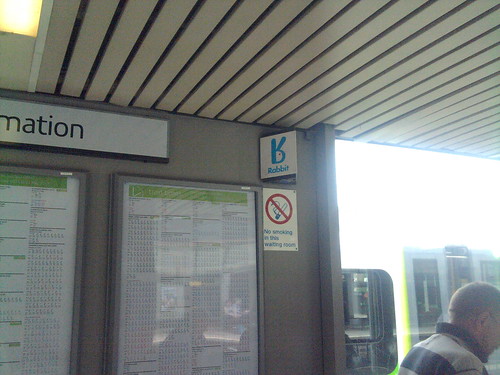
Also, I spotted what I'm convinced is the last Hutchison Rabbit private mobile radio hotspot in the wild...or at least the ghost sign for it.
Obviously, nothing in this post should be taken to condone or encourage such irresponsible, inconsiderate, and basically stupid behaviour. Especially not as I was stuck on a bus moving through Watford town centre not long after the event.
Funny place, Watford. Opposite Watford FC's Vicarage Road ground there is now a Brazilian evangelical house-church. Over the entrance to the ground, a banner for "The Watford Wedding Show" promises "Where your dream strats". On adverts for the Harlequin Shopping Centre, "1990-2011: 20 Years of Inspirational Shopping".
Also, I spotted what I'm convinced is the last Hutchison Rabbit private mobile radio hotspot in the wild...or at least the ghost sign for it.
Sunday, May 08, 2011
technical update
It has just come to my attention that both Dubai and Sharjah airports have redesigned their websites. Also, I've added 395 more meetings to the scraper this weekend, but for some weird reason the DFID disclosure isn't actually being treated as a csv file by the csv module. Scraping, scraping, scraping, always bloody well scraping. I even had to write a scraping script for work last week.
Also, does anyone else find the OpenTech schedule a bit thin?
Meanwhile, I think I may be about to buy a laptop. Does anyone have experience of the new, cheap-end Lenovo ThinkPads or indeed their top-end netbook-cum-tablet?
Also, does anyone else find the OpenTech schedule a bit thin?
Meanwhile, I think I may be about to buy a laptop. Does anyone have experience of the new, cheap-end Lenovo ThinkPads or indeed their top-end netbook-cum-tablet?
Sunday, April 24, 2011
lobbyists lobbying for lobbying
Best lobby metrics (lobbylyzer? lobster, for LoBbying Social Topology ExploreR?) result yet. Today I implemented my gatekeeper vs. flakcatcher metric - it averages the edge weights of all the neighbours of a minister, and returns a ratio of the difference between this and the average weight and the difference between the minister's weighting and the average. The principle is that if you lobby a minister, and then get access to another, your lobbying effort should gain or lose impact depending on the difference between the minister's own importance and the average. In the null hypothesis, where no minister is better or worse as a lobbying target than predicted by their department and their individual rank, you'd get the difference between the minister's weighting and the average.
If some ministers are gatekeepers, though, you would see a greater boost to your efforts at influence than the null case. Similarly, if some of them are flak catchers who mainly exist to turn away lobbying efforts, and you happened on one of those, you'd get a lesser boost. This metric should be greater than unity if the minister is a gatekeeper, 1 if they are perfectly mediocre, and less than unity if they are a flak catcher.
Interestingly, the Scotland and Wales Offices score highly. The highest value recorded is for David Jones MP, Parliamentary Under-Secretary of State for Wales, with 2.75. His closest rival is David Mundell MP, from the Scotland Office, on 1.94. The highest scoring Cabinet minister is the Scottish Secretary, Michael Moore. Some of this is down to the magic of low expectations. Nobody thinks these departments are great offices of state, not even the Welsh or the Scots - real power there has long since shifted to the devolved administrations. So if you meet any other minister, you're likely to do better. But the gatekeeper metric should handle this, as it measures influence relative to the structural difference between the minister and the average weighting. Arguably, this is a valid measurement. These ministries' role really is as a gatekeeper, something like a diplomatic representation in both directions.
So, who's the all-UK champ? It turns out to be Mark Harper MP, Minister for Political and Constitutional Reform, with an impressive 1.65, contrasting with his network degree of 0.08. Hilariously, one of his lobbies turns out to be the UK Public Affairs Council, the lobbyists' trade union, which wanted to see him in July, 2010 on the pressing matter of "lobbying".
He's followed home by Education PUSS Tim Loughton MP on 1.228, Defence PUSS Lord Astor on 1.2, Education's Lord Hill on 1.1, Justice PUSS Crispin Blunt MP with 1.09, and the sinister intellectual force that is Oliver Letwin MP, Minister of State for Government Policy, on 1.05. Francis Maude, whose horrific rise to national influence has been tracked with interest, turns out to be quite the flak catcher, on 0.43 - or is it that he claims to be a figure of authority in his own right? Does the buck stop there? After all, and as expected, once you meet the prime minister you can't really go anywhere but down.
Of course, what everyone will surely want to know is who gets the wooden spoon. Step forward Andrew Stunell MP, PUSS in the Department for Communities and Local Government, with a mighty 0.21 to go with his network degree of 0.3. Stunell held a large number of meetings around the country, notably in London, Bristol, and Bradford, as "Big Society Roundtables" with a wide range of community organisations. It would appear that nobody was more shortchanged than these. Meeting Mr. Stunell reduced one's average lobbying impact by a smacking 80%. Such was the coalition's contempt for, among other organisations, Operation Black Vote, the Stephen Lawrence Trust, and basically everyone in Bradford who showed up. The list is here.
It will surprise nobody that meeting a coalition minister would increase the UK Public Affairs Council's members' influence by 65%, but cut that of council tenants, Muslims, blacks, single mothers, young people (to list just a few) by 80%. But it's worth making it hideously explicit. And here's a lesson from all this obscure science that is easy enough to operationalise: if you see Andrew Stunell coming towards you through the Strangers' Bar with a smile on his face, don't make eye contact, don't shake hands, don't offer him your business card. Run. Spill a pint. Create a diversion. Trigger the fire alarm. Do not, in any circumstances, lobby him.
Here's the really sad bit. Stunell's dance card, from TWFY.
I remember the Lib Dems. Do you? I wonder if Andrew Stunell remembers Andrew Stunell.
If some ministers are gatekeepers, though, you would see a greater boost to your efforts at influence than the null case. Similarly, if some of them are flak catchers who mainly exist to turn away lobbying efforts, and you happened on one of those, you'd get a lesser boost. This metric should be greater than unity if the minister is a gatekeeper, 1 if they are perfectly mediocre, and less than unity if they are a flak catcher.
Interestingly, the Scotland and Wales Offices score highly. The highest value recorded is for David Jones MP, Parliamentary Under-Secretary of State for Wales, with 2.75. His closest rival is David Mundell MP, from the Scotland Office, on 1.94. The highest scoring Cabinet minister is the Scottish Secretary, Michael Moore. Some of this is down to the magic of low expectations. Nobody thinks these departments are great offices of state, not even the Welsh or the Scots - real power there has long since shifted to the devolved administrations. So if you meet any other minister, you're likely to do better. But the gatekeeper metric should handle this, as it measures influence relative to the structural difference between the minister and the average weighting. Arguably, this is a valid measurement. These ministries' role really is as a gatekeeper, something like a diplomatic representation in both directions.
So, who's the all-UK champ? It turns out to be Mark Harper MP, Minister for Political and Constitutional Reform, with an impressive 1.65, contrasting with his network degree of 0.08. Hilariously, one of his lobbies turns out to be the UK Public Affairs Council, the lobbyists' trade union, which wanted to see him in July, 2010 on the pressing matter of "lobbying".
He's followed home by Education PUSS Tim Loughton MP on 1.228, Defence PUSS Lord Astor on 1.2, Education's Lord Hill on 1.1, Justice PUSS Crispin Blunt MP with 1.09, and the sinister intellectual force that is Oliver Letwin MP, Minister of State for Government Policy, on 1.05. Francis Maude, whose horrific rise to national influence has been tracked with interest, turns out to be quite the flak catcher, on 0.43 - or is it that he claims to be a figure of authority in his own right? Does the buck stop there? After all, and as expected, once you meet the prime minister you can't really go anywhere but down.
Of course, what everyone will surely want to know is who gets the wooden spoon. Step forward Andrew Stunell MP, PUSS in the Department for Communities and Local Government, with a mighty 0.21 to go with his network degree of 0.3. Stunell held a large number of meetings around the country, notably in London, Bristol, and Bradford, as "Big Society Roundtables" with a wide range of community organisations. It would appear that nobody was more shortchanged than these. Meeting Mr. Stunell reduced one's average lobbying impact by a smacking 80%. Such was the coalition's contempt for, among other organisations, Operation Black Vote, the Stephen Lawrence Trust, and basically everyone in Bradford who showed up. The list is here.
It will surprise nobody that meeting a coalition minister would increase the UK Public Affairs Council's members' influence by 65%, but cut that of council tenants, Muslims, blacks, single mothers, young people (to list just a few) by 80%. But it's worth making it hideously explicit. And here's a lesson from all this obscure science that is easy enough to operationalise: if you see Andrew Stunell coming towards you through the Strangers' Bar with a smile on his face, don't make eye contact, don't shake hands, don't offer him your business card. Run. Spill a pint. Create a diversion. Trigger the fire alarm. Do not, in any circumstances, lobby him.
Here's the really sad bit. Stunell's dance card, from TWFY.
Voted very strongly against introducing foundation hospitals.
Voted strongly against Labour's anti-terrorism laws.
Voted very strongly against the Iraq war.
Voted very strongly for an investigation into the Iraq war.
Voted moderately against allowing ministers to intervene in inquests.
Voted a mixture of for and against greater autonomy for schools.
Voted moderately against replacing Trident.
Voted very strongly for the hunting ban.
Voted moderately for more EU integration.
Voted very strongly against introducing ID cards.
Voted very strongly for laws to stop climate change.
Voted very strongly against a stricter asylum system.
Voted moderately for removing hereditary peers from the House of Lords.
Voted strongly for a wholly elected House of Lords.
Voted very strongly for equal gay rights.
Voted moderately for a transparent Parliament.
I remember the Lib Dems. Do you? I wonder if Andrew Stunell remembers Andrew Stunell.
Friday, April 22, 2011
for those non-cooperative with the system
I was wondering what "Ingeus UK" was - it's the 15th heaviest lobby in the kingdom with degree 0.17, just behind HSBC and ahead of GlaxoSmithKline, Microsoft, and LOCOG - but now we know.
Routine maintenance
After this post and the outstanding response to it, I've just been working on the lobby project's underpinnings, specifically to backport some data cleaning from the analyser script into the original scraper, and to fix the one-edge-per-row version of the scraper. As a result I've had to flush the datastore and also search out some URIs that have changed. So far we've recreated 931 out of 1,721 meetings, although we're getting the dreaded "Execution status: run interrupted by a timeout". Actually, we've got 1,233 meetings back, and we've got rid of some crap. Anyone wanting the dataset can get it from the Scraperwiki API here or here for linkwise rather than meetingwise (coming soon) as either json-dict or csv. A full SQL syntax is available.
With luck, there will also be some more data quite soon. On the analysis score, notably, this and also this seem useful. The first estimates the value of a node based on its edges, which is fundamentally what I'm trying to achieve, and the second finds the cliques in the network a given node belongs to.
Regarding visualisation issues, I think one of my mistakes last time out was to visualise the data as a multi-graph - i.e. a structure with zero or more links between each node, permitting the existence of multiple links between the same pair of nodes. This invariably means a lot of links. The nature of the data - multiple meetings are absolutely central to the whole project, and lobbies meet ministers at different times and on different issues - enforces an underlying multigraph structure. But it would be possible to condense it for visualisation purposes - if we rolled up all links between the same nodes into one, we could tot up their weights and perhaps show that in the visualisation, as a thicker line for example.
With luck, there will also be some more data quite soon. On the analysis score, notably, this and also this seem useful. The first estimates the value of a node based on its edges, which is fundamentally what I'm trying to achieve, and the second finds the cliques in the network a given node belongs to.
Regarding visualisation issues, I think one of my mistakes last time out was to visualise the data as a multi-graph - i.e. a structure with zero or more links between each node, permitting the existence of multiple links between the same pair of nodes. This invariably means a lot of links. The nature of the data - multiple meetings are absolutely central to the whole project, and lobbies meet ministers at different times and on different issues - enforces an underlying multigraph structure. But it would be possible to condense it for visualisation purposes - if we rolled up all links between the same nodes into one, we could tot up their weights and perhaps show that in the visualisation, as a thicker line for example.
Subscribe to:
Posts (Atom)