Friday, July 15, 2011

how to clean out a sheep dip

Let's talk sheep dip. No, not drinking the stuff.

Sheep. Being dipped. In sheep dip

Spooks have another couple of uses for the word. One means to fix the admin when you borrow people or equipment from the real world. Another, and the one we're interested in, is to arrange things so it's not obvious to other people how you got hold of information. Typically, if you have a secret source of information you want it to stay secret. But there's no point having the secret source if you don't act on it. All the fun of secrets is telling other people about them, after all.

So you've got a problem - how do I make use of the secret without letting slip the bigger secret of how I got it? The answer is sheepdipping.

Here's a second world war example. As basically everyone knows, the British had broken the Germans' primary radio cipher, taking advantage of work Poland and France had begun earlier and eventually creating an industrial system to pull in radio traffic, break it, translate it into English, analyse it, and distribute reports based on it. In the process, Bletchley Park as good as invented the computer. It was a priceless source of information. So much so that serious precautions were needed to avoid giving the game away.

The answer was to make sure that you found out the information you already had from the code break before you did anything about it. So, once the ships and soldiers were already on the move, a reconnaissance plane would go out or a patrol would be pushed forward to look in exactly the right place. As well as disguising the real intelligence source, this was also an opportunity to check that the source was right.

So why are we indulging in ENIGMA kitsch? Well. The Sun denied vehemently that it got access to the medical records of Gordon Brown's son. Actually it didn't, quite. It denied that they were the source of the story they printed, and hid behind the PCC about the tax files and the bank account and his lawyer's notes and God knows what else. But they found somebody who says he told them all about Brown's son out of the goodness of his heart. As God will be his judge. Yeah, he really said that. Everyone say "Awww."

He really said it; it's in the Sun. Anyway, he swore an affidavit.

Here's the sheep dip, though. Imagine if you're a sweaty 'bloid hack who's just been listening to the chancellor's voicemail. But, unlike the rest of them, you read books. What are you going to do? Take the risk of using the illegal secret surveillance as your source? What if some bastard with a Web site and a grudge goes through years and years of stories and pulls all the ones that are single sourced to conversations on the phone? You're smarter than that.

So, you look up somebody who might be able to give you the story you've already got. This shouldn't be that hard. You've already got more than enough information. That way, you're covered. And you get to check the possibility that the whole thing is a nightmarish trap. And there's a chance that they might provide some more juicy details if correctly handled.

The sheep goes into the dip, and comes out cleansed of its ticks and blowflies and worrisome legal problems, ready to be fattened up, shorn of its valuable fleece, and finally roasted and served with red-top jelly.

Alternatively, a slightly less underhand version. So this bloke walks into a bar. No.

So this bloke walks into a newspaper office. And he says to the barman...I've got this incredible story about Gordon Brown's sick kid because mine's as sick and I go to the same support group or clinic or whatnot. And you punch the conniving, insensitive Nosey Parker in the mouth and throw him out in the street. Right? I mean, who behaves like that?

No. This is a newspaper, dammit. You're not going to turn a chance like this away. But there's a problem. If his motives really are as nice as he makes out, what's he doing hanging around the News International building? Perhaps it's all bullshit. He's taking you for a ride. Newspapers attract enough crazies as it is; look at the comments threads. Throw around money for stories into the bargain and you're going to be beating them off with a side-handled baton, like the printers' union pickets. It's Brown's kid because he knows that will get your attention. Hey, you'd prefer Ulrika Jonsson's. But he's probably crazy and crazy people like politicians.

So you need to check on him. Quick. And because you've got a human source, you don't need to mention whatever you do to check up in the final story. Into the dip goes the sheep. Baa.

In my life I've had the pleasure of cleaning out not just a sheepdip but a cattle dip. It's a long job. My advice is to drain off as much liquid as possible - keep checking the filter on the firepump - and then pressure-blast it with boiling steam. Accept no substitutes, and watch your feet.

Wednesday, July 13, 2011

a city wired for sound

Am I right in thinking that Andy Hayman's testimony yesterday fingered Met press chief Dick Fedorcio? Hayman admitted he'd regularly had dinner with News International executives while he was meant to be investigating them. He mentioned that he had done this in the company of the head of communications of the Met, presumably with his approval, although Hayman was also acting in his capacity as ACPO media lead.

Fedorcio has had the same job since 1997. He was named by Nick Davies as having been present in the meeting where the Met demanded to know why Dave Cook was being followed by News International private detectives, and apparently intervened with senior police officers to get them to go easy on NI. Surely the guy in charge of police-press-political relations is a key figure in a scandal that's all about relations between the press, the police, and politics?

Like the key News International men, Alex Marunchak and Greg Miskiw, there's no sign of him. The Home Affairs committee, and indeed anyone else who wants the truth about this, must call Fedorcio without delay. Oh, and is Greg Miskiw in the UK?

Second point. Yesterday's New York Times claims that Miskiw and others on the NOTW were able to locate mobile phones by paying £500 a shot to a corrupt police officer. That is to say, this policeman had access to the lawful intercept systems that are part of all GSM and UMTS cellular networks, or at least he could task people who did. ETSI Specification 01.33 defines this as a standard element of all GSM networks and the corresponding 3GPP TS 33.106 does so for UMTS ones.

If this is so, they could certainly also get pen-register information - lists of calls to and from given phone numbers - and even tap the calls themselves.

This is a massive violation of the UK's critical national infrastructure security, of the Regulation of Investigatory Powers Act, and of the Data Protection Act. News International, their police contact, and the police force responsible (not necessarily the Met) should all be prosecuted.

There is an urgent need to audit the lawful interception systems' logs, among other things to find out if there are other unauthorised users out there. International standards foresee a detailed audit trail as part of these systems in order to preserve the legal chain-of-evidence. If the Interception Request message was submitted in proper form from the police to the telcos, the operators are legally in the clear, but if I was in charge of their network security I'd suspend processing the requests until such an audit was carried out as we now know that an unknown but significant percentage of them are illegal.

Thank fuck we didn't build that giant national ID card database.

Third point. Not that anyone will answer this, but were any of the Prime Minister's designated deputies for nuclear retaliation subject to illegal telecoms surveillance?

Fourth point. Circling back to the Defence Vetting Agency and Andy Coulson, the vetting procedure as described on the DVA Web site states that in some cases, the decision may be taken to issue a security clearance subject to risk management measures taken by the department involved. In these cases, the DVA will disclose information to the sponsoring department that it would usually keep confidential. Did they make such a recommendation to the Prime Minister's office, and if so, what was the information?

Sunday, July 10, 2011

watch the skies, or rather, the airports

FMCNL. We loves you. Rupert Murdoch arrived this morning at London Luton with Gulfstream G550 tail nr N89NC at 09:25 UTC.

It would be improper, I think, if N89NC was to depart again if there was any doubt at all as to who was on board. We don't know how many other people involved, other than Greg Miskiw, are Americans and therefore difficult to extradite.

slight return: coup plot

As a relief from all the Murdoch/Met filth, what about a slight return to last week's coup plot? One of the oddest things about Technique of the Coup d'état is Malaparte's judgment of individuals. The most famous example is the chapter on Hitler, who he thinks was too soft. Seriously - he argued that he lacked a genuine revolutionary aim and was obsessed by remaining at least roughly within the law. He also predicted that there would be more and more tension between the SA and the broader Nazi Party as the first wanted a revolution and the second increasingly cozied up to the establishment.

This was good as far as it went, although most of his predictions can be put down to a case of where-you-sit-is-where-you-stand. Most of the people he interviewed were SA members. No surprises there - he was a fascist who swung to the Left, was fascinated by paramilitarism, and did we mention the slightly gay touch? Not surprisingly, therefore, he got the story on the SA being increasingly alienated from the Party. And his point about Hitler getting closer to the Establishment was a good one, although he expected the Establishment to swallow Hitler up rather than vice versa. Neither did he spot that in fact, Hitler would be quite capable of carrying out a violent coup once he was in charge, in order to get rid of the SA leaders and terrorise the Establishment.

Few people did, though.

Another odd personal assessment is his take on Lloyd George, who he glosses as a boring bourgeois moustache rather than the radically modern and excitingly crooked politician surrounded by spin doctors and intelligence-administrative technicians who was occasionally thought to be a potential putschist himself.

Owt else? Nothing much, except it strikes me that his ideal putschist is a sort of heavily armed flaneur.

plastic gangsters

Something else, (via BorisWatch's Twitter feed): I didn't know Coulson lived so close to the infamous pub at the centre of the Southern Investigations case.

Come to think of it, News International people always liked to project a gangsterish image, ever since they moved to the East End, even though the choice of Wapping was because there was a big empty warehouse there. As a fashion-statement it's hardly unknown, of course. It's no surprise that both Dave Courtney and "Mad" Frankie Fraser managed to weave the whole affair into their mutual beef. The Sun did both of their post-criminal careers as celebrities a power of good. Am I right in thinking this coincided with Brooks and Coulson's rise through the NI hierarchy?

There's much more good stuff over here, including a photo...of the pub!.

But if we were making a film, it would be round about now that the plastic gangsters found themselves involved in something far more serious.

this is a security announcement

There's been a little progress on some of the lines of inquiry in this post. First up, the question of whether or not Coulson was subjected to security vetting before joining No.10 Downing Street, and if so, what the Defence Vetting Agency said about him. This one took a relatively long time to spin up, but now it's landed in this piece.

Coulson, arrested by police on Friday over his role in the scandal, went on to be cleared by the security vetting team at Downing Street after three in-depth interviews about his professional and personal life. He was given "strap one" status, which allowed him the highest access to top-secret material.


So not only did they hire him, they gave him a Top Secret security clearance. Wow. Shoulda googled, DVA, shoulda googled. To say nothing of DontDateHimGirl, or perhaps that gangland website Jamie Kenny linked a while back. Here are the criteria for the different levels of vetting:

You will need a security check if, in the course of your work, you will regularly need access to SECRET and sometimes TOP SECRET (under supervision) information or assets. You will need developed vetting if your work will involve substantial unsupervised access to TOP SECRET information or assets, access to category 1 nuclear material or access to material from other countries and international organisations. If you don't think your job will involve accessing any of this information, you should check with your sponsor whether you need to be vetted.


A question. One of the reasons why this is important is that the prime minister's office receives, as well as Joint Intelligence Committee and Defence Intelligence assessments, a special ration of choice raw intelligence material from GCHQ. This exquisitely practised method of making the prime minister feel special comes in a file known as a BJ, and I'm damned if I'm not going to get a rise with this joke having invented it for my review of Richard Aldrich's history of British SIGINT as far back as last August.

I prefer to think of it as the world's most classified blog. But anyway, this is as secret as secret gets, and moreover it is signals intelligence and therefore covered by special security procedures. These procedures are standardised between the UK, US, and other allies who cooperate on signals intelligence in a document called IRSIG for International Regulations on Signals Intelligence. I'm pretty sure it doesn't contain the words "By all means show it to your dodgy spin doctor who hires people who plant drugs in cars during divorce cases, bribe coppers, and murder each other with axes in pub car parks". What do the Americans, to say nothing of the intelligence-bureaucratic complex right here, make of the whole sorry mess?

Moving swiftly on, what did Cameron know and when did he know it? What might have gone into the report? For the details, the DVA's "So you and your family are being grilled by faintly Pinter-esque security agents! Why didn't you decide to be, say, a quantity surveyor?" page is pretty illuminating although not quite as good as the official Subject's Information Leaflet (PDF).

The interview will cover most areas of your life. The vetting officer will build up
as complete a picture of you as is possible. We have to consider your loyalty, honesty and reliability, and whether you could be more at risk of bribery or blackmail than others. We will ask you about your wider family background (relationships and influences), past experiences, health, sexual relationships
and behaviour, drinking habits, experience of drug taking, financial affairs, general political views, hobbies, foreign travel and so on.


Apparently they didn't think to ask if Coulson was particularly likely to commit bribery. It looks like they'd have noticed if he was behind on his mortgage, if he was gay, if he'd ever so much as looked at a spliff, or if he'd been in a trade union - all the usual "well, somebody might blackmail you with the threat of having your security clearance withdrawn, so we have to make sure we withdraw the clearance, thus completing the circle and making the blackmail possible to begin with" stuff.

Another question. Who were Coulson's character references? Wouldn't it be hilarious if one was Rebekah Brooks, or one of the various politicians who claim to consider him a friend?

Snark. I once had to complete a security clearance form and the bit that stuck in my mind was that I had to swear that I would not try to overthrow parliamentary democracy by violent, subversive, or industrial means. I've managed to stay legit so far, although the temptation can be a bastard. But there was nothing about running a really shitty newspaper that had to hide from its readers behind high walls, steel fences, and CCTV cameras, nor about planting cocaine on unsuspecting women.

simple

More progress from here. In comments, we have an explanation of the PoCA 1906 vs. BA 2010 issue. It's actually much simpler than I imagined. Basically, the old Act was in force at the time of the crime, and it's not clear whether the new one is operational yet in the absence of the Ministry of Justice's guidance.

Friday, July 08, 2011

fun with charts!

I thought I'd reorganise the information in this Peter Oborne post.

There is a near perfect negative correlation between malpractice and information

I plotted the number of times each newspaper group reported on the phone-screwing case against the number of times they were caught paying for information. Even I was surprised when the R^2 correlation came out as 0.94 - a near perfect inverse relationship. The shittier your newspaper's general conduct, the less news it carried. If some twit at the Observer hadn't tripped over his cock, it would probably have been a linear relationship.

transmission belt

I still can't get over this morning's Cameron press conference. The incredible thing, as I said, was the transition in what was respectable to discuss. The Guardian went the whole hog and brought up the whole ball of police corruption, and Michael Crick of the BBC pressed very hard on the question of the money. Well, you might have expected that from them.

But ITV News's reporter demanded to know whether News International might shred all the evidence, Adam Boulton from Sky News was the first to raise the BSkyB issue, the Times wanted to know about the content of Coulson's "assurances", and the Sun asked if Coulson had betrayed the prime minister. Even if the Sun guy couldn't actually bring himself to say "Andy Coulson", it was quite the showing - about one step from a Nile TV-style on-air apology.

Cameron's response was odd. At one point he said this:

Democracy is government by explanation and we need the media to explain what we're trying to do".


Apparently he believes the mass communications organisations are a transmission belt between the Party and the People. How bizarrely communist.

At one point, he started talking about transparency, government credit cards, and releases of government meetings data. This was frankly surreal; I wasn't expecting him to go all ScraperWiki.

He also went on endlessly about having given Coulson a second chance. So much so that this was evidently a talking-point he'd been intensely coached with. I do wonder what work this was meant to do. Was it just meant to sound patronisingly nice? Surely someone ought to ask if he's soft on crime. After all, while criminals are in prison, you know they aren't spying on the families of the war dead.

The Tory crisis plan seems to be in two parts:

1) Hide behind OFCOM and the police.

2) Counter-attack Miliband's press secretary Tom Baldwin, because he used to work for the Times.

If you take this at face value, it implies that all current or former News International journos are marked men. So, I asked Tim Montgomerie if he would join me in calling for the resignation of Michael Gove, former assistant editor of The Times and current Education Secretary. We need to get a grip, etc. He's not replied yet.

neeeews of the world

In an effort to clear some of the NOTWFail stuff out of my mind, I thought I'd try to come up with some useful pointers for further investigation.

1. The Daniel Morgan/Southern Investigations line of inquiry

This is by far the most serious accusation, in every sense. It has police corruption, a murder, and the unusual sight of a police surveillance team following the NOTW's private detectives following Detective Chief Inspector David Cook around London as he tried to investigate them. (Isn't the movie going to be great?) And wasn't it an amazing moment this morning when Patrick "for once, bracingly chilly" Wintour brought it up in the No.10 press conference? It wasn't that long ago that only Fleet Street or London underworld obsessives knew the story and were unrespectable enough to talk about it.

Here's the Nick Davies version, which is nicely condensed. The whole affair has a strong taste of noir and this boils it down to a bitter, sticky, toxic, but powerfully caffeinated residue.

As editor of the News of the World Rebekah Brooks was confronted with evidence that her paper's resources had been used on behalf of two murder suspects to spy on the senior detective who was investigating their alleged crime.

Brooks was summoned to a meeting at Scotland Yard where she was told that one of her most senior journalists, Alex Marunchak, had apparently agreed to use photographers and vans leased to the paper to run surveillance on behalf of Jonathan Rees and Sid Fillery, two private investigators who were suspected of murdering their former partner, Daniel Morgan.


Note the involvement of Fillery, who was the investigating officer in the original case and took over Morgan's business afterwards, and who was later done for child porn offences. It's also worth noting that Marunchak was accused of being crooked in both directions - not only was he accused of bribing the police for information, he was accused of trousering a share of the money paid out, as a kickback in exchange for putting business their way.

If anyone needs investigating, surely he should be interviewed as soon as possible - and also Greg Miskiw, who comes up in the story. Compared to these two, the royal correspondent is a bit pathetic. Miskiw is an American citizen. Wouldn't it be embarrassing if he was to turn up in the States, protected against extradition?

2. The Met Press Office

So, who's the guy who briefs the News of the World? This blog asked the question repeatedly after the de Menezes and Forest Gate cases. Might that be Dick Fedorcio, the then Met press chief who insisted on going easy on the papers after they were caught spying on DCI David Cook?

On a related theme, Andy Hayman and Lord Macdonald's roles at NI are surely now completely unacceptable.

3. Andy Coulson's Background Check

This was also one of the things that made it a morning to remember. The prime minister explained that he had commissioned "a private company" - yet more private detectives! - to look into Coulson's career before hiring him. What company? Also, I'm not sure whether these enquiries were made when he joined the Tory press office or when he joined the Government.

Further, we know Alistair Campbell and other Government press officers had access to highly secret intelligence in the past. (Not a press officer, but the only politician outside the inner-cabinet who knew about Suez in advance was the then chief whip Ted Heath - it's a precedent for someone with a wholly political/propaganda role being clued in.) Obviously, the dossier was a bit of an outlier, but you'd be a fool to think that the practice of deep integration between government media staff and policymakers had vanished.

So, did Coulson have an official security clearance? Was he ever positively-vetted? If so, what did the DVA's notoriously nosy investigators say about him?

4. The Missing Millions of Messages

Probably not much point covering this as Davies the scoop is after it already and if the "sources" bits are accurate, the dibble are very close to making arrests.

But. 500 GB of Murdochmail. Please. Please. Even just the headers.

Similarly, shouldn't we at last get the big list of the hacked?

5. How Hack Happen?

There's really very little hard information about this around. This piece in the Indy may be by Jemima Khan but that doesn't make it less interesting. It looks like they had found a way of forcing a password reset - so even if you changed the PIN, they could force it back to the default.

Stupid telcos' stupid voicemail implemented a password reset by setting the password to a well-known default value rather than issuing a new, randomly generated PIN like your bank or really, any random website's "forgotten password" link.

But I think we'd all like to know how they did it. Smart money is on the call centres - especially as there have been cases of mobile phone salesmen paying competitors' call centre staff for lists of people whose contracts are up for renewal and also of credit card numbers being sold. Khan names a company: "CTI".

6. Mechanics of Collapse

So what just happened? Was it the advertisers? Who went first? How much advertising did they pull?

Also, what happened with the distribution chain? Did, as rumoured, the newsagents stop ordering papers?

7. Compare and Contrast

Andy Coulson has been arrested under Section 1 of the Prevention of Corruption Act 1906, as well as the Criminal Law Act 1977 for the phone-screwing (the NOTW term - after all it was hardly a hack). But this legislation was meant to have been superseded by the Bribery Act 2010. What's up?

One explanation would be that the Ministry of Justice has been working on official guidelines on how to interpret the new law, which encompasses many more forms of corruption than the old and provides for rather heavier penalties. Obviously, it wouldn't be ideal to choose the scandal of the century for the new text's very first run-out, so perhaps that's what's up.

However, there are some other issues here. The new Act provides for the seizure of ill-gotten gains and for the disqualification of company directors - the old one doesn't. And the old Act requires the approval of the Attorney-General for a prosecution; the new one gets rid of this and leaves it to the CPS as per usual.

Either way, it's enough that Coulson offered money. Whether they accepted it or whether they delivered is irrelevant - the crime is either offering or soliciting bribes.

Thursday, July 07, 2011

corruption production, fag packets, protection rackets...

It looks like rusty old thatcherbot Sir George Young announced a COI review of government advertising in the News of the World today. Fortunately, the Grauniad published a list of the top 50 NOTW advertisers by spending, and they're not on there, so you can be reassured the whole exercise was as pointless as everything else I've done since 2003.

Meanwhile, elsewhere:

DEVIL WORSHIPPER.COM YOU SATANISED NOTW JOURNOS WILL ROT IN THE PIT OF HELL GOD HELP YOUR DEVIL RIDDEN SATANISED SOUL.


Elsewhere, in "credit where credit's due" news, it was Channel 4 news that first connected the dots of the Daniel Morgan/Southern Investigations case and the phone-hacking affair, although it was Tom Watson, presumably having been clued-in by the Grauniad, who broke the detail that they were actually working for the Morgan accused at the time.


Wednesday, July 06, 2011

Who controls Government ad spending?

The Government's Central Office of Information, essentially its in-house advertising agency, spent £193 million on advertising in the financial year 2009-2010. The year before, it spent £211 million, making it the UK's single biggest media buying desk.

Is it appropriate for the Government to be spending taxpayers' money propping up the deeply discredited News of the World and its mates in Rebekah Brooks' Augean stables? In the light of 10 Downing St's creepily close relationship with News International - hiring workplace bully Andy Coulson as press spokesman, meeting Rebekah Brooks under MP-constituent privilege to avoid public scrutiny - doesn't this spending constitute a worryingly inappropriate use of public resources?

I don't think so. Perhaps you don't either. Or perhaps you're cool with it. Either way, perhaps the top management team at the COI should be aware of your opinion. Fortunately, the COI's top management team is on their website! So I've loaded it into a Google spreadsheet for convenient reference.


Obviously, there's the CEO, Mark Lund. But think like a civil servant. Who's in control? Mark Cross is in charge of "communications planning for all campaigns" so it looks like he's a key node. The org chart bears that out - might be nice to get Graham Hooper, director of client service and strategy, too.

Don't be abusive. They are public servants after all. But do be firm.

Sunday, July 03, 2011

ISP

OK, I'm completely sick of paying far too much to my shitty boutique ISP and BT for crackly steam voice and ADSL2+ that regularly provides between 400 and 600 Kbps downlink and 30-100 up. Right here in London. The SNR margin, attenuation, etc look normal and the modem trains to over 10Mbps, but there is reliably 1-3% packet loss so TCP never actually breaks out of slow-start mode.

I have some options.

Go to another ADSL op - well, the danger is that they'll just port the hank of copper flapping in the breeze, leaving me no better off, rather than replacing it completely.

Get BT FTTC service whether from BT or someone else - the problem is that our exchange was originally planned for the 31st December 2010 (at the time this was a horses' birthday, used for all areas where there was a planning permission fuck-up), and has since been sliding right. The last update pushed it from June 2011 to September 2011, although BT is claiming that "Lower Holloway" can have it now. But there is no such exchange.

Also, data bundle sizes for FTTC service are all incredibly stingy.

Bury the hatchet and get Virgin cable service - this eliminates the fritzing, bent-safety-pin mess that is BT's aerial plant around here, although some of the cable installs are worth seeing, and would probably get us much, much more bandwidth. Also, cable has been installed here before so they might let me off the install fee.

However, reading their tariff, I can't make any sense of what it actually costs. Everything's "FREE! for the first six months thereafter suchandsuch", or "NOW! MORE TELLY for just £5", or "FREE! with a Virgin Phone line for £12.99 a month". A Virgin Phone line? Is that a thing? On the principle that people who won't actually name a price are ipso facto lying, I'm not keen.

Also, no IPv6, daft adverts about "fibre optic broadband" when it's not, etc.

an update

I may have to update the scoring in this post. I went to see this over the weekend - too late as it happened, but I floaked it - and I have to say that it's not the project of someone torying-out. Far too 1945-68 British reasonablepunk.

Reflections on a HOWTO

I have been reading Curzio Malaparte's Technique of the Coup d'état this weekend. It's a fascinating document - the basic argument is that the October Revolution represented an exportable, universally applicable technology for taking control of the state, quite independent of ideological motivation or broader strategic situation. It was already fairly well-known at the time that Russia in 1917 really wasn't the environment Marxists imagined would lead to a revolution and that Lenin had essentially retconned the whole thing to provide for giving history a little push. Malaparte's unique contribution was to argue that it was more fundamental than that - the Bolshevik seizure of power could in reality have been carried out almost anywhere, for whatever reason. It wasn't a strategic or ideological question, but one of operational art and tactics.

So, what's this open-source putsch kit consist of? Basically you need a small force of determined rebels. Small is important - you want quality not quantity as secrecy, unanimity, and common understanding good enough to permit independent action are required. You want as much chaos as possible in advance of the coup, although not so much that everything's shut. And then you occupy key infrastructures and command-and-control targets. Don't, whatever you do, go after ministries or similar grand institutional buildings - get the stuff that would really cause trouble if it blew up.

Ideally, you do this by just floaking in through the front door as if you were in the railway station to catch a train rather than to seize the signalling centre. You'll probably need, once you've got control of the real instruments of power, to stage some sort of symbolic overthrow of the government, but this is really only in order to get the message across to everybody else. Then, induce whatever authority is meant to be in charge after the head of government has been incapacitated to legitimise your action after the fact. It doesn't matter much what state it's in - a pro tip is to keep the parliament but get rid of enough opposition members to rig the vote.

Bada bing, bada boom, you are now the dictator.

From the other side, Malaparte argues that the worst thing that can go wrong is a general strike. There's no point occupying key points if you can't make the machine work yourself, as you'll just be master of a lot of dark, cold buildings. The second worst thing that can go wrong is that you start to fall behind schedule. The whole trick relies on missing out as many people as possible, and the longer it takes, the more people have time to recover their orientation and get angry.

Interestingly, he comes up with something very like the 70s "historic compromise" concept in relation to this.

So you need either to get the support or at least the neutrality of the unions, or else render them unable to act in advance, which will mean fighting a civil war before you get to bring off the coup. And once you start, you've got to move quickly and keep moving.

Interestingly, he doesn't say much about how you're going to keep power once you've got it, if you can't rely on calling everyone out on strike. After all, two can play at this game. This is a weakness in the whole concept, and quite an illuminating one.

Malaparte was a deeply odd character, a border-nationalist of German origins, an Italian first world war hero, later a diplomat and journalist and a fascist of the first hour who went on to fall out with fascism and get locked up. This is probably why he is read at all now. Having been released, he reported the Eastern Front of 1941 for the Italian papers until he fell out with the Germans, covered the Finnish sector until something similar happened, ended up back in Italy in time to take part in his second Italian coup (he had already managed to invade Russia twice, once as an attaché with the Poles in 1920 and again with the Germans as a journo in 1941, and live to tell the tale), served in the pro-Allied Italian army, and claimed to have become a communist.

He was also an almost joyously unreliable source, a self-mythologising war junkie who made Hemingway look sensible, and to be frank, if he fell out with the fascists it wasn't because he was going soft or anything. I've read his dispatches from the Eastern Front (The Volga Rises in Europe) and found it hard to make out what the Germans objected to - obviously my standards aren't those of a Wehrmacht press officer, but there's a lot of hardboiled combat reporting, quite a bit of gratuitous fine writing, and nothing much critical of the war or Germany.

He also had an Ernst Röhm gay-fascist streak you could have landed a fleet of Savoia-Marchetti flying boats on, across it. Or at least his style did. The Volga... is just full of dashing blond Finnish officers and casually hunky, rough-trade Nazi recovery mechanics track-bashing in the Ukrainian sun, although there are a fair few fair country girls whose hearts and minds don't seem to need much winning in there as well. (By the time it all got stuck in a ditch outside Rostov-on-Don he'd long since been ghosted by the German spin doctors.)

Anyway, a fascinating, utterly mad, and often deeply creepy writer. Back to the steps of the telephone exchange.

I think his coup technique is quite telling. Fascism always had an odd central contradiction in that it insisted it believed in hardcore political realism but also in romantic activism. Power, and specifically either firepower or horsepower, was all that mattered, but with enough will it would always be possible to change the power realities. Marxists offered inevitability; fascists opportunity. Rapid shock action directed at the key installations will give us the state, and that will give us everything else. Speed, style, ruthlessness, and cheek are everything. It's the hope of audacity - get the right people together and a list of oil refineries, and everything is possible.

This may not sound very convincing, but it's certainly true that many, many coups have been carried out following this rough plan.

Malaparte makes a complex distinction between the seizure of power in a parliamentary state and just using the parliamentary institutions to go legit later. He's agin the first. I'm not so sure - two of the most successful coups of the 20th century were carried out in France, Petain's parliamentary coup and de Gaulle's rather less parliamentary one in 1958.

I think what's happening here is that his residual fascist is showing.

Another thing that runs through the book is the idea, very common in extreme politics since 1918, that the military tactics of the late first world war - infiltration, independent action, surprise attack - can just be ported straight into politics. Malaparte actually goes so far as to make this explicit. It's a great historical irony that the world experts of decentralised command were the Prussians, of course.

As always, though, it all makes for great tactics but lousy strategy.

there is no crisis except in Lord Hutton's pants

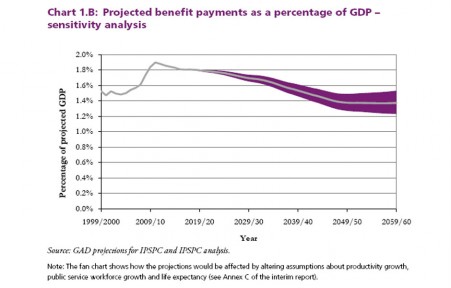
I note that "Not the Judge" Hutton is now said to be doing the rounds complaining that the sensitivity analysis chart from his pensions report - the one that shows that there is no crisis - is being "taken out of context". This is of course pol-speak for "a fact I dislike is being inconveniently publicised, please stop".

They're lying to you

I am, of course, delighted.

"trolling d-squared sunday" continues

While I was thinking about VRCs, I re-read this post of Dan's about how specialising in the problems of Irish immigrants was no longer as good a career move for a north London social worker as it had been in - say - 1981, although I think what he meant with regard to the date was "when he moved to Camden".

Looking back, it's ironic and probably inevitable that this post appeared on the 22nd of November, 2008, just as the hypothetical social worker's career prospects were about to be dramatically revived, before presumably running into the cuts wall a couple of years later. History makes fools of us all.

Geography, however, is the original time machine; it wasn't at all clear to me, over the Camden-Islington border in Holloway, that Islington Council could do without another social worker specialising in the problems of Irish immigrants, and it's even less so now.

now, where's Hopi Sen when you need him...

Daniel Davies has long had a beef with the government over its PR strategy towards the MMR vaccine, for which he sometimes seems to hold Ben Goldacre responsible. No, it doesn't make much sense to me either, but as a student of the Davies oeuvre, I think it can be best understood as a system of interlocking grudges. I personally think spite is underrated as a progressive force, so I don't have that much to complain about here.

Anyway, what I think this particular grudge is lacking is a sense of what might have been done differently. The official line-to-take was that there was nothing wrong with the MMR vaccine. Among the press talking points of the Tony Blair years, this stands out for having been the truth, the whole truth, and nothing but the truth, although this wasn't as obvious then as it is now.

As far as I understand it, D^2's point is that the government could have done more to accommodate the concerns of people who were worried about it. This is where I'd like to see an alternative proposal, though. Does this seem to you like a convincing media strategy? Obviously, what follows are caricature scenarios rather than specific proposals.

There's nothing wrong with it, but you're right to be worried


Let's try that one again from the top.

There's nothing wrong with it, but if you're rich you can go private


I think I see the problem.

There's nothing wrong with it, but if you're worried about it, here's a lot of content-free warm words and canned emotion. Hey, it's the Blair government - we've got more than enough to go round!


It is worth remembering that one of D^2's major criticisms is that the government was too patronising.

There's nothing wrong with it, but we must recognise the Very Real Concerns...


Ah, yes, those. We've met them before; I seem to remember a rather good essay on very real concerns.

Further, of course, all of these plans would have had the same fundamental failure mode, in that they would all have been reported as JABS WILL RAPE YOUR MORTGAGE: OFFICIAL by the Daily Hell and the Diana Tits.

I suspect that any answer to this will involve Blair refusing to say whether his kids got the MMR or not. I note that, tiresome prat that Blair was about it, John Selwyn Gummer stuffing a burger into his daughter is not actually remembered as a rhetorical triumph on a par with "I have a dream..." nor even as a masterpiece of cynical PR on a par with "The pound in your pocket has not been devalued".

Of course, there really was something seriously wrong with the burger, in fact all the burgers, and Gummer bore significant responsibility for letting that state of affairs persist. So even though he's apparently a nice old church gent who writes books about the environment these days, there's a grudge worth bearing.

Saturday, July 02, 2011

If you're out of luck and out of work, we could send you to the western mountains of Libya

The Libyan rebels are making progress, as well as robots. Some of them are reported to be within 40 miles of Tripoli, those being the ones who the French have been secretly arming, including with a number of light tanks. Now that's what I call protecting civilians.

They are also about to take over the GSM network in western Libya like they did in the east. How do I know? I'm subscribed to the Telecom Tigers group on LinkedIn and so I get job adverts like these two.

ZTE BSC Job: URGENT send cv at [e-mail] for the job position or fw to your friends : Expert Telecom Engineer ZTE BSC.Location:Lybia,Western Area,1300USD/day,start immediate


URGENT send cv at [e-mail] for the job position or fw to your friends : ERICSSON MGW/BSS/BSC 2G/RAN Implementation Senior Expert Engineer.Location:Lybia,Gherian,Western Mountains,1300-1500 USD/day


In fact, one of the ads explicitly says that the job is in the rebel zone and the other is clear enough. What the rebels are planning to do is clear from the job descriptions:

must be able to install a ZTE latest generation BSC - platform to be integrated with 3rd party switching platform,solid knowledge of ZTE BSC build out and commissioning to connect up to 200 existing 2G/3G sites


To put it another way, they want to unhook the existing BTSs - the base stations - from Libyana and link them to a core system of their own, and in order to do this they need to install some Chinese-made Base Station Controllers (BSCs - the intermediary between the radio base stations and the central SS7 switch in GSM).

Here's the blurb for the Ericsson post:

Responsible for commissioning and integrating an Ericsson 2G BSS network (2048-TRX Ericsson BSC plus Ericsson BTSs) in a multi-vendor environment. Will be responsible for taking the lead and ownership of all BSS commissioning and integration, leading the local team of BSS engineers, and managing the team through to completion of integration.

Experience of Ericsson MGW implementation, and integration of MGW with BSS, is highly desirable. Experience of optical transmission over A-interface.

Compilation, creation and coordination of BSC Datafill. This will include creating, generating, seeking and gathering of all Datafill components (Transport, RF Frequencies, neighbor relations, handovers, Switch parameters, ABIS mapping, etc.) based on experience and from examination of existing network configuration and data. Loading of Datafill into the BSC to facilitate BTS integration.

Working with the MSC specialists to integrate the BSC with the MSC. Providing integration support to BTS field teams; providing configuration and commissioning support to the BSC field team.


So they've got some Ericsson BSCs, the base stations are Ericsson too, and an MSC (Mobile Switching Centre, the core voice switch) has been found from somewhere - interesting that they don't say who made it. That'll be the "3rd party switching platform" referred to in the first job. They're doing VoIP at some point, though, because they need a media gateway (MGW) to translate between traditional SS7 and SIP. They need engineers to integrate it all and to work out what the various configurations should be by studying what Gadhafi's guys left. (It's actually fairly typical that a mobile network consists of four or so different manufacturers' kit, which keeps a lot of people in pies dealing with the inevitable implementation quirks.)

The successful candidate will also have some soft skills, too:

Willing to work flexible hours, excellent interpersonal skills and the ability to work under pressure in a challenging, diverse and dynamic environment with a variety of people and cultures.


You can say that again. Apparently, security is provided for anyone who's up for the rate, which doesn't include full board and expenses, also promised.

They already have at least one candidate.

Sunday, June 26, 2011

Admin

A question, 200 or so readers. How many of you also follow the twitter feed?

Embassytown: a partial review

While we're on drugs, why not a look at China Miéville's Embassytown, in which an unusual one plays a big role? This isn't quite an AFOE "Premature Evaluation" as I'm actually reading it, I just haven't finished it yet. A couple of points...

Pass by reference, not by value

This is the big-idea high concept here. It's sci-fi where the sci is linguistics, and fairly hard science fiction too. The aliens - and one thing that stands out is that we've got some seriously alien aliens here - are creatures that are comparably intelligent with humanity and indeed with a couple of other species and an occasional unusually bright robot, but who don't make use of a symbolic language.

As a result, the Sapir-Whorf hypothesis holds good for them - words are their own referents, language is limited by perception, and action is therefore constrained by language. One of the first results of contact between them and us is the development of what is essentially a creole, back-porting elements of symbolism into their vocabulary. This offers huge new intellectual possibilities but also a really awful failure mode.

After all, it's not as if they can't hear people or things speaking their language if it obeys their rules. The result is a little like a catastrophic, and accidental, buffer-overflow attack. Stuff leaks and gets incorporated into their internal thought processes.

Addiction and performance

Addiction is not a state of being, it's a relationship. This is why people rarely commit murder to get hold of coffee. It's the economic relationship, not the drug physiology, that does the work of corruption, and that works for the supplier as much as for the addict. When the aliens become dependent on a very specific product the humans can provide, this might sound like a grant of absolute power. It doesn't turn out very well for the humans, for just the reasons that suggests.

Similarly, people do the same sort of thing with their dependencies on each other. It's the diva mindset - when you can't tell "I need them" and "They need me" apart.

Diplomacy

In part this is a love letter to diplomatic culture in its weirdness and anachronism and necessity. It was fashionable a few years ago to say that the whole thing had outlived its purpose. There were a couple of versions of this. One was that as Prime Ministers X and Y could just phone each other or fly off and meet, there was no need. This was astonishingly stupid and naive and the people who pushed it - Simon Jenkins for example - should have known better, knowing as they did just how much preparation goes into summit meetings and how journalists covering them generally start, the day before the meeting, by reporting what is likely to be in the communique as the diplomats have already drafted it.

Another, less idiotic but more pernicious, was that there was nothing to discuss. Free markets ruled, businesses spoke to businesses, and for the rest, all that mattered was brute force. The neocons liked this and it went with the old US military contempt for "Foggy Bottom". Since 2007 and the roles of Ryan Crocker, Emma Sky, and the State Department PRTs in getting them out of their self-dug hole in Iraq, you don't hear that so often.

Diplomacy is the weird and paradoxical medium in which states swim. (This is a trope of the book - people and other creatures manoeuvre through language, spaceships in space and in another convenient dimension, and states through diplo-space.) At the very least, it's a continuing exercise in killing as few people as possible, like emergency medicine. Like lawyers, it's one of the things I learnt to stop hating in the Bush years.

Snark

The ambassadors in Embassytown are rather odd creatures, selected, raised, and trained to think precisely the same thing at the same time and express it with great discretion and irritating charm. Meanwhile, the embassy staff are really in charge behind the scenes. Who the hell can he be thinking of?

a theory of some people's moral sentiments

(Or, imagine you had to make a Homo economicus. Other than money, what chemicals would you immediately look up in Angewandte Chemie?)

So Dave from PR's constituency chairman was found dead in a portaloo at Glastonbury. Who now remembers William Hague in Notting Hill?

This made me think of something. There used to be a microgenre of writing in the late 90s that ascribed historical events to drugs. (Reader Richard J. occasionally threatens to write a history of the world titled Shitfaced: How Drunks, Junkies, Drink, and Drugs Created the Modern World or words to that effect, so it's not entirely dead.) I remember a piece in The Face (yeah, it would be) ascribing peace in Northern Ireland to the right pills.

But what if the polarity was reversed? If Michael Howard was right, but in the wrong way and for the wrong reasons?

Throw your hands in the air! You'll need the clearance from surrounding obstacles...

Because we're about to do some serious handwaving.

What if there was a long-term pathology of MDMA abusers in which serotonin production, or perhaps more likely sensitivity, was permanently compromised? This was a big official-line fear back in the 90s and not totally implausible.

Steroid abusers run the risk of losing their balls as the levels of androgens in their system are artificially kept high and therefore the negative-feedback control never kicks in to demand more production. This is why they shoot HCG - it's an alternate positive control - and hence why some of them can show up positive on pregnancy tests.

Similarly, keep a stimulus turned up long enough and the system will trim it out to deal with the new normal.

An Inquiry into the Nature and Causes of Paul Staines

What might be the symptoms? Well...you'll need even more space to wave your hands for this bit, but here goes. Permanently lacking in empathy, with lowered affect, and a tendency to blow up irascibly if challenged. Are you thinking what we're thinking?

Actually, I'm indebted to Owen "Owain the marxist architecture critic, see" Hatherley for this insight: like so.
I like CIF's preponderance of ravey right-wing libertarians. 'MoveAnyMountain', 'TakeMeHigher' etc


Yes. Yes. Perhaps we could do a poll on which Mancunian music hero is likely to make it to the Tory A-List first and therefore derive some assumptions towards a dose-response curve. Hooky? Squire? Barney? Shaun Ryder? Bez? Tony Wilson? I know he's dead, but seriously, it's the Tories and I'm kinda surprised he never had a serious crack at electoral politics. (John Squire, for his part, repeatedly threatened to but didn't get enough tuit. But you're a long time retired as they say.) Surely they'd find him a constituency down near Jake Rees-Mogg's where the mere termination of his biological existence wouldn't matter too much.

Aetiology, Diagnosis...and Treatment

I don't know about treatment, but it should be fairly easy to devise a screening protocol based on demographic and biographical information and a few clinical markers. Not quite the Voight-Kampff test, but similar. Anyway it's too well known, especially in the target generation.

The good news is that the demographic bulge ought to be near its peak and things should get better from here on in. A bit like public pensions.

Waste is a waste of time

Twitter is no fun when it comes to referencing a whole conversation, so you'll have to do some work here. So Matthew Turner and I had a row with "Hopi Sen", who apparently thinks the absolute top priority for the Labour Party is an attack on "waste". If you browse through the pile o'tweets you'll find that my argument breaks down as follows:

1) Government efficiency drives are hard and always disappointing

Literally every PM since Lloyd George, never mind Attlee, has declared a campaign for efficiency, against waste, against "scroungers" or whatever, at some point. Yet they are still with us. Cost-managing an organisation the size of government is very hard, expensive, and imperfect. Further, it's almost as common for government ministers and officials to complain about Treasury micro-management and obsession with the next five minutes' cashflow account. Strict cost accounting is not rare in the British civil service, in fact it is the primrose path of promotion.

2) Power is real

So the prime minister says we've got to be more efficient. Ministers and permanent secretaries fan out with his words. What happens next?

Obviously, the bureaucracy will partially cushion and vitiate the directive. Equally obviously, the directive will create opportunities to do stuff you couldn't before. Bureaucracy creates as many opportunities for a tactical excess of zeal as it does veto-points and buffering committees.

But the distinction between the two is non-random. Easier and more promising things will be done in preference to harder ones. Harder things will get watered down in drafting or held in the administration's delay loops. Who, honestly, doubts that a savings review would be enforced with greater enthusiasm on claimants of disability benefit than on BAE Systems, Capita, or EDS? Will anyone take a bet?

3) Waste is a pony

One of the reasons why governments and oppositions both love arguing about "waste" is that it's nicely undefined. Forecast the right amount of "efficiency savings" and you can promise all sorts of stuff without moving the slider marked "Income Tax" or touching the knob marked "NHS".

Whether any of this is deliverable at all is completely vague. Basically, it's equivalent to assuming a pony. And there is no pony.

Intermission

You do realise there is no need to debate this? We have data. We can observe. The Conservative campaign of 2010 promised huge efficiency savings and claimed that its cuts policy would be just fine thanks to the waste pony. How's that working out for you? The cuts have been hard to deliver (point 1), the efficiencies even harder (point 3), and in fact, they have fallen on the powerless (point 2) rather than the powerful.

We don't need a debate.

4) The issue is trivial

Even the comedy "fraud and error" numbers in the welfare bills aren't actually all that much money in the context of the government budget. Whether there is a lot of waste or a little waste, by definition it's going to be a couple of percent either way. If it wasn't, we wouldn't need to launch a massive auditing exercise to find it. This isn't Greece.

However, gigantic management-information systems and complex rules do cost serious money to implement. Especially if they're going to be commissioned from Capita or EDS, the people we know are rooking us anyway. So the real question is "How much waste is actually recoverable, considering the costs of recovering it?"

Intermission 2

If you're being cost conscious, be cost conscious. Spending on The War On Minor Fraud And Some Administrative Errors is spending. It's money. It doesn't become un-money because it is dipped in Blairite holy water. It's money.

So much for rehashed tweets. But there are some other issues here. So, that "savings review".

5. It's All Gordon's Fault. No, Really, Trust Me This Time

This made an appearance in Tony Blair's memoirs. I don't recall it being much discussed in 2006, the period it supposedly refers to. A quick look on google shows 363 total results, most of which are in articles reviewing the memoir.

It is worth pointing that he was prime minister. If he cared so much, why didn't he order it? He had the Bomb, for fucksake, and as prime minister he was also the minister for the civil service. So, making the hilariously generous assumption that the memoirs are a reliable source, Blair cared so much about the public spending menace that he...nearly said something. Of course, when it suited him, he usually managed to find some ruthlessness, but on this occasion clearly not.

Alternatively, it's a lot of old honk he made up because it was fashionable in late 2009 and an opportunity to moan about Gordon Brown - just another tiresome diva snit.

6. Actually, New Labour Was Obsessed With Civil Service Management

This bit of self-justifying guff is rapidly becoming the object of a post-Blairite founder cult. If it hadn't been for Gordon, zowee, we'd have clamped down on spending in 2006 and...

And what? What possible change in fiscal policy in 2006 would have prevented the great financial crisis? How? Remember that the US housing market's key bubbles peaked and crashed in the winter of 2006. After that, it was all whistling past the graveyard.

There was in fact no boom in public spending at the time. So any possible savings review would have achieved nothing. You can't fix a problem that isn't there. Again, we don't need a debate. We have data.

Hurtling upwards out of control!


7. How you say...Public Service Agreement?

Did I somehow imagine the creation of a massive infrastructure of management-information systems and numerical targeting linking the departmental civil service and its outside contractors to the Treasury and the No.10 Delivery Unit?

Was I having weird management consultancy hallucinations? Was everyone? Was my dad imagining that he'd suddenly found himself with an actual government minister as his line manager?

It's not as if there wasn't a hell of a lot of work going into this. But of course that was all over at the Treasury and has therefore been memory-holed.

8. Tell Me, Great Masters of Narrative Control...

Since when is it a strategic master-stroke to let the enemy's narrative control your actions? Look, you're meant to be a sinister Millbank PR Svengali. I thought the whole point was to control the narrative, not be defined by the other side. But here we are trying desperately to buy into the whole drivel-mythos that everything was just pony-licious until The Socialists Ran Out Of Money.

9. Slight Return to Point Three

Wages for the median UK worker have been flat to falling since 2003. Prices and taxes are going and up and the social wage is being cut. Just how much money do you possibly think you could extract from the waste pony and then recycle back into the wage packet? This isn't an argument. It's just an order of magnitude error, a missing zero.

Especially as - because New Labour made the economic majority significant claimants of in-work benefits - attempts to save money will primarily affect them. It's the original self-licking lollipop. For some reason the referent of this tweet is missing - how could it happen?

10. Jerry Springer's Final Thought

I think the deep play here is that the metaphors we use to speak about politics are themselves obstructive. We talk about creating "political space" and "holding the centre" and use a repertoire of phrases that map the issues into geography and tactics, just as we convert numerical data into graphics to understand it faster.

But what do any of these things actually mean? What is the causal relationship between them? One can argue that you need to say something "tough" about "waste" before going after George Osborne, and you might even be right, but what's the actual link between them?

Or is this just a way of exercising power?

Monday, June 20, 2011

failure of a stinker review

So I went to this. Unfortunately I actually thought pretty much everyone was good. Damn good. Brilliant, in fact. So the spirit of this post is not available. By about midnight the floor had got to about optimal density - not quite to the point where you start worrying that you're going to be knocked down in the ruth or tread on someone important's head or catch a dreaded skin disease but well past the point of running at maximum efficiency. People kept packing in and the tall ones turned up. You know the ones - I first encountered them in a pub in Highgate, looking around and being amazed by the vast cliffs on every side blocking out the light.

kitsuné - 0

Anyway, despite the inverse Randy Newman problem, the hit and hope photos over the wall of tall turned out a bit more fire and forget than I expected.

kitsuné - 1

And I was asked for drugs - on the contrary to this post, I wasn't taken for a user but a dealer. I should worry that I'm being accused of progressively more serious offences, I guess.

kitsuné - 2

Later I found out that someone had sent me a work e-mail while I was dancing. Gah, pales in comparison with the Frenchman I spotted peering at "courriels (professionels)" on a BlackBerry. Faut mieux laisser, quoi. The following isn't mine but the result of a cursory trawl.

There is no crisis, dammit

From yesterday's Obscurer, a story:
A senior union source told The Observer that it was clear Alexander had jumped the gun as the Treasury attempted to show it was taking a hard line on the burgeoning pensions bill.

"Danny Alexander has been reined in by the Cabinet Office," said a union source. "What he did was inflammatory and showed no sense of the seriousness of these issues for people's lives."


Did the senior union source really? Probably he said the bit that was directly quoted, but I doubt anyone senior in a union would talk about a burgeoning public-sector pensions bill. Because there is no such thing. No. There is no crisis.

They're lying to you

It is not, in fact, burgeoning. It is shrinking. Wilting. It falls year on year for the next forty odd years in the worst case scenario. This is not the work of subversive Bolshevik infiltrators, either, but of the government's own actuaries.

From today's Grauniad, here's Lord "Not the Judge" Hutton himself.
"It's an uncomfortable truth, but I'm afraid it's the reality, that the world is changing around us and people are living for much longer, and we have not been paying for those extra years of pensions – the taxpayer has. Strikes won't make this problem go away, we have to act now. If we don't act now, it's our kids who are going to pick up the tab, and it's not right."


Well, the problem is going away. Strikes or no strikes.

What bit of this chart don't you get, fucko?

Hutton can't plead ignorance. It's in his own report. Iain Duncan Smith commissioned it but he's not read it either:
He is expected to say: "We're heading towards an unprecedented burden being placed on the next generation who will have to pay for their parents' retirement on top of paying for the national debt. It's not fair. This bill will address the realities of our increasing longevity by sharing the costs between the generations. We will stand by the 2018 and 2020 timetable."


It's precedented alright - the precedent is now. It goes down from now on if we do nothing. Doing nothing fixes the problem.

Jesus wept - how many times do I have to say this?

Now, I don't expect very much from the pundit-wanker types like Patrick "Unseasonably Mild" Wintour or Toby "Toby" Helm. They're beyond help. But Allegra Stratton is usually worth reading in the Grauniad because she's a reporter rather than a pundit wanker political editor. However, even she didn't find it worthwhile to read the report or even just to look at a couple of blogs, or if she did she didn't think it newsworthy that this whole row is being sold to the public on false pretences, in total and absolute denial of the facts.

In the opinion of the people whose business it is to pay them, public sector pensions will cost less every year from here on in.

Surely, if you're writing a story about a labour-management dispute over pensions, it's incumbent on you to say something about the state of the pension scheme involved? It's as if the Islington Gazette covered Friday night stabbings without mentioning the location, the motive, or even that a knife was used. But national press journalism seems to inject people with some sort of morally fattening and neutralising hormone. And this is the Guardian!

Shall we take it to the bridge? Yeah? Yeah!

There are reasons, of course.

Pensions: the public sector is in denial, from Saturday's Money supplement. Oddly there isn't a Poverty supplement.
Ian Naismith, head of pensions market development for Scottish Widows, said although more people were saving adequate amounts towards retirement in the public sector, and the changes will still leave them with reasonable pensions, those in the private sector who are saving towards retirement are contributing a bigger proportion of their earnings — 9.7% compared to 9.3%.


Well, they oughter as they probably don't get any employer contributions.

Sadly, the Grauniad's hack doesn't mention them at all at any point and you have to rely on one Ken Chu, an NHS sysadmin, who gets randomly voxpopped to raise this issue. But the paper has bigger fish to fry. Scottish Widows' "head of pensions market development" - yes, really - has to get his sales-driven "research" in the media somehow. No doubt the nice lady from SW will be striding along the beach in next week's glossy for a sizable payment.

To finish, and repeat:

Public pensions as a percentage of GDP will fall every year for the next forty years.

There is no crisis and everyone in the newspapers is lying to you, personally, quite deliberately.

Saturday, June 18, 2011

a few thoughts on the exciting world of social media

So how do you get from Shoreditch to the South Bank? Well, as Tom from Boris Watch pointed out, you take a number 243 bus. Or you wait 15 years - one way or another. Or you practice, baby. Or you get a haircut. Anyway, so much for taking the opportunity to reuse what I thought was quite a good joke. If journalism is the first draft of history - an ill-thought out exercise in speed-typing riddled with basic factual errors that aspires one day to be edited into ideological propaganda - and blogging is the first draft of journalism, then Twitter is evidently a lot of old cock.

I wanted to flag this article on how the tube map is a lie. Apparently, people tend to underestimate how long their routes will take when using the Beck map, not just tourists but natives (or as we call 'em round here, slightly less recent immigrants) too.

I think the explanation, and the fix, are as follows. Beck's key insight was to analogise the system to an electrical circuit and draw a schematic diagram of it, showing the key components (stations) and how they interconnect. However, the problem is that we expect a map to show geographical information whereas the Beck map shows logical information.

The fix is, I think, to adopt cold potato routing. The Internet normally uses hot-potato routing - networks hand over traffic to each other at the first possible interconnection point, trying to get rid of it as soon as possible. This has some advantages - it avoids the situation where traffic for Network B is routed into Network A, carried across it, and then carried back towards its source because the furthest interconnect point has failed.

Occasionally this causes a pathological equilibrium - consider a network with customers on both coasts of the US and interconnections with another similar network. Under hot-potato routing, traffic from a customer of A on the East Coast to a customer of B on the West Coast could get routed into B on the East Coast, back out to A, and eventually into B on the West Coast.

Cold-potato routing is the opposite. You carry the traffic as far towards its destination as you can yourself, then hand it off. Roughly, cold is more efficient but hot is more robust. Basically, the recommendation from this would be to avoid changes as far as possible, including changing between modes of transport - which includes, of course, getting onto the tube in the first place. When everything breaks down - every five minutes - of course you can revert to hot potato to route around the break.

You'll note that Tom's solution gets it in a one-r.

I fought the Laws and the half-molten clock seduced a giant tortoise

This sycophantic FT piece on David Laws has been kicked around quite a bit already. Personally, I feel it represents a new kind of journalism - writing that should have been kept behind a paywall, so nobody would have to read it. Beyond that, though, it's pretty weird. Check out this par:

From 1987 to 1994 he worked in the City, ­earning “an incredible amount of money for somebody of my age – and frankly for anybody” in senior positions at BZW and JPMorgan. Going to work for a then fringe political party was not the most obvious career choice. “I seem to remember I was in a bath at the top of a skyscraper in Hong Kong when we were there on a quarterly conference when I finally decided that if I didn’t make this move that year, I never would.”


The surrealism of it. André Breton didn't say that nothing was as beautiful as the chance meeting of a skyscraper, a bathtub, and a very serious centre-right banker turned politician on the expensively crunchy gravel driveway of a cottage in Somerset, but you bet he'd have got the joke.

In fact there's a painting in it. The horizon lines thunder off into the distance like a gang of TGVs, the South China Sea standing in for the Mediterranean. Lurching in from the near future, an erect skyscraper dives upwards into the swimming pool. Suddenly an ornate, brassbound Victorian bathtub freed from its stifling interior is zooming and twirling and throwing baroque flick rolls and Lomcevak manoeuvres around it! And here's the intrepid aviator, trailing an enormous Hérmes silk tie as a squadron scarf over the desert landscape interleaved with the wine-dark sea. The bath bubbles with sticky cash as he gazes into a future - or conceivably, a past - of drastically reduced housing benefits and unprecedented PFI opportunities, inflating to enormous size as a tiny Michael Gove beckons in the foreground, saying:

“David has an old-fashioned English manner and he does look like a Tory, but he has an intellectual coherence that few human beings have.”


And here is a pile of damp Polo mints. Orgasmic shame ensues. (Do you realise Laws borrowed the fifty grand off his dad to pay back the money he ripped off the taxpayer?) PS, if anyone better than I wants to actually draw this and put it up on DeviantArt or wherever, I'll buy you a drink and I may even buy the thing to go on my wall.

Seriously, having an epiphany about massively redistributing income from the poor to the rich in a bathtub on top of a skyscraper in Hong Kong is not what I call intellectual coherence. Obvious would do it, as would flaky.

the 1980s considered as a battle in the air war over Germany

Thinking about my last post brought one of the ideas in this one to mind, especially given today's front page. That is, was the miners' strike a strategic bombing campaign?

You what? But consider the strategy the NUM adopted. The basic idea was to concentrate on the supply of coal to the steel industry - hence the battle of Orgreave. The point of this was to force British Steel, as it then was, to idle production. That would, they hoped, cause the steel managers and the downstream industries that consumed steel to put pressure on the government to settle. It might even bring out the steelworkers on strike.

The other option was to concentrate on the other big coal consumer, the electricity industry. Power cuts would hit the economy generally, and would hit consumers directly, unlike cuts in supply to the steelworks.

An important difference between the two was that much of the steel industry's coal was delivered as coke, whereas the power stations received coal directly from the mines. (Other differences included the fact that the power sector had more options and that power cuts might have unfavourable political consequences because they affected the public directly.) This created a number of critical network nodes between the coal and steel industries. The NUM hoped to target these and therefore send the crisis cascading through the downstream industries until the adversary cracked and gave in or the population rioted and got rid of them.

This really is very close to the whole package of airpower theory, or for that matter John Robb's global guerrillas concept. As readers will be aware, I'm sceptical of both. Anyway, why didn't it work?

Arguably, the big problem with this as a strategy was that the government didn't actually care about what happened to the downstream industries. For the government, even the maximum degree of trouble the miners could inflict on the steelmaking and metalworking economy was a price they were willing to pay.

A question to the reader: What is it that the Tories value most?

MGIs for cleaner skies, and Power Tool of the Week

Swinging off a discussion at Jamie Kenny's of climate deniers, I wonder what Jamie thinks about Steve Levine's thesis here that China's emerging culture of mass protest, the famous Mass-Group Incidents or MGIs, may have major and positive consequences for Chinese energy policy and therefore for the world.

It's surely time we started calling the MGIs a movement; they are big, they are angry, they are common and increasingly so. Also, they seem to be getting more simultaneous as well as more frequent. The range of issues involved is enormous, from pay to police violence via public corruption and land appropriation. And they're effective - the Chinese Communist Party, although it has more than enough brute force to crush them, often seems to semi-tolerate mass protests by trimming policy or sacking discredited officials. I've suggested before that the top level of the Party may actually see them as a useful force in disciplining the industrial bosses and territorial proconsuls who rule below it. The emperor may be far and the mountains may be high, but that's the last thing you want when an enraged mob is trying to burn down the Public Security Bureau offices.

Beyond that, it's conventional to say that the Party wants stability above all and that the organising principle of Chinese politics is Hobbesian fear of chaos. JK would probably point out that they're damn right - if you had China's history, you'd be obsessed by chaos because there's been so much of it and it was so fucking chaotic. Anyway, Jamie is the blogosphere's MGI expert and therefore I'd like his opinion.

Levine's argument is that forecasts of China's economic and energy future tend to arrive at an enormous and prolonged boom in coal-fired generation. They do this by projecting current rates of growth into the future. This scares the shit out of everyone with any sense, as it's this huge, epochal belch of CO2 (and a lot of other stuff besides) that will eventually fuck us all up. Of course, if the CAGRs for coal consumption were wrong quite a few assumptions would need to be reviewed.

Levine argues that it's the other stuff you get with coal, especially the low grade brown coal China uses a lot of, that will intervene. Basically, he reckons, air pollution, power-plant development, and mining will become a major and rising source of serious MGIs and will result in the Party restraining the coal industry before the mob does it for them. L

Levine points out that Chinese interests were quite restrained during last year's rush of coal-related mergers and acquisitions - which is interesting when you think that if the Party wanted them to, they could bid almost without limit thanks to SAFE's enormous foreign exchange reserves.

Further, and I seem to remember James Hansen making this point, there are real constraints on how much coal the Chinese economy can get through, in that moving that much coal from mines and ports to power stations will fairly soon use up most of the State Railways' freight capacity. As most of this coal is going to drive the machine tools in all those export processing factories...well, either the bulk haul trainload of coal moves or the intermodal linertrain of containers of exports moves. Are you feeling lucky, punk? Building a completely new railway is of course the sort of thing that gets people in an MGI mood.

From a technocratic perspective, as Joe Romm explains here, restrictions on all the other stuff coal-fired power stations shit into the atmosphere are basically as good as a ban on them.

The question is therefore whether "green MGIs" are a serious possibility. It's not actually necessary that the MGIs be specifically about what Greenpeace would call a green issue, of course. Rioting over pay or safety down the mines, over ethnic resentment in the coalfields, or over land appropriation for new power stations or railway lines would do as well. But it's worth noting that environmental protests happened in the 1980s in Eastern Europe and the Soviet Union and acted as a sort of gateway drug to dissidence more broadly. Not that people who are willing to burn down the police headquarters and run the mayor out of town when they feel their interests are insufficiently recognised need one.

Relatedly, and also via LeVine, meet the Unitec Model 5 pneumatic hacksaw, guaranteed by the manufacturer to slice through a 24" pipeline in one blow and only 16lbs dead weight to tote away from the scene of the crime. And it's nothing but good American workmanship, too. Mesh wireless is so pre-Iraq by comparison, don't you think?

Sunday, June 12, 2011

at last, a post with rockets

Did the UK and France get around the Missile Technology Control Regime in order to sell Saudi Arabia the Stormshadow air-launched cruise missile just by draining off some of the fuel to get the range under a key number? This should probably get more publicity than it has.

outrage turns out not so outrageous and actually quite sensible

There's a good story to be told (somewhat in the New New mode) about the old Eurostar terminal at Waterloo Station.

It's basically as follows: after the Eurostars moved to the new St. Pancras, the thrillingly modern structure Nicholas Grimshaw gave them was abandoned to rot by "Sir" Brian Souter's privatised train empire and eventually used as the stage for a production of The Railway Children "with a real steam train!" This, of course, is an example of everything that's wrong with our society, nicely dramatised by the fact that the home of nuclear-powered, French super-express rockets has become the setting for a slap-up feast of Victorian kitsch and is now entirely surrounded by additional retail opportunities. Hey, the panto advert even has "Welcome to Yorkshire!" on it even though you're very unlikely indeed to get to Yorkshire from Waterloo.

Like all the best myths it even fits the facts. Pat Robertson's best mate is indeed responsible. But then you read a good blog; London Reconnections's horrifically detailed discussion of the possibilities of improving the South West main lines. In fact, although the trains suck, it's not because they're short of platforms at Waterloo, and the best option for making use of the Eurostar terminal requires building a flyover near Clapham Junction and painfully reworking the timetables.

It does worry me, though - how much of what passes for a national discourse is just weightless aesthetic guff? There's a big difference between the sort of thinking you get with just the look-and-feel and the sort you get once you shove in something like that LR post under it.

If you did want some weightless style page handwaving guff, though, I'd like to point out that I really was a 1980s kid and because of this, I *don't* have any memories (fond or otherwise) of The Breakfast Club - I'm too young. So if you're younger than I am, you surely don't. Nostalgia for the past you don't remember. Now there's a bit of conservative culture for you.

meet Project Lobster

My lobbying project has been entered in the Open Data Challenge! Someone posted this to the MySociety list, with rather fewer than the advertised 36 hours left. I was at a wedding and didn't read it at the time. After my partner and I had tried to invent a tap routine to the back end of Prince's "Alphabet Street" and had got up at 8am to make it for the sadistic bed & breakfast breakfast and gone back to help clean up and drink any unaccountably unconsumed champagne, and the only thing left to look forward to was the end of the day, I remembered the message and noted that I had to get it filed before midnight.

So it was filed in the Apps category - there's an Ideas category but that struck me as pathetic, and after all there is some running code. I pushed on to try and get something out under the Visualisation category but ManyEyes was a bit broken that evening and anyway its network diagram view starts to suck after a thousand or so vertices.

As a result, the project now has a name and I have some thin chance of snagging an actual Big Society cheque for a few thousand euros and a trip to Brussels. (You've got to take the rough with the smooth.)

The most recent experiment with the Lobster Project - see, it's got a name! It's got you its grips before you're born...it lets you think you're king when you're really a prawn...whoops, wrong shellfish - was to try out a new centrality metric, networkx.algorithms.centrality.betweenness_centrality. This is defined as the fraction of the shortest paths between all the pairs of nodes in the network that pass through a given node. As you have probably guessed, this is quite an inefficient metric to compute and the T1700 lappy took over a minute to crunch it compared to 7 seconds to complete the processing script without it. Perhaps the new KillPad would do better but the difference is big enough that it's obviously my fault.

Worth bothering with?

As far as I can see, though, it's also not very useful. The results are correlated (R^2 = 0.64) with the infinitely faster weighted graph degree. (It also confirms that Francis Maude is the secret ruler of the world, though.)

The NX functions I'm really interested in, though, are the ones for clique discovery and blockmodelling. It's obvious that with getting on for 3,000 links and more to come, any visualisation is going to need a lot of reduction. Blockmodelling basically chops your network into groups of nodes you provide and aggregates the links between those groups - it's one way, for example, to get department level results.

But I'd be really interested to use empirical clique discovery to feed into blockmodelling - the API for the one generates a python list of cliques, which are themselves lists of nodes, and the other accepts a list of nodes or a list of lists (of nodes). Another interesting option might be to blockmodel by edge attribute, which would be a way of deriving results for the content of meetings via the "Purpose of meeting" field. However, that would require creating a list of unique meeting subjects and then iterating over it creating lists of nodes with at least one edge having that subject, and then shoving the resulting list-of-lists into the blockmodeller.

That's a lorra lorra iteratin' by anybody's standards, even if, this being Python, most of it will end up being rolled up in a couple of seriously convoluted list comps. Oddly enough, it would be far easier in a query language or an ORM, but I've not heard of anything that lets you do SQL queries against a NX graph.

Having got this far, I notice that I've managed to blog my enthusiasm back up.

Anyway, I think it's perhaps time for a meetup on this next week with Who's Rob-bying.

pointless whining

Really. Seven months. Six updates including a major version. Still no fucking blogger import into WordPress.

Why is this being such a fucking pain? Does anyone know if Movabletype (or whatever) has a working importer? Note that solutions that involve downloading the complete TYR Classic and then re-uploading it over home "Very" ADSL are not working solutions.

Monday, June 06, 2011

post-IKEA and indeed post-furniture

Quiggin is discussing why some things are neo- and others are post-. How do we deal with the current revival of high modernism (see Owen Hatherley's blog and indeed his career, the proliferating Mid-Century Modern groups on Flickr, the wave of preservation campaigns for mid-20th century landmarks)? It's obviously silly to call it post-modernism and in any case it's explicitly opposed to it. I've heard post-postmodernism but that's more of an admission that it hasn't got a proper name yet than a solution.

Neo-modernism? I can't help but feel there's some stylistic problem with calling something both new and modern in the same word. I guess you could call it the New New, like the science fiction world's New Weird, but that would get irritating quickly. But the vaguely pejorative sense of neo- might work. Modernism was always half in love and sometimes quite a bit more with either fascism or communism. To say nothing of the times it was involved in a bizarre love triangle with both of them, or its repeated flings with developmental dictatorship, urban corruption, Gaullism, liberal technocracy, and really anyone with the keys to the planning office, when the other two weren't in town. Then, architecture is the slut of the arts, almost as much as journalism, and always has been. It can be no other way; somebody has to build something and that takes serious amounts of money. (So what's the journos' excuse?)

I would guess that a camp revival of it would enjoy the trains-running-on-time/white concrete rostrum aspect even more. Of course the revivers would furiously deny this, and indeed that there was anything camp or revivalist about it, thus inadvertently confirming it. In fact, I suspect they'd prefer just to insist that it is continuous with earlier modernism and that it's just modernism, dammit. At this point I see the nightmarish academic plural lunging from the flank and sidestep.

Or perhaps it should get a -punk suffix. As it goes with nostalgia for the great compression and the era of giving us the fucking money, I would suggest we call it something like reasonablepunk. (After all, punk itself began very near to the historic peak of economic egalitarianism in the UK.) Because social democracy is basically reasonable. It's the other side who want the moon on a stick. This reminds me a bit of Hasek's Party of Measured Progress within the Limits of the Law, but then again that's too long. Perhaps it was snappier in Czech.

There's obviously a resonance with what Paul Mason calls "gut Labour" here. It's worth remembering that although Tony Blair talked a good game, in practice he was just as horrified as Prince Charles at the suggestion that he might have an aesthetic hidden away somewhere on his person, so I would argue that this is unequivocally a good thing. We've already got gut Labour wanktanks so we may as well have an aesthetic. (Although, who's going to feed the bugger?)

Elsewhere, I read this weekend that IKEA is going to adjust its product line for the UK to be more "British". This turns out to be a question of function. The Swedish designers have apparently been struggling to grasp the problems involved with fitting their products between the chimney breast, the bay window, and the landlord's washing machine sticking out of its chipboard kennel by 10-14 cm depending on which end you measure. As a result, one of the new products is a wardrobe that's only 35 cm deep. I am looking forward to their next lineup, which will include a table whose legs can be removed quickly to beat your relatives senseless over the last tin of catfood, a bookcase that doubles as a coffin, and a range of products designed to be easily converted into firewood.

Friday, June 03, 2011

why we fight

Stop! Don't do it, man! Barclays is the UK's most powerful single private lobby with a weighted network degree of 0.36. The Co-Op Bank is on 0.003 - 120 times less lobbyish. Really.

Obviously, nothing in this post should be taken to condone or encourage such irresponsible, inconsiderate, and basically stupid behaviour. Especially not as I was stuck on a bus moving through Watford town centre not long after the event.

Funny place, Watford. Opposite Watford FC's Vicarage Road ground there is now a Brazilian evangelical house-church. Over the entrance to the ground, a banner for "The Watford Wedding Show" promises "Where your dream strats". On adverts for the Harlequin Shopping Centre, "1990-2011: 20 Years of Inspirational Shopping".

Also, I spotted what I'm convinced is the last Hutchison Rabbit private mobile radio hotspot in the wild...or at least the ghost sign for it.

Rabbit

lazyweb: terms and conditions

OK, so there's a month to go before del.icio.us gets sold and anyone who hasn't agreed to the new Ts & Cs gets zapped. I asked this on Quora but so far haven't had a useful reply. I know the Ts & Cs are substantially different, but is there anything in them that should dissuade me from having the bookmarks transferred?

it's not Thursday...

So it must be time for a non-Thursday music link. New Order "Beach Buggy". Not sure if this counts as a remix - IIRC it actually predates Blue Monday. It's certainly a far better version of the same theme.

Also, this rocks although I found it looking for a shareable version of something else. They're supporting this lot next week but this has probably fallen prey to my disorganisation.

kostenloser Counter