Thinking about the political castration of Ken Clarke and the fact that not even the Treasury in its most R.G. Hawtrey-esque mood seems to be able to stop the expansion of the prison industry, it struck me that the political class's attitude towards the public service known as justice is fundamentally different to its attitude to all the others, including defence and policing.
Since the mid-1980s and the rise of the New Public Management - possibly an even more pernicious intellectual phenomenon than New Classical economics - it's been a universal establishment consensus, shared by all parties, that any public service can be improved by giving bits of it a pseudo-budget to spend in a pseudo-market. Playing at shops is the defining pattern language of post-80s public administration. (This chap wrote at the time that the whole thing was remarkably like the 1960s Kosygin reforms in the Soviet Union, and perhaps we can induce him to post it up on his blog!)
For example, the 1990s Tory government wanted "fundholder" GPs to buy hospital services in an NHS internal market. Now they want to do something similar again, but more, faster, and worse. All sorts of local government services were put through a similar process. Central government agencies were ordered to bill each other for services vital to their operations. The Ministry of Defence was ordered to pay the Treasury 6% a year of the value of all its capital assets, such as the Army's tank park, reserve stocks of ammunition, uniforms, etc. As a result, the MOD sold as many vehicles as possible and had to buy them back expensively through Urgent Operational Requirements when they had to fight a war. Supposedly, some vehicles were sold off after Kosovo, re-bought for Afghanistan in 2001, sold again, re-bought for Iraq in 2003, sold again, and UORd in a panic in 2006.
(Off topic, if you're either a reporter hunting a story or a dealer in secondhand military vehicles, watch closely what happens to the fleet acquired under UORs for Afghanistan in the next few months.)
But there is one public service where the internal market is unknown. I refer, of course, to criminal justice. For some reason, it is considered to be normal to let magistrates and judges dispense incarceration, one of the most expensive products of the state, as if it were as free as air. The Ministry of Justice is simply asked to predict-and-provide sufficient prisons, like the Department for Transport used to do with motorways. Like motorways, somehow, however hard the bulldozers and cranes are driven, it never seems to be enough, and the prison system operates in a state of permanent overcrowding. Interestingly, the overcrowding seems to prevent the rehabilitative services from working, thus contributing to the re-offending rate, and ensuring both the expansion of the prison industry and the maintenance of permanent overcrowding.
The new public managers bitch endlessly about "producer interests" - they mean minimum-wage hospital cleaners, but somehow never GPs - but you never hear a peep about our bloated and wasteful criminal justice system. In fact, now that we have private jails, this producer interest is vastly more powerful as it has access to the corporate lobbying system and a profit motive.
Clearly, the problem here is that the gatekeepers to the system - the courts - have no incentive to use taxpayers' money wisely, as they face neither a budget constraint nor competition. There is a rhyme with the fact that a British Army company commander in Afghanistan has a budget for reconstruction of $4,000 a month, which he must account for meticulously to the Civil Secretariat to the Helmand Task Force, but in each section of ten riflemen under his command, at least one of them can spend $100,000 on destruction at any moment, by firing off a Javelin anti-tank missile, every time he goes outside the wire. As once the thing is fired, he no longer needs to tote the fucker any further, you can see that a lot more is spent on Javelin rounds than reconstruction, and indeed the task force was getting through 254 of them a month at one point.
But it's not a precise match. The military do, indeed, have to worry about their resources, as do the police. Only the courts can dispense public money without limit.
What if we were to give every magistrates' court a Single Offender Management Budget, out of which it could buy imprisonment, probation, community service, electronic tagging, etc in an internal market? This would make it obvious to the magistrate how much cheaper non-custodial interventions are than jail. It would force them to resist the temptation to jail everybody out of risk-aversion or political pressure. If a court was to start off the year handing down 16-month sentences for stealing a packet of fags, and end up in queer street by Christmas, well, that will teach them to waste taxpayers' money.
In fact, we could go further. Foundation courts would be able to borrow, if necessary, to tide themselves over to the end of the year, although of course they would have to make efficiency gains next year to repay it. It would be possible for a foundation court to go bankrupt and close. This, of course, will drive up standards. Perhaps we could even introduce an element of choice, letting defendants choose which jurisdiction they are prosecuted in.
I am, of course, joking. But not entirely.
Showing posts with label funny ha ha. Show all posts
Showing posts with label funny ha ha. Show all posts
Sunday, October 30, 2011
Sunday, September 04, 2011
as for the Mahler, I think it could do with a helipad
China's neo-con blogging fever-swamp, via (of course) Jamie K.
A well-known music critic? Now that's special. You don't get detailed comment on the Royal Fleet Auxiliary's seabasing capability from Martin Kettle when he's in one of his SUCK ON MY CULTURE, PROLE moods, or indeed when he's editorialising, do you? Does Brian Sewell take a view on whether the much delayed Maritime Afloat Replenishment Ship project should go down the Dutch/Canadian JSS route, perhaps building on licence from Schelde in the UK, or stick with specialised tanker and dry-replenishment hulls?
It's a pity that this doesn't mean their politics is any more pacific.
For instance, Gao Yi, a well-known music critic, tweeted: "Compared with a war, US$7 billion is much more worthwhile. Right now, we lack the off-shore staging capacity for a mid-intensity war.
A well-known music critic? Now that's special. You don't get detailed comment on the Royal Fleet Auxiliary's seabasing capability from Martin Kettle when he's in one of his SUCK ON MY CULTURE, PROLE moods, or indeed when he's editorialising, do you? Does Brian Sewell take a view on whether the much delayed Maritime Afloat Replenishment Ship project should go down the Dutch/Canadian JSS route, perhaps building on licence from Schelde in the UK, or stick with specialised tanker and dry-replenishment hulls?
It's a pity that this doesn't mean their politics is any more pacific.
Sunday, August 28, 2011
various official agencies knew about the usual lobotomised pc crowd
This Melanie Phillips piece is remarkably insightful.
Sunday, April 10, 2011
three lessons on risks: a movie
Daniel Davies is notorious for making more than full use of a joke once he gets hold of it. I think this is the original source (perhaps even the Urquell) of his line that Black Swan author Nassim Nicholas Taleb must be furious at what Hollywood did to his book in development.
Well, I watched the movie on a plane the other day. It was that or The Social Network - I was planning on a week in Silicon Valley surrounded by tightly wound super-ambitious geeks, so I get enough of that at work. As it happens, there are a couple of good lessons about risk in Black Swan. Perhaps Taleb shouldn't be so touchy about it after all.
1. Tail-risk is real
Just as Nassim Taleb said in the book, no matter how good your planning, you can't hedge everything and you will tend to underestimate the weirder and wilder ends of the distribution. One day, something not just bad but incalculably weird, something you never expected you didn't expect, will come rapid-roping into your back garden and piss in the pool. Of course, it's likely to happen on stage on the first night at the worst possible moment. You'll have to be ready, but you can only be ready in a general sense. Get your trigger movements right - far better to be calling an ambulance and plunging into the fray than locked in the bunker with a PR agent and a large amount of toilet paper. Act right in the crisis and much will be forgiven.
Inevitably, if you want a clue, look at the things you try to repress and deny and don't believe could ever happen. That's why you deny them.
2. That said, you've got to put up with it
All precautions must be seen in the light of the scale of the threat. Too much security is as dangerous as too little (this may be more Schneier than Taleb). Without a certain amount of optimism bias and risk tolerance, you'll never get anything done. In fact, you'll end being terrified of your shadow. (And why did you choose the word shadow, with its, ah, many meanings, Mr. Garrovell?) Your colleagues may well wish they had your job, but that's no reason to kill yourself. In fact, after a certain level of neurosis is passed, self-protection shades over into self-sabotage - delivering just what you imagine your enemies want, whether they be real or imagined.
3. Don't draw conclusions based on regional accents
Black Swan is the only movie I can think of in which New Yorkers see an outsider - a Californian - as being unimaginably evil, sophisticated, cool, and cunning. In fact, this was the plot detail that kept coming back to me. Wall Street and City investors in dozens of regional mortgage lenders that turned into financial neutron bombs imagined they were smarter than the offcomed'uns.
Well, I watched the movie on a plane the other day. It was that or The Social Network - I was planning on a week in Silicon Valley surrounded by tightly wound super-ambitious geeks, so I get enough of that at work. As it happens, there are a couple of good lessons about risk in Black Swan. Perhaps Taleb shouldn't be so touchy about it after all.
1. Tail-risk is real
Just as Nassim Taleb said in the book, no matter how good your planning, you can't hedge everything and you will tend to underestimate the weirder and wilder ends of the distribution. One day, something not just bad but incalculably weird, something you never expected you didn't expect, will come rapid-roping into your back garden and piss in the pool. Of course, it's likely to happen on stage on the first night at the worst possible moment. You'll have to be ready, but you can only be ready in a general sense. Get your trigger movements right - far better to be calling an ambulance and plunging into the fray than locked in the bunker with a PR agent and a large amount of toilet paper. Act right in the crisis and much will be forgiven.
Inevitably, if you want a clue, look at the things you try to repress and deny and don't believe could ever happen. That's why you deny them.
2. That said, you've got to put up with it
All precautions must be seen in the light of the scale of the threat. Too much security is as dangerous as too little (this may be more Schneier than Taleb). Without a certain amount of optimism bias and risk tolerance, you'll never get anything done. In fact, you'll end being terrified of your shadow. (And why did you choose the word shadow, with its, ah, many meanings, Mr. Garrovell?) Your colleagues may well wish they had your job, but that's no reason to kill yourself. In fact, after a certain level of neurosis is passed, self-protection shades over into self-sabotage - delivering just what you imagine your enemies want, whether they be real or imagined.
3. Don't draw conclusions based on regional accents
Black Swan is the only movie I can think of in which New Yorkers see an outsider - a Californian - as being unimaginably evil, sophisticated, cool, and cunning. In fact, this was the plot detail that kept coming back to me. Wall Street and City investors in dozens of regional mortgage lenders that turned into financial neutron bombs imagined they were smarter than the offcomed'uns.
Sunday, February 27, 2011
Fun with nonsense and hash functions
Churnalism is a brilliant idea - no surprise that it was originally one of Chris Lightfoot's. Basically, it allows you to determine how much of a given newspaper article was copied from which press release. There's a nice graphic visualisation, and a diff, so you can see precisely what was altered and what taken over in its entirety. It's right up there with Piggipedia and SukeyDating as a brilliant piece of geek activism.
However, here's something amusing. There's a basic API here; I chucked the text of the GSMA final press release from this year's MWC at it, and I was quite surprised at the results. The first article it extracted from Journalisted was none other than this piece in the Guardian from...February 2008. One consequence of churnalism is that your newspaper is likely to get repetitive.
As far as I can see, if there's anything missing here it's that the comparison is mostly the wrong way - having a newspaper article and wanting to know what vacuous NIB-fodder got regurgitated into it is a much more common use-case than having a press release and wanting to know which newspaper articles it got into. Actually, the latter use-case is far more likely if you're a PR and you're trying to measure how the talking-points are spreading. But once it has more press releases on file, it'll work better in that sense. And that's just a question of hoovering Businesswire, PRNewsWire etc up.
However, here's something amusing. There's a basic API here; I chucked the text of the GSMA final press release from this year's MWC at it, and I was quite surprised at the results. The first article it extracted from Journalisted was none other than this piece in the Guardian from...February 2008. One consequence of churnalism is that your newspaper is likely to get repetitive.
As far as I can see, if there's anything missing here it's that the comparison is mostly the wrong way - having a newspaper article and wanting to know what vacuous NIB-fodder got regurgitated into it is a much more common use-case than having a press release and wanting to know which newspaper articles it got into. Actually, the latter use-case is far more likely if you're a PR and you're trying to measure how the talking-points are spreading. But once it has more press releases on file, it'll work better in that sense. And that's just a question of hoovering Businesswire, PRNewsWire etc up.
Wednesday, January 12, 2011
not Thursday, so it must be a music link
Also a neat remix here, although my Internet link still tends to jam every time a comment comes up on soundcloud.
Tangentially, I saw a poster for Jon Pleased Wimmin (of all possible DJs) the other day, which made me think "Bloody hell, I thought he was dead? Or at least rendered generally harmless?" So much so that I was about to pass some remark to that effect, when I realised I was enormously tempted to follow up with "I know he's dead...because I killed him." Also, I didn't ask someone if the haddock, as a blackboard appeared to say, really was "21 days aged". This sort of thing is funny, and then it gets less funny. It rather worries me that it wasn't so long ago I'd have been unable not to say it. I mean, I told a cold-caller who asked if I was the homeowner that I was a burglar, and another that I was monitoring the line for MI5 in the interests of national security.
Progressively realising that "brilliantly funny" is quite often "fucking tiresome". It took a while. Fortunately there's you, reader, to take it out on.
Sunday, December 19, 2010
Quoted without comment
"Richard sent me photos of his private parts before I'd even met him," says the redhead. "I thought this was very odd for a politician."
Saturday, August 07, 2010
architecturally designed
Owen Hatherley has an immense post about Sheffield, modernism, socialism, privatisation, etc. Which reminded me of an estate agent ad I saw recently, for a gaff in the Highgate New Town estate. The sales-slug referred to a "3 double bedroom apartment in an architecturally-designed ex-local authority development, with 19' kitchen/diner, 12' reception, and exclusive access to a full-width south-facing balcony". Well, indeed. A snip at £340,000. I liked the "architecturally-designed" - as opposed to what, exactly? All buildings are architecturally designed - some are designed by architects, some are designed well, a lot are designed badly. But don't let that put you off. It's not really my point either.

I do think it's a sign of the times; suddenly, buildings like this aren't concrete monstrosities imposed on the poor by a remote leftist elite, but rather, "architect-designed" jewels. This is relevant. That this should come up just at the point when Grant Shapps wants to end security of tenure in council housing (which Highgate New Town mostly is, still) should not really be surprising. In the Cameron future, we'll swap over - the poor can move back into draughty, mouseful Victorian buildings they can't afford to heat, and the elite can enjoy Parker-Morris space standards. (75% of the houses Peter Tabori's project replaced didn't have a bathroom.)
I do think it's a sign of the times; suddenly, buildings like this aren't concrete monstrosities imposed on the poor by a remote leftist elite, but rather, "architect-designed" jewels. This is relevant. That this should come up just at the point when Grant Shapps wants to end security of tenure in council housing (which Highgate New Town mostly is, still) should not really be surprising. In the Cameron future, we'll swap over - the poor can move back into draughty, mouseful Victorian buildings they can't afford to heat, and the elite can enjoy Parker-Morris space standards. (75% of the houses Peter Tabori's project replaced didn't have a bathroom.)
Sunday, July 25, 2010
Sunday, May 23, 2010
we're the muslimeen, creating a scene
So, I went to see Chris Morris's takfiri flick, Four Lions. Short review - it's desperately, barkingly hilarious. Stupidly funny. It started with the snickering. The snickering led to giggling and the giggling led to batshit honking horselaughs all night long.
Perhaps too funny - one of the markers of Chris Morris's work is that everyone is an idiot, is responsible, and deserves the most extreme mockery and sarcasm. The jihadis are either simpletons, paranoiacs, or deluded. The police are bunglers. The defence establishment is desperately trying to be as ruthless as the CIA but can't manage it. Democracy is represented by Malcolm Sprode MP, a contemptible Blairite stooge, brilliantly observed, babbling nonsense. The mainstream of British Islam is represented by a Sufi imam who is an obscurantist windbag full of half-digested quotations, who keeps his wife locked in a cupboard ("It's not a cupboard! It's a small room!", he protests). The general public are either tiresome eccentrics or half-wits. The NHS employs the jihadi leader's wife as a nurse - she is charming, tough, probably the most sane and competent person in the entire movie, and she offers him crucial psychological support when he doubts the wisdom of exploding. Even his little son is cool with Dad blowing himself up and encouraging all his friends to do so as well, and weighs in to help him through his dark night of the soul and on the way to self-induced fragmentation. The real jihadis on the North-West Frontier treat the international volunteers as especially low-grade cannon fodder, hardly surprising given the volunteers' self-regarding pomposity and utter inability to do anything right.
This plays out in a nicely observed version of Sheffield; it's as much a Yorkshire film as Rita, Sue, and Bob Too or This Sporting Life. There are a hell of a lot of jokes that turn on this; they only need to drive up a hill and climb over a dry stone wall in order to go from the deep city to somewhere you can safely test-fire a bomb without attracting attention. While meticulously reducing their stash of hydrogen peroxide and assembling the devices, they pose as a band - it's Sheffield, after all. What else? Inevitably, they attract a rehearsal studio hanger-on somewhere between cool and fairly serious mental illness. Again, who else? Their in-house psychopath is responsible for proclaiming the Islamic State of Tinsley (I really began to lose it with this bit). The volunteers hugely overestimate their knowledge of Islam, and suffer from a sort of quasi-colonial superiority complex to actual Pakistanis in Pakistan - one of them makes the serious mistake of calling a Waziri sentry a "Paki banchut!". (George MacDonald Fraser would have had him knifed for that, but Chris Morris has crueller plans for him.)
They learn that their cover has been blown from a news screen on the Sheffield Supertram; Omar, the leader, works as a security guard at Meadowhall.
There is a great moment of direction early on where the camera catches the shopping centre roof lit up just as the sun is coming up, catching it briefly showing off its oddly Islamic dome. Around the same time, we watch the CCTV feeds from within the centre through Omar's eyes - the place is entirely empty and a large sign announces "SHOPPING", with an arrow pointing upwards. Clearly, when he looks at Britain, this is what he sees.
Omar is a classic type, an autodidactic revolutionary, the only member of the cell with any self-reflection or intellectual depth or capacity for anything much. He's a man surrounded by novelty-marathon running managers, daft younger brothers, and SHOPPING with an arrow; arguably, what he's really rebelling against is the sheer horror of Chris Morris's worldview. A main force in the plot is his progressive self-corruption - he is throughout the least convinced of them about the rightness of their cause, chiefly because he's the only one with any capacity for doubt. As the mission progresses, he resorts to increasingly sordid deception to keep the show on the road through this or that crisis, and his eventual explosion is more motivated by horror at his failure to stop the others from blowing themselves up and a sense of having run out of options than anything else. It's also telling that, despite his fury and loathing at British consumerism, self-satisfaction, etc, he's by a distance the best dressed, shod, housed, and generally equipped member of the gang, redrafting his manifesto on a shiny new laptop in boxfresh trainers, although he does have to communicate with the others and The Emir through a children's social network website called Puffin Party.
Barry, on the other hand, would have been the Islamic State of Tinsley's chief of secret police. Barry is the only offcomed'un and the only white man in the group, not so much a convert to Islam as a lifelong convert to non-specific extremism and raging paranoia. As the plot progresses, despite his spectacular ineptness, he begins to take over as the driving force, and eventually it is his action that forces them to go ahead with the attack. One thing he has successfully learned in a long implied career of political madness is that paranoia, ideological enforcement, and ruthlessness pay. This doesn't mean his thoughts make any sense, though; his idea of strategy is to blow up the mosque in the hope of triggering a wave of race riots and the revolution, but he rather undermines his planned false-flag operation by insisting on recording a martyrdom video taking responsibility for it. A hopeless case in anything that involves practical work, he helps to doom the plot by recruiting any fool he falls in with and blames everything that happens on Jews.
Cameras play a special role. The wannabe terrorists are compulsive film-makers - a running gag has Omar with a laptop at the kitchen table, despairingly trying to edit the latest rushes of his comrades' martyrdom videos into something presentable. They keep filming and filming, but they always get it wrong - accidentally advertising fast food, posing with a tiny plastic gun, falling out about strategy as the camera rolls. Barry insists on doing a second video just in case they attack the mosque anyway. Omar is secretly keeping an out-takes reel for his own amusement. Reliably, people freak out and fuck up as soon as the red light comes on; Faisal falls over a sheep and accidentally triggers a suicide vest while clowning for a bit of impromptu iPhone video. Hassan makes a fool of himself at training camp by firing off a Kalashnikov for his holiday snaps. As well as Omar's official making-of project, and their own unofficial video diaries, the state is also making a movie - several scenes show that they are under surveillance as they carry out a test explosion. But it's a blooper in itself, a sight gag; the cops raid the wrong house and only succeed in giving themselves away and encouraging Omar to bring forward the attack.
The police response, like the mad conspiracy theories and the bomb making and the ratty, third rate band scene gaffs, has obviously had the benefit of careful observation and a close reading of the Stockwell II report - it follows the detail for Operations KRATOS and C closely, and as actually happened, the command and control system breaks down at once and the wrong man is shot, but there is far worse left to happen.
I urge you to see this film at once, although given that you read this, you probably already have done.
Perhaps too funny - one of the markers of Chris Morris's work is that everyone is an idiot, is responsible, and deserves the most extreme mockery and sarcasm. The jihadis are either simpletons, paranoiacs, or deluded. The police are bunglers. The defence establishment is desperately trying to be as ruthless as the CIA but can't manage it. Democracy is represented by Malcolm Sprode MP, a contemptible Blairite stooge, brilliantly observed, babbling nonsense. The mainstream of British Islam is represented by a Sufi imam who is an obscurantist windbag full of half-digested quotations, who keeps his wife locked in a cupboard ("It's not a cupboard! It's a small room!", he protests). The general public are either tiresome eccentrics or half-wits. The NHS employs the jihadi leader's wife as a nurse - she is charming, tough, probably the most sane and competent person in the entire movie, and she offers him crucial psychological support when he doubts the wisdom of exploding. Even his little son is cool with Dad blowing himself up and encouraging all his friends to do so as well, and weighs in to help him through his dark night of the soul and on the way to self-induced fragmentation. The real jihadis on the North-West Frontier treat the international volunteers as especially low-grade cannon fodder, hardly surprising given the volunteers' self-regarding pomposity and utter inability to do anything right.
This plays out in a nicely observed version of Sheffield; it's as much a Yorkshire film as Rita, Sue, and Bob Too or This Sporting Life. There are a hell of a lot of jokes that turn on this; they only need to drive up a hill and climb over a dry stone wall in order to go from the deep city to somewhere you can safely test-fire a bomb without attracting attention. While meticulously reducing their stash of hydrogen peroxide and assembling the devices, they pose as a band - it's Sheffield, after all. What else? Inevitably, they attract a rehearsal studio hanger-on somewhere between cool and fairly serious mental illness. Again, who else? Their in-house psychopath is responsible for proclaiming the Islamic State of Tinsley (I really began to lose it with this bit). The volunteers hugely overestimate their knowledge of Islam, and suffer from a sort of quasi-colonial superiority complex to actual Pakistanis in Pakistan - one of them makes the serious mistake of calling a Waziri sentry a "Paki banchut!". (George MacDonald Fraser would have had him knifed for that, but Chris Morris has crueller plans for him.)
They learn that their cover has been blown from a news screen on the Sheffield Supertram; Omar, the leader, works as a security guard at Meadowhall.
There is a great moment of direction early on where the camera catches the shopping centre roof lit up just as the sun is coming up, catching it briefly showing off its oddly Islamic dome. Around the same time, we watch the CCTV feeds from within the centre through Omar's eyes - the place is entirely empty and a large sign announces "SHOPPING", with an arrow pointing upwards. Clearly, when he looks at Britain, this is what he sees.
Omar is a classic type, an autodidactic revolutionary, the only member of the cell with any self-reflection or intellectual depth or capacity for anything much. He's a man surrounded by novelty-marathon running managers, daft younger brothers, and SHOPPING with an arrow; arguably, what he's really rebelling against is the sheer horror of Chris Morris's worldview. A main force in the plot is his progressive self-corruption - he is throughout the least convinced of them about the rightness of their cause, chiefly because he's the only one with any capacity for doubt. As the mission progresses, he resorts to increasingly sordid deception to keep the show on the road through this or that crisis, and his eventual explosion is more motivated by horror at his failure to stop the others from blowing themselves up and a sense of having run out of options than anything else. It's also telling that, despite his fury and loathing at British consumerism, self-satisfaction, etc, he's by a distance the best dressed, shod, housed, and generally equipped member of the gang, redrafting his manifesto on a shiny new laptop in boxfresh trainers, although he does have to communicate with the others and The Emir through a children's social network website called Puffin Party.
Barry, on the other hand, would have been the Islamic State of Tinsley's chief of secret police. Barry is the only offcomed'un and the only white man in the group, not so much a convert to Islam as a lifelong convert to non-specific extremism and raging paranoia. As the plot progresses, despite his spectacular ineptness, he begins to take over as the driving force, and eventually it is his action that forces them to go ahead with the attack. One thing he has successfully learned in a long implied career of political madness is that paranoia, ideological enforcement, and ruthlessness pay. This doesn't mean his thoughts make any sense, though; his idea of strategy is to blow up the mosque in the hope of triggering a wave of race riots and the revolution, but he rather undermines his planned false-flag operation by insisting on recording a martyrdom video taking responsibility for it. A hopeless case in anything that involves practical work, he helps to doom the plot by recruiting any fool he falls in with and blames everything that happens on Jews.
Cameras play a special role. The wannabe terrorists are compulsive film-makers - a running gag has Omar with a laptop at the kitchen table, despairingly trying to edit the latest rushes of his comrades' martyrdom videos into something presentable. They keep filming and filming, but they always get it wrong - accidentally advertising fast food, posing with a tiny plastic gun, falling out about strategy as the camera rolls. Barry insists on doing a second video just in case they attack the mosque anyway. Omar is secretly keeping an out-takes reel for his own amusement. Reliably, people freak out and fuck up as soon as the red light comes on; Faisal falls over a sheep and accidentally triggers a suicide vest while clowning for a bit of impromptu iPhone video. Hassan makes a fool of himself at training camp by firing off a Kalashnikov for his holiday snaps. As well as Omar's official making-of project, and their own unofficial video diaries, the state is also making a movie - several scenes show that they are under surveillance as they carry out a test explosion. But it's a blooper in itself, a sight gag; the cops raid the wrong house and only succeed in giving themselves away and encouraging Omar to bring forward the attack.
The police response, like the mad conspiracy theories and the bomb making and the ratty, third rate band scene gaffs, has obviously had the benefit of careful observation and a close reading of the Stockwell II report - it follows the detail for Operations KRATOS and C closely, and as actually happened, the command and control system breaks down at once and the wrong man is shot, but there is far worse left to happen.
I urge you to see this film at once, although given that you read this, you probably already have done.
Sunday, March 21, 2010
Sunday, November 01, 2009
optimise your social isolation more efficiently
OK, back from eComm in Amsterdam; here's something interesting. Besides all the stuff I was meant to be following for work, we had a presentation from a group of the sort of media-arts types who get a lot of coverage on Bruce Sterling's blog; in fact the whole gig was faintly Beyond the Beyond-esque when it wasn't Charlie Stross-esque. Notably, two projects struck me as emblematic of a certain kind of thinking.
The first one was the Isophone, which is a mashup of a flotation tank and a telephone. The idea is that you sink into yummy sensory deprivation while talking to someone else in the same condition; it looks like this.
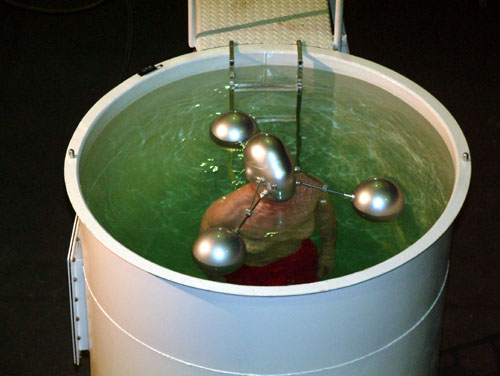
Maybe it's just me, but having to take phone calls under a state of total sensory deprivation is not my idea of fun. I couldn't help imagining some sort of nightmarish prison call centre, a whole pool full of them.
Then there was Mutsugoto. Let the official description speak for itself.

Well, I think we can probably guess. Anyway, I found both of them depressing; it also struck me that too many of these projects are all about sucking information out of the virtual space and representing it on a piece of hardware in private space. Basically, a gadget that reads out Twitter feeds, that you're meant to think is your friend. Further, once you get rid of the microphone, pointing device, keyboard, webcam, etc, you're basically watching TV on your own. It's read-only communication into the private realm.
The suit faction in this field, oddly, works the other way round - the M2M (Machine to Machine) community in telecoms, the big IT types, they're all more interested in getting data from the real world and representing it in virtual space. Basically, it's all SCADA applications - monitoring the current status of CO2 pipeline valve number 58634. Flowrate, direction, valve setting and temperature, please, and when did you last have your grease changed?
What seems to be missing from this as an artistic project is sending stuff into the public space. A lot of data gets captured from the public space into the private space; CCTV is one version, promoting your demo on Flickr and taking photos of the cops is another. Nothing much seems to be sent back, though; can't we have truth-screamer robots that run about yelling out under-reported news? Of course, if you or I were to encounter one we'd probably dropkick it into a handy canal. Splosh; "Hey there! CitizenMediaBot is sinking!"
But it would at least be fun, and more fun than gazing at a waldo that turns puce when #drivel is trending again. I suspect there's scope for this with things like Layar, who were also presenting. Then, we're deep into the Strossosphere; "what do we want? Brains!" indeed.
The first one was the Isophone, which is a mashup of a flotation tank and a telephone. The idea is that you sink into yummy sensory deprivation while talking to someone else in the same condition; it looks like this.
Maybe it's just me, but having to take phone calls under a state of total sensory deprivation is not my idea of fun. I couldn't help imagining some sort of nightmarish prison call centre, a whole pool full of them.
Then there was Mutsugoto. Let the official description speak for itself.
Mutsugoto is meant to be installed in the bedrooms of two distant partners. You lay on your bed and wear a special touch-activated ring visible to a camera mounted above. A computer vision system tracks the movement of the ring and projects virtual pen strokes on your body. At the same time these pen strokes are transmitted to and projected on the body of your remote partner. If you follow your partner's movements and your strokes cross, the lines will react with each other and reflect your synchrony. Special bed linens, silk curtains and other aspects of the physical context have been designed to enhance the mood of this romantic communication environment.But what are the civilian applications? As they say.
Well, I think we can probably guess. Anyway, I found both of them depressing; it also struck me that too many of these projects are all about sucking information out of the virtual space and representing it on a piece of hardware in private space. Basically, a gadget that reads out Twitter feeds, that you're meant to think is your friend. Further, once you get rid of the microphone, pointing device, keyboard, webcam, etc, you're basically watching TV on your own. It's read-only communication into the private realm.
The suit faction in this field, oddly, works the other way round - the M2M (Machine to Machine) community in telecoms, the big IT types, they're all more interested in getting data from the real world and representing it in virtual space. Basically, it's all SCADA applications - monitoring the current status of CO2 pipeline valve number 58634. Flowrate, direction, valve setting and temperature, please, and when did you last have your grease changed?
What seems to be missing from this as an artistic project is sending stuff into the public space. A lot of data gets captured from the public space into the private space; CCTV is one version, promoting your demo on Flickr and taking photos of the cops is another. Nothing much seems to be sent back, though; can't we have truth-screamer robots that run about yelling out under-reported news? Of course, if you or I were to encounter one we'd probably dropkick it into a handy canal. Splosh; "Hey there! CitizenMediaBot is sinking!"
But it would at least be fun, and more fun than gazing at a waldo that turns puce when #drivel is trending again. I suspect there's scope for this with things like Layar, who were also presenting. Then, we're deep into the Strossosphere; "what do we want? Brains!" indeed.
Sunday, August 30, 2009
coming to a security theatre near you
US security agents indulge in street theatre, frequently accidentally involving members of the public:
More to the point, in a real sense, nothing has changed - whatever their props and verbal furnishings, Spodak's character remains the same, the archetypal crazy gunman. Stephen Sondheim, come to think of it, dedicated a whole drama to the notion that this is a fundamental American character type, and it looks like these guys agree. However, the style is very different. Both highly formalised - motorcade, escorts, crazies - and formless, it can be staged anywhere in the public space, literally shooting holes in the fourth wall and recruiting random civilians into the action. Brecht would approve. Like this:
And this is no surprise; the impresario behind what you might call the Unmarked Gulfstream Ensemble is Military Professional Resources International, Inc, a company better known for hiring ex-servicemen as instructors for armies the US wishes to support.
As a presidential limousine rolls closer, an instructor cues, "How about a little homicide bomb?" Bracaglia throws himself at the limousine and detonates.....Mike "The Horse" Dutch, who is 6-foot-2 and weighs 280 pounds, has been playing villains for five years. He's been hit by so many training bullets that he has "black-and-blue dots all over . . . the size of a dime." When Dutch sunbathes at the beach, people stare, "like I have leprosy."How many times has he assassinated the president? I suspect he must have some very strange dreams. The bulk of the trainers are out-of-work actors, who volunteer because it beats the usual round of restaurant and bar jobs, but they also include a clinical psychologist who specialises in portraying the maniacs of today. Since the Reagan administration, he's changed the style but not the content.
"I hate getting shot in the rear end," says Bill Embrey, who wears shorts under his pants to soften the impact. "I'm stiff, for goodness sakes. When did we have our last 'force on force?' "
"Tuesday," says Dennis O'Toole, his role-playing partner. They ambushed President Obama's security detail during in-service training, firing simulated AK-47s.
O'Toole rolls up his sleeve, revealing a pocked arm. "Sister Mary Margaret is in these FX [special-effects bullets]. They will help you learn your lesson."
Embrey and O'Toole play "op-4s," opposition forces, and "tangos," terrorists. They specialize in assassinations. Embery's wife, a kindergarten teacher, describes Embrey's job as "playing all day." Some days the men hide out for hours in the woods at a secluded Maryland site, waiting for a motorcade to prey on. Once, after a snowfall, they wore white camouflage and lay so still, O'Toole says, that an agent "stepped on me."
When Spodak first played a character named Jeffrey Barry, he was "a mentally ill person, picking up trash and babbling about killing Reagan." During the 1990s, Jeffrey Barry believed Joan of Arc wanted him to kill Bill Clinton. Today Barry, still mentally ill, wears a Muslim prayer cap, receives messages from the 12th-century sultan Saladin and tells trainees he has incinerated a kitten as "a sacrifice to Allah."I really, really want to know what the acts whose run in this very special repertory company ended with the Bush years were; wasn't a Muslim kitten-torcher Cheneyesque enough? You can't fault the cultural observation, though; where else would a berserk racist teabagger work but at a huge, semi-bankrupt, South Carolinan mortgage lender kept alive by transfusions of public funds?
Characters also change with presidencies. "I just had to dump 18 roles from the Bush administration," Spodak says.
For Obama, Spodak created a new character, Gideon Caine, a white supremacist who works as a data-entry clerk at Wachovia...
More to the point, in a real sense, nothing has changed - whatever their props and verbal furnishings, Spodak's character remains the same, the archetypal crazy gunman. Stephen Sondheim, come to think of it, dedicated a whole drama to the notion that this is a fundamental American character type, and it looks like these guys agree. However, the style is very different. Both highly formalised - motorcade, escorts, crazies - and formless, it can be staged anywhere in the public space, literally shooting holes in the fourth wall and recruiting random civilians into the action. Brecht would approve. Like this:
Five minutes before his job interview, John Fisher parks at Ace Fire Extinguisher Services in College Park, his window open and his stomach jumpy. He is nibbling on spoonfuls of cottage cheese when shouts erupt from the car next to his.Actually, it's not Fisher who's pulled a gun, but how long before that happens, and someone who was a spectator a few moments ago gets to become the Crazy Assassin? Until then, of course, the main message the lucky participant/spectators will take away is that they should remain terrified, as David Kilcullen said about airport security. (Come to think of it, that's another theatrical exercise where you are both a spectator, and also get to play the role of Suspect.)
Fisher believes what he is seeing is real.
"Gun! He has a gun!" a man with a Secret Service earpiece yells, riffling through the glove compartment.
And this is no surprise; the impresario behind what you might call the Unmarked Gulfstream Ensemble is Military Professional Resources International, Inc, a company better known for hiring ex-servicemen as instructors for armies the US wishes to support.
Thursday, February 19, 2009
talking without speaking; speaking without talking
I often miss chunks of the humour at the Stiftung because I would rather do almost anything than watch US business-spot TV news. If you wanted to hide something from me, you could do worse than put it next to a TV tuned to CNBC. But I think I experienced something of the culture the good doktor despises so much the other day.
The scene; 3GSM/sorry/MWC keynote session. Dramatis personae: Steve Ballmer, CEO of Microsoft, Olli-Pekka Kallasvuo, ditto of Nokia, Ralph de la Vega, ditto of AT&T Mobility, and moderator Walt Mossberg of the Wall Street Journal. Others present - diverse delegates, press, staff, self.
It was of course dull; you don't go to the keynotes at tech conferences for content, you go to the actual conference sessions, or for that matter, the cocktail parties. De La Vega's presentation at least contained actual factual material, Kallasvuo's was inoffensive and reflected a Finnish disinterest in conference stardom, but Ballmer's was vacuous to an incredible degree. I was aware of his reputation for histronics, but what I wasn't prepared for was the degree to which the entire performance was divorced from its content.
He shouted, he stomped around the stage, he gave every impression of passion, but the text was content-free. It was the style of rolling TV news - had the sound been turned off, it would have been possible to synchronise almost any imaginable text with the video. David Hockney once said that in the theatre you don't put a tree on stage, you put treeness there; this was an exercise in the theatre of Ballmerness.
One reason why I went to the keynote was to witness what happened when Ballmer of all people had to speak on the topic of "openness"; in the event, he avoided the obvious problems here by talking a great deal without saying anything.
He reminded me a little of the only time I ever heard Arthur Scargill speak; he didn't have anything like Scargill's style, but he acted in much the same fashion. This is of course the heart of demagogy - it's all about turning your audience into a crowd, through a display of free-floating emotion. In this case, much of it consisted of a display of empty optimism and emotional stroking - that uniquely American mode, boosterism. We were called on to be optimistic, bullied to be bullish, badgered with progress.
We proceeded to the panel discussion, during which Mossberg encouraged the Great Men to waffle with him at great length about the Apple iPhone, possibly because this was a level of discussion he felt comfortable with. Then, he turned to taking the rise out of the head of Nokia (clearly some minor provincial), apparently having no idea where he was and who the audience were. At one point he used the success of the US automakers as an example; apparently, even if the Europeans had invented the car, blah, blah. Why was Nokia so weak in the US? Kallasvuo replied to this at some length, taking in several major news announcements of the day, some technical issues, questions of design and more.
The subject was changed back to iPhones.
By this point I was only staying in the hall in anticipation of the promised questions from the floor. I had a strong sense of having wasted my time.
Asking provocative questions is a time honoured way of drumming up business at conferences, as well as a contribution in itself. After the next homey anecdote about so-and-so's wife and the funny little keys on their Nokia, my finger was itching. It was time to throw a pavé in the water. Questions were finally announced, and the first to be called was none other than John Strand, who I interviewed for the first ever story I wrote for Mobile Comms International in 2005.
And that was when the comfortable round of anecdotage was broken up; Strand started positively shouting that the session was outrageously US-centric, that the iPhone made up a tiny percentage of the market, and why weren't we talking about something more useful? Dead silence...and then, applause. The viewpoint of the entire hall had shifted to yer man, standing near the back, surrounded by horrified organisers.
Neither Mossberg or Ballmer had any answer to this; it was a My Pet Goat moment. The rest of the world had turned up and crashed their OODA loop completely. In a theatrical sense, it was positively Brechtian; his intervention, in breaking the frame, forced an alienated re-evaluation of the characters. Kallasvuo maintained a poker face; there was a rumour that De La Vega sought Strand out later.
Before I or anyone else could move in with a further question, Mossberg announced that the session was closed and left quickly through the stage door, as Strand was still orating, having been deprived of the microphone. I couldn't help imagining a helicopter on the roof. It was the most fun all week.
The scene; 3GSM/sorry/MWC keynote session. Dramatis personae: Steve Ballmer, CEO of Microsoft, Olli-Pekka Kallasvuo, ditto of Nokia, Ralph de la Vega, ditto of AT&T Mobility, and moderator Walt Mossberg of the Wall Street Journal. Others present - diverse delegates, press, staff, self.
It was of course dull; you don't go to the keynotes at tech conferences for content, you go to the actual conference sessions, or for that matter, the cocktail parties. De La Vega's presentation at least contained actual factual material, Kallasvuo's was inoffensive and reflected a Finnish disinterest in conference stardom, but Ballmer's was vacuous to an incredible degree. I was aware of his reputation for histronics, but what I wasn't prepared for was the degree to which the entire performance was divorced from its content.
He shouted, he stomped around the stage, he gave every impression of passion, but the text was content-free. It was the style of rolling TV news - had the sound been turned off, it would have been possible to synchronise almost any imaginable text with the video. David Hockney once said that in the theatre you don't put a tree on stage, you put treeness there; this was an exercise in the theatre of Ballmerness.
One reason why I went to the keynote was to witness what happened when Ballmer of all people had to speak on the topic of "openness"; in the event, he avoided the obvious problems here by talking a great deal without saying anything.
He reminded me a little of the only time I ever heard Arthur Scargill speak; he didn't have anything like Scargill's style, but he acted in much the same fashion. This is of course the heart of demagogy - it's all about turning your audience into a crowd, through a display of free-floating emotion. In this case, much of it consisted of a display of empty optimism and emotional stroking - that uniquely American mode, boosterism. We were called on to be optimistic, bullied to be bullish, badgered with progress.
We proceeded to the panel discussion, during which Mossberg encouraged the Great Men to waffle with him at great length about the Apple iPhone, possibly because this was a level of discussion he felt comfortable with. Then, he turned to taking the rise out of the head of Nokia (clearly some minor provincial), apparently having no idea where he was and who the audience were. At one point he used the success of the US automakers as an example; apparently, even if the Europeans had invented the car, blah, blah. Why was Nokia so weak in the US? Kallasvuo replied to this at some length, taking in several major news announcements of the day, some technical issues, questions of design and more.
The subject was changed back to iPhones.
By this point I was only staying in the hall in anticipation of the promised questions from the floor. I had a strong sense of having wasted my time.
Asking provocative questions is a time honoured way of drumming up business at conferences, as well as a contribution in itself. After the next homey anecdote about so-and-so's wife and the funny little keys on their Nokia, my finger was itching. It was time to throw a pavé in the water. Questions were finally announced, and the first to be called was none other than John Strand, who I interviewed for the first ever story I wrote for Mobile Comms International in 2005.
And that was when the comfortable round of anecdotage was broken up; Strand started positively shouting that the session was outrageously US-centric, that the iPhone made up a tiny percentage of the market, and why weren't we talking about something more useful? Dead silence...and then, applause. The viewpoint of the entire hall had shifted to yer man, standing near the back, surrounded by horrified organisers.
Neither Mossberg or Ballmer had any answer to this; it was a My Pet Goat moment. The rest of the world had turned up and crashed their OODA loop completely. In a theatrical sense, it was positively Brechtian; his intervention, in breaking the frame, forced an alienated re-evaluation of the characters. Kallasvuo maintained a poker face; there was a rumour that De La Vega sought Strand out later.
Before I or anyone else could move in with a further question, Mossberg announced that the session was closed and left quickly through the stage door, as Strand was still orating, having been deprived of the microphone. I couldn't help imagining a helicopter on the roof. It was the most fun all week.
Sunday, February 01, 2009
a genuinely sinister drug
I liked this (via):
And then I jumped under a tram. No. In fact I thought someone should write the book before someone actually invented it, with whatever nightmarish meat-hook consequences that would have. Then I forgot all about it at wheels-up, until now, when the approach of the next 3GSM brought it slithering to mind.
Although technically speaking releasing testosterone precursors on the world’s trading floors to try to rally valuations wasn’t criminal as such, the affected traders lobbied to declare it illegal. But governments liked the idea too much, and oxygen masks were forbidden.I think it was at last 3GSM I suddenly thought of the possibility of someone inventing a sales drug - a pill that would fill you with energy and induce repetitive behaviour (always be closing, right?), whilst at the same time making you hypersensitive to others' emotions...but completely indifferent to them, and also completely incurious about what you were doing. The street, or the Street, would probably call it Animal Spirit.
(Electronic traders were of course immune, but they knew floor traders would be bullish and that was enough for them to become so, too. Soon there was no need to spend on the chemicals anymore.)
And then I jumped under a tram. No. In fact I thought someone should write the book before someone actually invented it, with whatever nightmarish meat-hook consequences that would have. Then I forgot all about it at wheels-up, until now, when the approach of the next 3GSM brought it slithering to mind.
Friday, November 28, 2008
a short film about killing turkeys
The Rude Pundit has a very good point.
But it's not just ridiculous; it's morally repellent and politically more than dubious. After all, what is the turkey's crime? Being a turkey? Pardon implies that you committed a crime, and also that you were punished by some legitimate authority, which has now offered you mercy out of the goodness of its heart. It's a sort of reversed sacrifice - rather than killing a goat to expiate your sins, it's not killing a turkey so as to go off and eat millions of 'em with a clean conscience.
Pardon is also interesting because it can't be separated from executive power. To pardon someone means that the head of state decided, whatever the law happened to be, whatever the judiciary thought of the case, whatever the jury thought of the evidence, just to intervene and make an exception. It's only possible, after all, because the executive has the power to execute. It also means that the executive agreed to all the other executions; what, after all, would happen if the president pardoned everyone? That would be about as likely as pardoning all the turkeys. Executive clemency is the flip side of executive cruelty. (Note, of course, that a British prime minister isn't the head of state.)
It's therefore a profoundly anti-rational, authoritarian custom; no wonder it's a holdover from absolute monarchy. And this, I think, is what worries me about this ceremony - it's the sacralisation of the executive branch. Like the King's touch for scrofula. (He can even un-turkey a turkey!) No wonder, as Rude so wisely points out, Bush loves it.
Before we go on, here's a video from Talking Points Memo in which you can see both Bush doing the turkey thing and also Sarah Palin's now-notorious performance in which she pardoned a turkey while a worker slaughtered turkeys in the background. It will help your comparative turkeyology to watch closely.
Now, what about the well-known cockup in Alaska? A couple of points come to mind. For a start, as befits an anti-rationalist movement, neoconservatism has no culture of competence. They never run anything; their natural habitat is the thinktank, the university campus, the elite circle. Hence the Schlamperei that follows them around, like a drugfuddled burglar in a darkened room full of gym equipment. Of course they'd fuck it up - even in Washington, Bush managed to grant the bird a "full unconditional unconditional pardon".
The second is that perhaps they aren't trying. Looking back, when did they lie convincingly? The case for war was based not on lies, but on the unwillingness to confront the lies. Later, on things like torture and mass surveillance, they moved beyond this and simply admitted the facts while denying the form. Yes, we waterboarded the guy and pulled your call-detail records - are you with the terrorists? Of course, we do not support torture or illegal surveillance. In a very real sense, they were pardoning turkeys in front of the slaughter live on TV all the time.
You can't even picture Obama pardoning a fucking turkey. Sure, he'll probably do it. But unlike Bush, who approached such obligations with dunce-like glee, for Obama it'll be like a kick in the groin.As usual with Rude, there's a serious point here, sneaking past the guards while all the noise and snark and chainsaw dust draw their attention. Pardoning a turkey is, let's face it, exactly the kind of stupid crap most British people look at as just the kind of stupid crap Americans get up to. Can you imagine a British prime minister trying this? He or she would be laughed out of the country; probably they'd end up doing a John Profumo and choosing a life of deliberate monkish obscurity.
But it's not just ridiculous; it's morally repellent and politically more than dubious. After all, what is the turkey's crime? Being a turkey? Pardon implies that you committed a crime, and also that you were punished by some legitimate authority, which has now offered you mercy out of the goodness of its heart. It's a sort of reversed sacrifice - rather than killing a goat to expiate your sins, it's not killing a turkey so as to go off and eat millions of 'em with a clean conscience.
Pardon is also interesting because it can't be separated from executive power. To pardon someone means that the head of state decided, whatever the law happened to be, whatever the judiciary thought of the case, whatever the jury thought of the evidence, just to intervene and make an exception. It's only possible, after all, because the executive has the power to execute. It also means that the executive agreed to all the other executions; what, after all, would happen if the president pardoned everyone? That would be about as likely as pardoning all the turkeys. Executive clemency is the flip side of executive cruelty. (Note, of course, that a British prime minister isn't the head of state.)
It's therefore a profoundly anti-rational, authoritarian custom; no wonder it's a holdover from absolute monarchy. And this, I think, is what worries me about this ceremony - it's the sacralisation of the executive branch. Like the King's touch for scrofula. (He can even un-turkey a turkey!) No wonder, as Rude so wisely points out, Bush loves it.
Before we go on, here's a video from Talking Points Memo in which you can see both Bush doing the turkey thing and also Sarah Palin's now-notorious performance in which she pardoned a turkey while a worker slaughtered turkeys in the background. It will help your comparative turkeyology to watch closely.
Now, what about the well-known cockup in Alaska? A couple of points come to mind. For a start, as befits an anti-rationalist movement, neoconservatism has no culture of competence. They never run anything; their natural habitat is the thinktank, the university campus, the elite circle. Hence the Schlamperei that follows them around, like a drugfuddled burglar in a darkened room full of gym equipment. Of course they'd fuck it up - even in Washington, Bush managed to grant the bird a "full unconditional unconditional pardon".
The second is that perhaps they aren't trying. Looking back, when did they lie convincingly? The case for war was based not on lies, but on the unwillingness to confront the lies. Later, on things like torture and mass surveillance, they moved beyond this and simply admitted the facts while denying the form. Yes, we waterboarded the guy and pulled your call-detail records - are you with the terrorists? Of course, we do not support torture or illegal surveillance. In a very real sense, they were pardoning turkeys in front of the slaughter live on TV all the time.
Sunday, November 16, 2008
Thinktanks we can believe in
Did I say I like Touchstone?
But he ignores the fact that the European left did not soar in the polls within days of the Great Crash. It took a World War and 15 years - does Tony Barber really not know this, or does he not mind displaying faux ignorance so publically?Now that's thinktankery you can believe in. Policy Exchange? Pathetic. And who knew Two Brains was a concert-party star?
Mind you, at least his sin is only to appear ignorant. Gideon Rachman seems rather proud, for a journalist, of eschewing the real world for the claret-swilling elite in his fearless pursuit of the facts.
He stresses how vital it is to share vintage port over the cheese course with diplomats and politicians if you want to find out what’s really going on in the Middle East peace process and the Doha Development Round trade talks.
I’ve been to these country-house colloquia myself, and of course I love them to bits. I prefer Wilton Park to the Ditchley venue that Gideon cites, but that may be because last time I was at Ditchley I had to suffer the indignity of having my workshop report sung in the bar by Shadow Cabinet member David Willets to a piano accompaniment (the tune was “Waltzing Matilda”) by the then Director General of the OECD (I’m not making this up - how could you?)
But I do rather feel that I find out more about the Middle East from my Palestinian mate Fathi whose door got kicked down by Israeli goons who thought his son was a member of Hamas last time he went to a conference.
the stars are right...
This looks like being the ultimate TYR event. Via Ballardian, yer man from BLDGBLOG is going to be speaking at UCL on the 26th November on Feral Cities and the Scientific Way of Warfare. Quote:
I can't help feeling that a Dadaist response is appropriate somehow.
At the very least, you'll get an early preview of Antoine's forthcoming book – in which he introduces the term chaoplexic warfare in a survey of everything from ant "swarms" and the use of 18th-century battlefield metaphors to the distributed geographies of the Russian mafia, the Medellín drug cartel, and Al-Qaeda – and that's already quite a lot right there.It's being organised by the Complex Terrain Lab. And it's going to be held in the J.Z. Young Lecture Theatre - yes, that's J.Z. Young as in the squid expert. Surely I can't miss that? We could make this into a little rantercon, perhaps.
I can't help feeling that a Dadaist response is appropriate somehow.
Thursday, October 30, 2008
Gilligan's "Ibogaine Frenzy"; Assaults Wrong Man, Screaming Nonsense
It seems that Andrew Gilligan has been stung by the phrase "Bendy Jihad". So much so that he has devoted a whole column to moaning about it, or rather to moaning about anyone having the cheek to disagree with him. It's a pity, then, that he couldn't see his way to attributing his attack correctly, quoting accurately, or refraining from beauties like these:
And it is gratuitous. We know now that they do not kill cyclists. Not one authenticated case of a Bendy attacking cyclists has been provided. No evidence for any of the other horrors they supposedly inflict on the public has been adduced whatsoever. But rather as so many Conservatives are indiscriminately in favour of killing small animals, the Bendy Jihad rolls on, despite the fact that the contracts between Transport for London and the bus operators mean that come what way, 50 bendies will still be in operation at the next mayoral election, despite the fact that some of the routes involved are impassable to double-deckers because they go through the Strand underpass, despite the fact Boris Johnson forgot all about paying for the extra drivers and conductors required for 24-hour operation...clearly, the role of the Bendy Jihad is not instrumental, but symbolic. Rather than fighting for a secular triumph in which the Caliphate of a better transport system is actually achieved, the Bendy Jihadis hope to prove themselves worthy of their place in paradise (also known as the House of Commons) by their sacrifice.
However, their religion is actually considerably less advanced than Islam in anthropological terms. Rather than propitiating god by good works or asceticism, they are still at the stage of making sacrificial offerings of dead animals; in this case, these savages intend to stage a mass cull of defenceless bendies. Perhaps they will build a giant pyre and dance round it, or burn Peter Hendy in a wicker man atop City Hall. It's potlatch politics; they're doing it purely because they can. Politically, it's an appeal to the primitive instincts; watch us smash their big, long, red totem!
I suspect the authors of the Bendy Jihad are well aware of this; it's hard to remember this now, but it wasn't that long ago that the main strategic problem facing the Conservative Party was how to win an election in a climate of prosperous housing-boom contentment, without risking any of their core ideological substance. The answer, of course, is to pick an aesthetic and push it as far as you can.
Now, Gilligan claims that "one tireless Johnson-basher, Tom Barry, explains how the Mayor's opposition to bendy buses is actually part of a sinister, global neo-conservative conspiracy". Unfortunately, he's got this the wrong way round. The opposition to bendy buses is actually a conspiracy which consists of sinister global neo-conservatives.
For example, we have Policy Exchange's founder Michael Gove, shadow Schools Secretary. Mr. Gove is on record as recommending the pseudonymous "Bat Ye'or"'s book Eurabia, in which you can learn that the European Union is secretly controlled by Arabs. (There are pills you can take for that, I think.) We have its recent director Anthony Browne, the toast of US extreme-rightist group VDARE, who apparently thinks we are "on the edge of anarchy" because of the not-ricin not-plot, now Boris Johnson's policy chief. We have the truly odd figure of Policy Exchange research director Dean Godson - advocate of "political warfare", former special assistant to John Lehman as Secretary of the Navy (that's the US Navy, and he's now the head of John McCain's transition team), and shaky-on-facts thinktanker. Why am I bothering with this obscure thinktank?
Because, of course, not only did Boris Johnson staff up from it, but it published a paper back in 2005 which specifically proposed the Bendy Jihad in the following terms:
What a bunch, and how bizarre that they all share a deep interest in buses despite having never been at all interested in transport policy before. I suppose their nonsense is explicable by the Dunning-Kruger effect - the principle, experimentally demonstrated, that incompetent people are not only unaware of their incompetence but convinced that others are even more incompetent than they.
Anyway, this is all very interesting, but it's just a pity that Tom Barry didn't actually say it, just like he didn't invent the Bendy Jihad. The two halves of the quote, each side of the oh-so-convenient ellipsis, come from two distinct pieces of writing, welded together like the halves of a dodgy secondhand car and with much the same purpose. Tom Barry says in the first one that there is a curious overlap between the Bendy Jihad and a neo-conservative worldview, quoting me. I think we've amply demonstrated that. He says in the second that the Boris Johnson campaign was motivated by Tory hatred of Ken Livingstone for cosying-up to the "new economic superpowers". That's an opinion, on a whole range of stuff that has bugger-all to do with bendies.
Comment is free, facts are sacred. Remember? Much more of this and I might conclude Alistair Campbell was right. Which would be a considerable stretch for me. But then, they say you should never meet your heroes. Especially not when they get caught sockpuppeting.
There's a certain mad nobility in the way Boris's opponents seem determined to strap themselves to the most unpopular causes going. You wonder what's next a support group for double-glazing salesmen? A bid to rehabilitate that misunderstood feminist icon, demonised by the Right-wing media, Rose West?Do stay classy, Andrew. Anyway, to get to the point: Tom Barry is not responsible for the phrase "Bendy Jihad"; it was me. I invented the phrase to express the bizarrely gratuitous nature of the campaign against these peaceable giants of the urban savannahs; is it really a top priority, after all, to replace some brand-new buses with other brand-new buses which have had some glassfibre curlicues added?
And it is gratuitous. We know now that they do not kill cyclists. Not one authenticated case of a Bendy attacking cyclists has been provided. No evidence for any of the other horrors they supposedly inflict on the public has been adduced whatsoever. But rather as so many Conservatives are indiscriminately in favour of killing small animals, the Bendy Jihad rolls on, despite the fact that the contracts between Transport for London and the bus operators mean that come what way, 50 bendies will still be in operation at the next mayoral election, despite the fact that some of the routes involved are impassable to double-deckers because they go through the Strand underpass, despite the fact Boris Johnson forgot all about paying for the extra drivers and conductors required for 24-hour operation...clearly, the role of the Bendy Jihad is not instrumental, but symbolic. Rather than fighting for a secular triumph in which the Caliphate of a better transport system is actually achieved, the Bendy Jihadis hope to prove themselves worthy of their place in paradise (also known as the House of Commons) by their sacrifice.
However, their religion is actually considerably less advanced than Islam in anthropological terms. Rather than propitiating god by good works or asceticism, they are still at the stage of making sacrificial offerings of dead animals; in this case, these savages intend to stage a mass cull of defenceless bendies. Perhaps they will build a giant pyre and dance round it, or burn Peter Hendy in a wicker man atop City Hall. It's potlatch politics; they're doing it purely because they can. Politically, it's an appeal to the primitive instincts; watch us smash their big, long, red totem!
I suspect the authors of the Bendy Jihad are well aware of this; it's hard to remember this now, but it wasn't that long ago that the main strategic problem facing the Conservative Party was how to win an election in a climate of prosperous housing-boom contentment, without risking any of their core ideological substance. The answer, of course, is to pick an aesthetic and push it as far as you can.
Now, Gilligan claims that "one tireless Johnson-basher, Tom Barry, explains how the Mayor's opposition to bendy buses is actually part of a sinister, global neo-conservative conspiracy". Unfortunately, he's got this the wrong way round. The opposition to bendy buses is actually a conspiracy which consists of sinister global neo-conservatives.
For example, we have Policy Exchange's founder Michael Gove, shadow Schools Secretary. Mr. Gove is on record as recommending the pseudonymous "Bat Ye'or"'s book Eurabia, in which you can learn that the European Union is secretly controlled by Arabs. (There are pills you can take for that, I think.) We have its recent director Anthony Browne, the toast of US extreme-rightist group VDARE, who apparently thinks we are "on the edge of anarchy" because of the not-ricin not-plot, now Boris Johnson's policy chief. We have the truly odd figure of Policy Exchange research director Dean Godson - advocate of "political warfare", former special assistant to John Lehman as Secretary of the Navy (that's the US Navy, and he's now the head of John McCain's transition team), and shaky-on-facts thinktanker. Why am I bothering with this obscure thinktank?
Because, of course, not only did Boris Johnson staff up from it, but it published a paper back in 2005 which specifically proposed the Bendy Jihad in the following terms:
One of the remarkable things about the debate over the Routemaster – London’s much loved hop-on, hop-off double deckers complete with conductor – is that it is about much more than just a bus. It is highly revealing about so many aspects of public policy in Britain today. The first is the rising tide of the group rights agenda (or at least a particularly extreme interpretation of it) which has overwhelmed key public utilities and those who do business with them.That's Godson. "The group rights agenda", no less. Here's some more:
The Routemaster’s crime, in short, is not that it is ineffective; it is that it is unfashionable. It does not fit with the modern, sleek, concrete-and-glass Euro-city that Mr Livingstone wants to create; never mind that this city exists only inside the Mayor’s head.It's always the EU in the end with these people, isn't it? You'd think that Andrew Gilligan might have been aware of this document's essentially partisan and political nature; after all, he wrote that last bit and Godson edited it.
What a bunch, and how bizarre that they all share a deep interest in buses despite having never been at all interested in transport policy before. I suppose their nonsense is explicable by the Dunning-Kruger effect - the principle, experimentally demonstrated, that incompetent people are not only unaware of their incompetence but convinced that others are even more incompetent than they.
Anyway, this is all very interesting, but it's just a pity that Tom Barry didn't actually say it, just like he didn't invent the Bendy Jihad. The two halves of the quote, each side of the oh-so-convenient ellipsis, come from two distinct pieces of writing, welded together like the halves of a dodgy secondhand car and with much the same purpose. Tom Barry says in the first one that there is a curious overlap between the Bendy Jihad and a neo-conservative worldview, quoting me. I think we've amply demonstrated that. He says in the second that the Boris Johnson campaign was motivated by Tory hatred of Ken Livingstone for cosying-up to the "new economic superpowers". That's an opinion, on a whole range of stuff that has bugger-all to do with bendies.
Comment is free, facts are sacred. Remember? Much more of this and I might conclude Alistair Campbell was right. Which would be a considerable stretch for me. But then, they say you should never meet your heroes. Especially not when they get caught sockpuppeting.
Sunday, September 14, 2008
tomorrow's public inquiry today
Is anyone else disturbed by the fact Ed Balls appears to have been replaced by Chris Dillow?
If this is officially policy amateur hour, I'd point out that my own pet scheme on this issue deals with the problem of what if this winter's really bad and WON'T SOMEBODY THINK OF THECHILDREN CODGERS? rather well. To recap, I propose to fund it out of the existing bill for fuel subsidies capitalised over several years, and make it subject to individual choice, and voluntary-but-automatic. Those who don't want to or can't take advantage of it can just continue to receive cash. Full implementation of it would eventually reach one-third of UK households, and the bill is £1.98bn, all of which is existing spending. So we could chuck in the £910m from the gas pushers to fund an extra payment for the opters out.
Oh yes, and there's this. I'm beginning to picture some sort of awful inquiry commission wanting to know just what I was thinking, and how I can claim I didn't know cooperatively-owned prefabricated guerrilla hospitals linked to some sort of leftwing cross of Facebook and CVSTrac were going to grow to enormous size and attack our cities.
Ed Balls, the schools secretary and only member of the Co-operative party in the cabinet, will today propose that 100 schools over the next two years become co-operative trust schools owned and controlled by the local community. He will tell the annual conference of Labour's sister party that he is putting up an extra £500,000 so trust schools have extra financial help to become co-operatives. The move comes as Michael Stephenson, the new general secretary of the Co-operative party and a former political officer at Downing Street, claims co-ops could be on the brink of a revival in Britain. "Co-ops are an idea whose time has come back."The actual policy is fairly milksopful, but still; it can hardly blow up too badly. Meanwhile, Gordon Brown announced an insulation push, but for some reason, not an air-source heat pump in sight. It's been badly received; there could be more, although that's hardly an insight, but I'm not impressed by Tony Woodley trying to make "lag the loft" a smear analogous to McCain's tyre gauges.
He is looking at how to persuade Labour to bring the co-operative model into railways, schools, housing and other public services, arguing that Labour, searching for new ideas, can find intellectual renewal in those behind co-operatives. The Co-operative party has already succeeded in persuading Network Rail to review its governance structures to see how it can make rail users part of its board.
If this is officially policy amateur hour, I'd point out that my own pet scheme on this issue deals with the problem of what if this winter's really bad and WON'T SOMEBODY THINK OF THE
Oh yes, and there's this. I'm beginning to picture some sort of awful inquiry commission wanting to know just what I was thinking, and how I can claim I didn't know cooperatively-owned prefabricated guerrilla hospitals linked to some sort of leftwing cross of Facebook and CVSTrac were going to grow to enormous size and attack our cities.
Subscribe to:
Posts (Atom)