Friday, June 10, 2005

Happy Blogday Everyone!

Two years ago today, The Yorkshire Ranter was born in a striplit computer room in Royal Holloway College's International Building. Since then we've had ranting, spam, funnies, mystery jets, vituperation, stupidity, more ranting, and some terrible afternoons spent with HTML and frustration. I've picked over yards of extremely dull official documents, debated the EU with Chinese telecoms people (one of whom, I later learned, had previously tried to bribe my editor), been shouted at by a red porker with a CIA badge at the Hutton inquiry...and the most popular post in the lot was some twaddle about trams carrying freight in Vienna, which was picked on by BoingBoing.net and resulted in a surge of 2,578 hits over four days, including 1,000 on 22nd May 2005.

Mind you, some of the Viktor Bout posts attracted three-figure days, too, so I can't be too dismissive of the readership. People from all parts of the world read the Ranter, including Finland, the DR Congo, .arpa addresses, the Elysee Palace, the British Antartic Survey, and various parts of the US Department of Defence. Oh yes, and the North Derbyshire Chamber of Commerce, who visit daily. And some of you search for the most remarkable things. I'm not sure if my favourite is "thatcher unguents", which conjured up the image of some fool trying to replicate Maggie's "beauty" regime, or "2005 mail contacts of flying boat mechanics Ukraine", which came in from a cybercafe in Kinshasa. Whoever it was, I hope you got your flying boat fixed. If you're still stranded, I don't think I can help, but Carlos W might. He knows his flying boats, and according to his latest post carries the kind of stuff in his rucksack that would probably do the job. "Male bulging bellies", though, was just sick. But I'm proud to be the only Yahoo! result for colombian ghetto music, tunisian tribal music and italian national anthem.

I'm even more proud that Richard Chichakli and friends got their bank accounts frozen. Solid! I'd like to thank everyone who's helped so far by sending useful information, and even non-useful information. I'd also like to remind y'all that so far, no-one has ever used the PayPal donate link. Not even lye2.latimes.com, who researched his Viktor Bout story right here in considerable depth (read every last post, so he did), never got in touch with me, and finally published without any acknowledgement at all. Shame on you. I now have a job, but it's the principle of the thing.

But before you rush to send money, there's something more important I want from you: your comments. I'd like to hear what you want from this blog in the future.

Thanks for reading. Double thanks for commenting. Triple thanks for linking. And finally, this comment left at Tim Worstall's:
I've no idea why you persist with reporting this sort of twattish idiocy from the Yorkshire Ranter. There are plenty of good left-of-centre blogs out there - eg Harry's Place, Normblog - why not quote one of their articles instead of yet more wrong-headed nonsense from the Yorkshire Ranter.
Why indeed.

The Press, GPS, and road tolls

Why is it that nobody ever gets it right about GPS? Every time the magic navigation system is mentioned in the national press, someone always tells us that the satellites "track" the user. This time, it was the Grauniad, and worse still, it was its normally fantastic science supplement, Life. In a report about the government's delightful road-charging scheme, they said this:
"Darling wants to levy varying fees from 2p to £1.30 a mile according to the distance, time and type of road. The idea is that a black box in each car, roughly the size of a DVD player, will be tracked using global positioning systems (GPS). Many family cars already have GPS, and Ellen McArthur used a similar device to navigate the high seas. The in-car box is typically monitored by several satellites, which combine and "triangulate" to give accurate coordinates."
No, the black box will not be tracked. No, it is not "typically" monitored by satellites. It is never monitored by satellites. They nearly got it right in that it involves triangulation, but again, the satellites do not triangulate: the box does. But that wasn't it, though...
"New Galileo technology will improve this by using perhaps eight or 12 satellites to pinpoint each black box."

Let's get this straight. The NAVSTAR satellites that make GPS work do not track, monitor, pinpoint or do anything else to the receiver. They are essentially highly accurate clocks. The whole system architecture is exactly the opposite of this: for a good reason. Like the internet, it's a stupid network - all the intelligence is at the end-point. There's a damn good reason for this, too. GPS was designed to work anywhere and at any time, even in a nuclear war. If the satellite control centre in Colorado Springs or wherever is blasted down to nothing, the system functions just as well, because it all happens on the user device. What happens is that the user device contacts the satellites and records how long it takes for them to send back a signal, which tells it how far away each one is at that precise moment; where the circles intersect is your position, so long as you're within the satellites' orbit. The receiver tracks the satellites. Monitors them. Not the other way around. Is that completely clear?

It's an interesting question why they always get it wrong. If it was purely ignorance, you'd expect the mistakes to display a normal distribution. Given that there are essentially two possible options, this would suggest a fifty-fifty split. In practice, there will be a small but significant chance of someone saying it works with skyhooks, fairies and Miracle Whip, so it won't be exact, but being right or wrong would be equally probable. But in this case, they always get it wrong in the same way. (Pity about the rational expectations hypothesis, eh.)

I wonder if the idea that it tracks you, not the other way around, is some kind of unconscious reflection of one's fears of total surveillance? You won't be surprised to learn that I think Alastair Darling's scheme is poison, especially as he's already pledged to make an equivalent cut in fuel duty. This is so stupid as to be unbelievable: the one policy lever that gets right to the problems caused by cars (i.e. pollution, climate change and resource depletion), has been demonstrated to work, and requires absolutely no new administrative apparatus or technology, and he's carefully ruled it out? Under Darling's idea, drivers of monster SUVs in the suburbs will actually benefit.

Another point is that the proposed box is vulnerable to fiddlers precisely because of the way GPS works. It tracks the satellites to work out where it is. Then, every so often, it rings up and says where it's been (just like the electronic tag used on criminals). Of course, that gives the hacker a week or so to break into the thing. Now, a navigation device that did track the user would be far better, as it would require only a very cheap client and would collect the information centrally and in real time. But there aren't any at the moment. It's conceptually possible, but I doubt it would be better enough than GPS/Glonass/Galileo to make it worthwhile, especially as centralisation in computer networks means complexity and cost.

Stupid idea, stupid government, stupid press.

Thursday, June 09, 2005

How to get on in the civil service

Remember all that kerfuffle about the 2004 local elections in Birmingham? When three Labour councillors were kicked out by a special election court because it turned out they'd been forging huge quantities of postal votes? When Judge Richard Mawsley said that the election "would have disgraced a banana republic"? Where the police discovered two of the men in question in a warehouse at dead of night, surrounded by piles of ballots they claimed to be "taking to the count"?

Well, the chief executive of Birmingham City Council at the time is now the director of the Immigration Service. The woman in question - the heir, if you will, of Joseph Chamberlain's municipal socialism - is one Lin Homer. She wasn't accused of rigging the vote herself. No. But she was named on the petition to the court, though. Alongside the councillors themselves, there she is (Hansard reference). What did the judge have to say?
BBC West Midlands: "The petitioners also accused the city's returning officer and chief executive Lin Homer of failing to discharge her duties in accordance with electoral law.

Judge Mawrey said that Ms Homer "threw the rule book out of the window" to deal with overwhelming numbers of postal vote application forms received."
Memo to IND HQ, Lunar House, Croydon: don't let the rule book hit you as it departs the window. Shall we have a concrete example of what she could have done to prevent the fraud? As it happens, I've got one here.
The Daily Telegraph: "Mr Mawrey said: "Postal ballot packages are sent out by ordinary mail in clearly identifiable envelopes. Short of writing 'Steal Me' on the envelopes, it is hard to see what more could be done to ensure their coming into the wrong hands."
Great, eh? What about this little beauty?
The Birmingham Post:"The elections officer for Birmingham was suspended last night after the discovery of a hidden box containing an estimated 1,000 uncounted postal votes from the 2004 local authority elections...."I went to the elections office with the head of the fraud squad, Dave Churchill.

"Lo and behold there was an orange crate high up on a shelf. When we took it down it was full of envelopes." Coun Hemming said the envelopes had not yet been fully examined, but he believed they contained postal ballot papers from between ten and 15 wards."
And there's more from the Post, which sounds like an impressive local paper:
Birmingham Post:"Mr Mawrey was critical of the council's elections office and returning officer, Lin Homer, who allowed "corners to be cut" when sorting and counting postal votes.

But he said her decision was understandable given the quantity of postal ballots, which Mrs Homer and the elections officer John Owen could not have foreseen.

Although Mrs Homer's decision to allow postal ballot papers to be transported to the count in plastic shopping bags was "the direst folly", it was not a serious enough breach to declare the result unsafe."
I like the bit with the carrier bags. But there was worse:
The Times: "Lin Homer, the city council’s chief executive, gave evidence that there was widespread anxiety about postal voting fraud during the campaign. Cheating reached such depths that a pillar box was set alight in an attempt to destroy completed ballot papers, she said."
Widespread anxiety, eh? Pity it wasn't anxious-making enough to induce her to actually do anything. But, of course, everything was cleared up in time for the far more important general elections, wasn't it?
The Times, Again: "
20,000 missing votes heighten Birmingham postal fraud fears
By Jill Sherman and Dominic Kennedy
SOME 20,000 missing votes became the focus of Britain’s biggest election count early today. Early indications showed that a third of postal votes issued for the 11 constituencies in Birmingham had not been returned.

Explanations include late delivery, fraudsters afraid of filling them in because of extra police attention, or low turnout. However, postal voting typically results in high turnouts of up to 80 per cent because voters are seen as more motivated. Birmingham is the scene of several marginals where the parties have used mass postal voting to try to capture or hold seats. The total number of postal votes issued in the city was 59,000 compared with 16,000 at the last election.

But Lin Homer the returning officer disclosed last night that only 37,000-43,000 arrived. She said: “It might be that people have thought again about postal voting because of the uncertainty. Some of it could have been because of the work we have been doing. We have conducted 700 door-to-door interviews and forensically examined data.”
Does anybody like the way she tries to make the disappearance of ~20,000 ballot papers sound like a good thing? Naturally, of course, even if there had been no time to make changes before the election, our darling Lin was right on the case as soon as the dust settled to ensure that nothing like this could possibly happen again. Or perhaps not.
The Guardian: "n the meantime, Mr Khan, who stood for the Liberal Democrats against former cabinet minister Clare Short in Birmingham Ladywood, is planning to meet West Midlands police and the returning officer for Birmingham city council to discuss his fears.

It follows claims that a Labour party activist in the constituency kept a ballot box at his home the night before polls opened. The activist, whose daughter was a presiding officer for one polling station, has strenuously denied any impropriety.

But Mr Khan, who brought a successful petition against postal vote fraud in last year's local elections, said he would be raising the issue of how the general election was run with returning officer Lin Homer. He said it was "alarming" that ballot boxes were kept with presiding officers who were not council employees, particularly if they have links to a political party."
Naturally, the activist had no intention of interfering with the ballot box in any way. Nuh. He felt sorry for it. It looked lonely. So he thought he'd take it home. As a pet. The children would love it..especially his daughter.

If you can't trust local government to run an election honestly or at least without letting it degenerate into a catastrophic farce through sheer incompetence, surely you can count on central government to weigh in. Surely the G-men will soon be on their way from headquarters to clean up our democracy's Sin City? Well, the people in question are the brand-new Department for Constitutional Affairs. But there's a problem. They may not even know what's going on in Birmingham. Why? A source at DCA, who can be identified only as "Shallow Neck", informs me that DCA staff are forbidden to read blogs. Not just this blog, but all blogs are barred by the DCA web proxy.

Desperate DCA staff mob local cybercafes every lunch hour like swarming filth ants, thirsty for blog. Exactly how they determine what is and isn't a blog is unclear. Tests conducted there show that even independently-hosted blogs are barred, so they aren't just blocking Typepad and Blogspot. Neck was told that "it was decided that blogs could be a problem". Strangely, though, the BNP's website is available. And so is Sinn Fein's. Terrorists - Yes. Blogs - No.

Lin Homer's new job carries a salary of £170,000 a year.

Saturday, June 04, 2005

Mystery Prop Update: Transafrik

In our last mystery-aircraft post, we were looking into the affairs of a firm called Transafrik, which operates 11 of CIA frontco Southern Air Transport's Hercules aircraft in Angola and holds UN contracts in various places. TA was based in Sao Tome for years, and I recently discovered that a Swiss merchant named Hellinger started it, but he sold up in 1993 or 1994. The biggest shareholder now is some strangelet entity called International Aircraft Management and Consulting. Well, the only Google result for that is on the TA website, but International Aircraft Management Consulting Ltd. apparently exists or existed in the Anglo-Caribbean taxdodger elysium known as the Turks and Caicos Islands, at 107 Duke Street, presumably in the capital Cockburn Town. It seems to have existed in 1994 (i.e. when Hellinger sold Transafrik).

At the time, Viktor Bout had a lucrative operation flying fuel to locations in Angola, both for the government and also for UNITA. Transafrik is described in a French TV documentary (thanks Cargodog!) as doing the same, on contract with Angolan state oil (Sonangol). Graft fans will remember Sonangol as being at the heart of the Elf-Aquitaine scandal, Angolan department, in which Elf was paying huge bribes to Angolan politicians in order to get their signatures on a contract with Sonangol to develop the country's oilfields. Further to that, the French government (the owner of Elf) was supplying arms from the ZTS Osos arsenal in Slovakia to the Angolan government via a state company, Sofremi, for which Charles Pasqua was responsible, and the arms dealers Arkadi Gaydamak and Pierre Falcone. Interestingly, the documentarists describe Transafrik as operating Boeing 707s - but no such aircraft has ever been registered to them.

However, informed sources in Angola say Transafrik served the MPLA side, and hence the government. The 707 may be a mistake, of course. 727s are present in their fleet, and the documentarist might have mistaken one of their DC8s for a 707. Possibly, the Transafrik they reported on was Trans African?

But the first time I ever heard of Viktor was in connection with Boeing 707 tankers in Angola. And can anyone tell me what on earth S9-BOP, Lockheed L-100 serial no. 4477, was doing getting itself destroyed in Luzamba, Angola whilst apparently wearing a Kazakh registration, UN-485, two months after arriving at Transafrik? Apart from delivering diesel fuel, that is. It wouldn't have surprised the plane any, though, as whilst it was with SAT it got photographed in Germany wearing "Alaska International" colours.

Being Europe: Part 2, After the Fall

Well, the referendum week is past and the people have spoken. As usual with referendums , though, deciding what they said is already proving to be tough. No is clear enough, but it is increasingly obvious that there were as many noes as there were voters. That's democracy for you. It's also one of the reasons I don't like referendums on principle, as they simply don't provide for the expression of views in any detail. And understanding the diversity of no is vital, because exactly what they said no to will define what Europe needs to do next. British Eurosceptics, of course, have been hopping up and down with glee, convincing themselves at least that the Hour of EFTA is at hand. The institutions will go! Minimal free trade area! Yay! But this is chucklehead stuff.

Very simply, try telling the French "no" who said that they voted against the constitution because they "didn't believe European workers should compete with each other" that they voted for Tim Worstall's utopia. (Imagine trying to get the Treaty Dis-establishing a Constitution for the European Union through a referendum in France.) Or alternatively, try telling the Dutch that what we need is a wider, looser Europe including Turkey and the Ukraine. One thing nobody in the UK has picked up on is the strange revival of the French Communist Party; the French no-vote splits broadly into the angry left and the angry right. And neither of those groups shares anything much with the Brits - the angry left wants proletarian internationalism in a "social Europe" (but no international proletarians here, thank you very much), and the angry right wants French nationalism in one country, complete with tariff barriers, border controls and certainly no British competitors.

The only French noes who agree with British eurosceptic discourse are the vanishingly tiny group around what's left of Alain Madelin's following. And, frankly, nobody cares about them. The most economically Anglophone of serious French politicians is Nicolas Sarkozy, and he was stumping the country for a yes vote. UKIP ally Philippe de Villiers, meanwhile, achieved more profile than he ever had before but couldn't deliver a no in his home powerbase in the Vendee (which went marginally yes). The guy my partner calls Le Fou du Bocage (roughly, the madman in the woods) was rejected by his fellow outback weirdsters.

Bizarrely, though, the discourse of the lefty noes has sometimes been eerily similar to the far right. They are at pains to deny it (some of them turned up in the Guardian complaining that the British no campaign was outrageously flirting with the right, a remarkably hypocritical statement), but this is absurd. There was the chap who said he wasn't against the Polish plumber, but the underpaid and exploited Polish plumber...well. It's clearly OK for the hypothetical plumber to stay underpaid and exploited so long as he does it in Poland, where he isn't on the Frenchman's conscienceh. The chair of Attac France lowered himself to alleging in Le Monde that Spain had only ratified because they were recipients of EU funds (missing out that the structural fund, which redistributes money to infrastructure projects in poor parts of the Union, is about to stop funding the western members almost completely as it reorientates to the new joiners, who need the cash more), a charge that could have been copied from the BNP's manifesto and is anyway a fine example of the art of chutzpah given the amounts of agricultural subsidy that flow to France every year. All that now separates José Bové from Jean-Marie Le Pen are their views on the future Europe: their critique and their campaigning have converged.

That brings us to Lenin time. What's To Be Done? Well, the first thing is to accept that the treaty is dead as a dead thing. Yes, there are arguments for pressing on, but they aren't very good arguments. It's true that the ratifier countries have a right to make their voice heard. But in any vote there are people who find themselves on the losing side. It's true that it was in the plan. Well, no plan long survives contact with the enemy, and neither do plans often survive contact with the voters. Clearly it wasn't a very good plan, anyway. The argument against pressing on is far stronger.

First, the people who rejected the treaty deserve to have their views respected. Second, if we agree there is a democratic deficit in Europe, let us do some democracy and respond quickly to popular criticism. Thirdly, the treaty cannot realistically come into force, so the whole affair is a waste of time and money. A national referendum in a country of 60 million is not cost-free. And most importantly, letting the treaty stagger on along a Via Dolorosa of months of rejection is dangerous. As long as it is mathematically, theoretically possible to try to salvage it, some people will refuse to believe it needs dramatic change. People like the tired old mediocrity Jean-Claude Juncker, for example. But throughout this period, the EU is going to be unstable and fractious. Serious business will be on hold, political time and capital tied up, and the ground rules uncertain.

As voting no, or yes for that matter, will be without cost, you can expect a outpouring of demagogy and nonsense. But this will have real effects. We've seen the Euro have a wobbly Wednesday crisis this week brought on by a cocktail of post-referendum tension and loose talk. A year of this will do the economy a power of no good. It's time to spike the treaty. The institutional paralysis feared by so many has not yet happened under the current Nice Treaty arrangements. There's no reason to fiddle with them unnecessarily. Whilst everyone was agonising over the fate of political Europe and the Euro, under the ice the Handelsblatt was reporting a rush by German entrepreneurs to incorporate companies in London - not to set up there, but simply to use British company law to create firms cheaply and speedily. This is one of the things that will do Germany a lot of good (can you spell "Mittelstand"?), and it's all down to the EU. It was reported in the International Herald Tribune that the US was considering turning to the EU as an honest broker in the North Korean nuclear dispute. And Switzerland is having a referendum on joining the Schengen area, without joining the EU of course.

Right. That's step one. What next? First of all, we need consensus on aims. And this demands self-consistency. You can't argue for keeping the Polish plumbers in Poland and simultaneously enjoy the freedom of movement around Schengenland. I doubt, at bottom, that a majority of Frenchmen would not agree with the aims of free movement of persons, capital, goods, ideas and organisations around Europe. I also doubt that a majority of Dutchmen would disagree with Europe being a zone of peace and democracy. A lot of people have moaned about the constitution being too long, the reductio ad absurdum on this being a commenter at Wallstrom's who thought it should be limited to two pages of A4. Well, my student union's constitution took up twenty or so pages, plus about the same length of caveats, amendments and such. What is needed to start with, though, is a short paper on aims and principles.

This could be tossed to the European Parliament, sitting, say, as a committee called to review the constitutional treaty (thus sparing its drafters' blushes). Let us have proposals to it from the national parliaments. Then let us have an act of democracy to approve it. In six months' time (at the finish of the UK presidency), we could have a working set of principles sitting on top of the treaties. Then we can decide whether we need to go for a single document rewrite of those, or whether we can amend them as necessary to implement the principles.

In the meantime, let's concentrate on managing the business of Europe, dealing with concrete issues and sane solutions. And - can we perhaps get some new national politicians? One of the problems, perhaps the biggest, is that the key national leaders are a depressing bunch. In France we have the unprincipled old crook Jacques Chirac, currently in the process of trying to stage a death-battle between the never-elected Dominique de Villepin and the loathed Nicolas Sarkozy. In Germany we have another slimy operator, Gerhard Schröder, on his fourth wife and his last chance. In Italy, the execrable Berlusconi. In Austria, the ridiculous Wolfgang Schlüssel and his increasingly weird extreme-right coalition partners. In Britain, the hopelessly discredited Blair. In Brussels, the Luxembourgers are in the chair, with Juncker, a decent mayor in a bad year who seems to have been permanently in Brussels for as long as I can remember. The politics of the Czech Republic seem permanently mired in scandal. What a bunch!

You have to go to Spain, Sweden or Poland before you find anyone who doesn't stink of death or money. As so often, a better Europe will have to start with better national politics.

Wednesday, June 01, 2005

If Not Mystery Jets...

Then at least mystery turboprops.

The New York Times has a big story on the CIA's air proprietaries, the new-old network of anonymous charter airlines that provide spook transport with deniability (at least until those pesky journalists get at them). Flying has been a CIA business since the agency was founded - the year after, it bought into the assets of Claire Chennault's postwar business venture, China Air Transport, to save it from the Communists. That became the core of what was known to the public as Air America, operating a gigantic fleet of aircraft in all kinds of places you wouldn't want to go out of a huge base in Taiwan. Pretty much anywhere the US had interests in the cold war, you could find one of the morass of frontcos they used - CAT, AA, Southern Air Transport, CNRRA, Continental Air Transport, Intermountain, Pacific Helicopters, Western Heli, Atlas Air - operating the same kind of aircraft (Dakotas, Curtiss Commandos, C-119, -123, and -130s, Twin Otters, Pilatus Porters, Helio-Couriers and choppers. Machines for the hairy of arse and horny of hand..) with the same kind of crews (madmen), doing much the same thing (delivering guns, cash, and drugs).

In fact, very often they were the same aircraft and the same crews. In the mid-80s, the Sandinistas shot down a C-46 that had been with them since the 1940s, manned by a crew who'd been with them since the 1960s..but that's enough babbling.

They had among other things the ability to strip whole C-130s, shuffle the parts like a deck of cards, and put them back together as aircraft that had officially never been built, at least as far as Lockheed knew. Most of the aircraft were on free lease (the technical term was "bailed") from the US Air Force, which drove the USAF liaison people to distraction. They, after all, had to justify their budget to Congress; and they couldn't very well say "Senator, the reason we keep buying more C-130s is because the CIA keeps crashing'em". The liaison officer, Colonel Fletcher Prouty, developed a system of collecting the fuel receipts from US bases to keep track of the aircraft (can anyone guess why I was interested in the Viktor Bout fuel contracts?).

Now, according to the Times, all the old-line features are there: there's even a Dakota still on the roster. Nobody will be very surprised to know it's these aircraft that have been hauling secret prisoners around.

This may throw light on some aspects of the Viktor Bout system. I've recently been asked for information on any C-130s operated by Viktor. The reason is that they have been spotted operating for "Air Mero", which according to Ruud, fellow Bout stalker, is a name used by both Aerocom and Jetline/Jet Line for their KBR contracts in Iraq.

Now, western aircraft are rare in the Bout inventory. But there is a possibility that something called "TransAfrik", a Sao Tome-based company set up by investors in Ireland called "IAS Group", may be at the heart of this. TransAfrik, as well as nearly sharing a name with Trans African (who, by the way, have swapped planes with Jetline in the past), own some 11 Lockheed L-100s. A Lockheed L-100 is simply a C-130 Hercules sold to a civilian owner.

These Hercs have a past, though. They all belonged to none other than that Air America isotope, Southern Air Transport.

However, Transafrik was set up in 1986. Which fits with the liquidation of SAT, but not with the only air-related IAS Group I've heard of (a KLM-owned firm established in 1994). The current owners are apparently something called TWL Ltd. Questions, questions...

On another point, the NYT story is accompanied by a nice photo of one of Aero Contractors' CASA CN-235s. The registration is N168D, which is registered to Devon Holding & Leasing, Inc. Serial no. is C135. Another Devon ship is N187D, serial C143, another CN235. Interestingly, there's one lonely CN235 knocking around the US Air Force's inventory, too, usually in Afghanistan. (Photo here.) Its serial is C-42, military reg. 96-6049. And it, too, frequents rural North Carolina..(Link)

Does that satisfy your craving for mystery aircraft, Tim?

The Not-Real Cost of Air Travel

The Independent got its head caught between the cheeks this weekend (If you wonder why I'm so behind, it's because blog builds up over time and I have to find opportunities to vent spleen). They ran their usual screamer front page with a giant headline "The Real Cost of Air Travel" and a map of European destinations giving the figures for CO2 emissions and fuel consumption, along with various size-of-Belgium type comparisons. (For example, Oslo was the weight of four reindeer in carbon.)

Unfortunately, the figures given couldn't possibly be right.

I thought they sounded high, and reading the small print explained why. Their working assumption was that the aircraft was always a Boeing 747, whereever in the world it was supposed to be going. Now, there are many good reasons why nobody flies London-Paris with a B747, but one of the biggest is that it would be wildly uneconomic due precisely to the spectacular waste of fuel! The 747 was designed to be efficient over intercontinental distances, just as 737s and Airbus 320s are to be efficient in short haul.

Unsurprisingly, they didn't say whether they assumed a 747-400 or Classic - which would have been significant.

This drives me up the wall with inchoate fury. Surely, surely, surely it helps no-one to give people dodgy figures? Even if the idea was to scare them, the risk is that they will never believe any environmental stats again.

Blair In Blatant Corruption Scandal, No Bugger Notices

Last week, the London Evening Standard, or the Daily Mail with a lobotomy as I prefer to think of it, carried a significant report about the plans for the final, much-belated commercial use of the Millenium Dome. The Standard loyally swooned over the two huge arenas, the indoor street of bars and restaurants, the exhibition, concert, conference, and sporting facilities. They even found fairly friendly words for the news that mobile network operator O2 (BT Cellnet as was. I can't stand this trend for fancy names in the industry - a phone company should call itself something like PTT Globtelnet, not pretend to be Nathan Barley's PR agency) was to paint the biggest corporate logo in the world on top of the bugger.

Hold that thought - the biggest corporate logo in the world. Kinda fitting end for Blair's Dome, no? I was personally counting on the place for a mausoleum to Blair, where his mortal remains could lurk in a granite coffin stuffed with his native earth, next to Alastair Campbell and Rebekah Wade's identical sarcophagi. After all, the war crimes trial and public execution could have been staged in the place, too - plenty of room and a truly dramatic setting, good security and lighting.

Bah well, I'm sure we'll find somewhere.

The Standard mentioned, indeed headlined, that part of Philip Anschutz's plan for the monster was a "Las Vegas-style casino". But they completely missed the significance of this. Remember the fantastic Gambling Bill our lovely and intelligent culture secretary Tessa Jowell rammed through Parliament immediately prior to the election? That originally foresaw monster casinos springing from the earth pretty much everywhere (I paraphrase), but after an outbreak of conscience spread through the back benches, the government was forced to slash the Bill dramatically in order that it didn't meet the ID Cards Bill's fate and die horribly when Parliament rose.

Crucially, they hacked the number of big casinos permitted - their backbench critics wanted no part of them at all, and secured two successive reductions. But the government was insistent that some big casinos must make it, before the election. Finally they got down to permitting only one single casino. There, though, they stuck and refused to budge. The Bill became law, with one large casino permitted. Which was an improvement, at least, on the original plan under which Britain would have become one large casino.

Can you tell what it is yet? More precisely, have you guessed exactly where the one large casino is going to be yet? And precisely why we have to have a large casino?

Got it in one. It's the dealbreaker on the sale of the Dome. Casinos are a great way to make money, so long as you're not a punter. And the best ones are like this one: big, and plonked somewhere that draws herds of cow-eyed tourists. The old-fashioned Mayfair high-roller job is worse, because it's a far safer deal to scoop the house percentage on thousands and thousands of little bets than to run the risk of Sheikh Whoever having a winning streak with million-quid chips. London Clubs International, the operator of most of London's casinos, occasionally has to wap the stock market with profits warnings after the 'rollers get lucky. This doesn't happen with slot machines and video poker.

So, as they say, where's the outrage? Apart from right here...I wrote in my column for the Brussels Sprout this month that British Eurosceptics have a one-eyed view of corruption. They went ape about Barroso's holiday on Latsis's yacht, but say nothing about Latsis pére's massive financing of the Conservative Party. More broadly, corruption, to the British in general, is something that foreigners do.

Sunday, May 29, 2005

Clarkie Can Be Useful, Though

Comedy home secretary Charles Clarke does have his uses, though. Last week, he stated that he would use the UK presidency of the European Union (when he will chair the council of interior ministers) to improve cross-European preparedness for natural disasters and major terrorism. He mentioned specifically that the financial system was vulnerable to cascading effects from an attack in one state to others.

Does anyone think he's been reading John Robb? Dark globalisation, cascading network failures, systempunkts - it's all right there. Who would have cast the Safety Elephant as Europe's general for 4th Generation Warfare?

ID Cards - As Bad as you Thought, But Worse!

The Government's crusade to breathe life into its dead ID Cards scheme ran deeper into trouble this week. First, along with the old-new Bill, the results of the Home Office's trial of biometric identifiers were out. The HO tested its gizmos on 10,000 guinea pigs/citizens, and came back with a best result of a failure rate of 4%. Now, 4% does not seem very much. It seems even less if you call it a success rate of 96%. But, as Karl Marx said, quantity has a quality all of its own. 4% of 10,000 means that 400 people were misread, misidentified, or not identified at all.

As the ID card and its monster database threaten us with a fine of up to £2,000 for anyone whose card is "damaged", even if they don't knows it (that is to say, anyone whose card does not swipe properly), and much worse for anyone who has a false card or someone else's card (that is to say, anyone whose card the machine misreads), this would have been 400 possible miscarriages of justice just from the trial alone. If "miscarriage of justice" is too much, then it was at least 400 cases of inconvenience, embarrassment and administrative cost. That was for the sci-fi super soaraway iris scan. All the other options were worse by an order of magnitude at least.

Now, there are 60 million or thereabouts people in Britain. 44 million are slated for tagging. Even as a one-off, that makes 1,760,000 cockups from the iris scan alone, not to mention the hopeless facial scan, which failed on 30% of cases.

Better yet, the system didn't just not work, it discriminated. Older persons and - guess who? - black people were far more likely to be misidentified. That is to say, one of the biggest target-groups for police ID checks is also the most likely to be victimised by the machinery. Advice: if the ID Cards Bill comes in, and you're black, get a good lawyer now.

Today's Observer pours on the vitriol. According to a study carried out by the London School of Economics, it seems, the cost of ID cards and a monster database of absolutely everybody will be north of £12 billion and nearer £18 billion, or £300 a card. Not only that, they argue that the cards will need renewing twice as often as the government says. And changes of address will require something between 300 million and 1.2 billion changes to the Big Database over 10 years. We are looking at an IT equivalent to the Tower of Babel here. To get that error rate down to non-terrible levels, the whole thing will have to be reliability-engineered to the standards of the public-switched telephone network. Which costs money. Lots of money, especially when it's not just a database but also a biometrics system. 99.999% reliability on 99.999% uptime would still leave us with 44 wrongful arrests, though.

Eighteen billion quid. For what? To save us whatever fraction of the highly dubious "£1.3 billion" actually is attributable to frauds the cards might stop? Given that a majority (let's say, for argument's sake, half) of that figure is credit-card not present scammery, that's £650 million a year. On the lowest costing, we would be paying £1.2 billion a year to save £650 million. This is madness.

Saturday, May 28, 2005

An-12 Crash

People will be searching for this, so just to cover...

An Antonov-12 aircraft was destroyed in the DRC on Thursday, with a reported loss of 27 lives. As far as I know, the registration was 9Q-CVG, which if true belongs to a Boeing 707 last heard of being scrapped in Kinshasa, ex-Hewa Bora Airways. The An12 was said to be operating for something called Air Victoria (hmmm...). The dead included four Russian, or Ukrainian depending on report, aircrew and 22 nameless passengers. It's rough when they don't even give you a nationality.

I don't at the moment have any data about owners or even a truthful registration, so I won't mention you-know-who. It's reported that both engines failed, tho' the status of this information is dubious.

Chinese View on the EU

Just back from a trip outside the EU, to Norway as a matter of fact, to ask questions of a bunch of Chinese telecoms people who just put in the first US-type (CDMA-450, fact fans) network in Europe there.

Sitting in Oslo airport, waiting for a colleague to rock up from Stockholm, the sweating hack-gaggle (all right, three of us) was left to chat to a Chinese representative of A Certain Telecoms Kit Manufacturer. As always happens, the conversation moved to European geo-politics. It always happens like that. Really. It wasn't even my fault this time.

She had a couple of very interesting points to make. The first was that, apparently, Europe had "a debate that China has never had - where it begins and ends. We've always known clear borders." Indeed. The cliche form of this, in European discourse, is the contradiction between the old cold-war Western Europe and de Gaulle's crack about a Europe from the Atlantic to the Urals (which was real at the time, but only for the military planners). More importantly now, her company has set its bridgehead for Europe in Istanbul. Asked whether they assumed Turkey would join the EU, they said yes.

But here we were, in non-EU Norway. (Note - I'm not going to pretend that Oslo is wracked by nationalist gangs sniping at each other from barricades of blazing cars and bread riots and all that comes from outside the union.) But looking at it another way, it made more sense. Norway has to accept the EU's single market regulations to deal with the EU under the EEA Treaty, but it has no vote in Brussels. It's a committed member of NATO. Next door are Sweden, in the EU but not the Euro and certainly not NATO, and Finland, in both EU and € but very neutral, and down the road is Denmark, in the EU and NATO but not the €. Question: do the Chinese believe that all these overlaps will be sorted out in a rationalised EUrope, or do they believe that they will matter less?

The company in question certainly seems to have a strategy of moving around the periphery, in the interface zone between full-bore integration and less integration. This reflects the politics of telecoms networks, of course - no-one, but no-one will sell CDMA-450 in Germany or the UK, or Finland, or France for many years if ever. But does it also reflect a view of the EU? If they don't argue that the semi-integrated states, like Scandinavia, will be incorporated in a full EU solution, this doesn't necessarily mean the UK isolationist dream is coming true, and that the Thing is breaking up. The original house ideology of the European Commission, as formulated by Monnet and Schuman, was that "neofunctional spillover" would unite Europe. Starting with dull and technocratic issues, increasing integration would begin to hop boundaries when the locus of negotiation moved to the European level. More recently, the counterattack of the European Council and the intergovernmental machinery has put this story in question. (As Andrew Moravcsik puts it, it's the art of the state, not state of the art.)

It's possible, though, that the "spillover" isn't from the European to the national level, but across the EU's borders. If you play by EU single market rules, and your networks need to be standards compliant with the Europeans, and you work in the military shadow-Europe of NATO, what is the difference? (Especially if there is any truth to the stereotype of Chinese long-term thinking.)

Hint: it's representation. You can have membership with a voice, or enforced interoperability without one...

HOWTO Occupy Tunisia

Back in late 1942, the British Army's Bureau of Current Affairs prepared a guide for the soldiers who were about to move into Tunisia as the 1st Army landed in Operation TORCH and the 8th Army completed its march from Alamein. Thanks to the lads from ARRSE, we have some pages from it...


You may insert your own comments with regard to Iraq in the comments, naturally. Not only do these pages reflect an impressive commitment to the avoidance of offence, some also show a degree of self-knowledge regarding the troops, and a healthy disrespect for (someone else's) imperialism.

Monday, May 23, 2005

Welcome to the Two-Class City

This is deeply depressing.
"Britain's first hi-tech identity cards are being issued to London workers today, the Evening Standard can reveal. The cards, containing details of credit history, criminal records and immigration status, are being introduced to combat identity theft and illegal working.

Hundreds of staff at City banks, blue chip companies and government departments are being issued with them. Thousands more are expected to follow. But critics condemned the scheme, which is being administered by a private-sector company, as an "unprecedented invasion of people's privacy"......[snip]....Most of the cards are being issued to foreign nationals, who work as contract cleaners, restaurant and mailroom staff."
Foreigners? Well, that's all right then. Regular readers may recall this post from July, 2004 on the danger of RFID, and especially this one from May, 2004 on the possibility of segregation by ID.

Why Schröder Doesn't Matter...Very Much

As everyone probably knows by now, German Chancellor Gerhard Schröder is trying to call new elections after a cudgelling from the electors of Nordrhein-Westfalen. I say trying, because unlike in Britain he doesn't have direct control over the dissolution of parliament, and he may have to arrange his own defeat in a vote of no-confidence. Which would be fun. There's plenty of stuff wandering about the interwebs on this event, but I'd like to focus on a couple of things.

For a start, I was amused in a dark sense by a remark of the Schockwellenreiter's in which he said (roughly) "I know I've said enough about the SPD's swing to the right, but that's no reason to go out and vote conservative!" Well, this is a case of the inherent danger of voting for a party you don't want to elect - unlike in the British general election just past, your protest vote really could put in the conservatives. French readers, take note - if you are thinking of a "non de gauche" or a "non pour l'Europe", don't delude yourself. They'll put your vote in with the Front National bloke from your local cafe who sweats red wine and spits at anyone who looks North African. Seriously.

Moving swiftly on, Schröder's coup de théatre has revived one of recent German politics' favourite rows, the K-Frage. That is, who should be the candidate of the Right for the chancellorship. You'd think it was easy, that the one they elected as party leader might get the job, but that would be too simple. Although Angela Merkel was, ahem, elected, after a bout of hard-core internecine backstabbing she was kiboshed in favour of Edmund Stoiber. Stoiber, the elected king of Bavaria and protégé of Franz-Josef Strauss, turned out to be just too rightwing, too Bavarian, too Catholic, and too old-fashioned for the public, and Schröder got a pass. Now, anyone with any sense could have told them Stoiber was a very rightwing, very Bavarian, very Catholic, old-fashioned machine politician, but unfortunately the CDU-CSU delegates tend themselves to be old-fashioned, rightwing, Catholic, Bavarian machine politicians. Angela Merkel, however, is a Prussian, Protestant, right-liberal sort - and, perhaps most importantly, she's a woman, which the pompous old buffers of Swabian politics weren't ready for.

Merkel has spent the intervening period practising the art of internal party politics, progressively culling out the buffer herds from the CDU federal offices. They push back, of course, but their options have been so limited that for a while they were seriously spinning a return of the old crook Wolfgang Schäuble in the columns of the FAZ. It now seems that her hour is at hand. And I think, contrarily to Tobias over at AFOE who claims she has "negative charisma", that she's going to win. I have two reasons for this: first, that she makes the CDU look more like Germany. The CDU-CSU grew up in the two-thirds Germany of 1945-1990, which meant it could govern from a base in the Catholic south and south-west, simply because half the Lutheran and SPD-voting north had been lopped off by the Red Army. The regional split was exemplified by this: the CDU's election-night party served white wine, and the SPD's served beer. With reunification, the north is back. Bavarians seeking the chancellery will always run into a headwind for this reason.

Second, that she represents the Party of Change. Schröder reminds me in some ways of John Major. At bottom, he's an unprincipled operator who inherited more than he cares to admit from the Kohl years. He's now, by the way, embarking on something very similar to John Major's half-resignation in 1995 - does he hope to make Franz Müntefering his John Redwood? - with the important difference that he's going the whole hog and asking the people to decide. A curious feature of the crash in NRW is that the Greens, Schröder's coalition partners, were wiped out. Going Green has always been a vote for "change", and I wouldn't be surprised to see some of their army of feminists swinging to a "first woman chancellor" campaign.

This "change" factor is doubly important, because the easy reading of the NRW election is both easy and wrong. Painful economic reforms, working class protest against SPD sell-out/unrealistic and reactionary resistance to liberalisation (delete version not suiting your prejudices). But the NRW public voted for a party that says it will cut subsidies to the Ruhr coal mines - a rebellion against Hartz-IV? Surely not. Coincidentially, on the same day, General Motors announced that the Saab 9-5 will be built, not in Sweden, but in Rüsselsheim, home of Opel. Uncompetitive? Reports of German industry's death have been greatly exaggerated. I don't know about you, but when I look at an economy with flat growth, low inflation and the world's biggest export sales despite a surging currency and high oil prices, I don't see desperate inefficiency at the heart of its problems. Neither can I take seriously the chap who's making a mint selling a Hartz-IV cookbook for people supposedly reduced to eating grass, except perhaps as a money-making proposition. Come on, it's hardly Bradford in 1992. What Germany needs is perhaps some fiscal or monetary stimulus, and a goodly dose of confidence. They will have the immeasurable advantage of starting economic recovery with a world-class industrial base and monster trade surplus.

And, with any luck, the FDP will keep any Thatcherite fantasies on Merkel's part from wrecking it.

Saturday, May 21, 2005

Thought experiment

Richard North has answered my question, stating that neither he or Helen Szamuely has been paid for their efforts with the Bruges Group. However, EU Referendum Blog still doesn't carry any disclosure of their association with the Group for a Europe of Democracies and Diversities (the European Parliament caucus that includes UKIP) or the Bruges Group respectively.

This may seem petty, but can anyone else imagine the hyperventilating spasm of rage the Right would work up if - say - a blog calling itself Euro Referendum was to set up, claiming to - say - "discuss the UK referendum campaign", operated by the director of research of the Britain in Europe campaign and the former head of research of the Party of European Socialists, without making any mention of their former lives? They'd be bleeding from the eyes with loathing.

Total disclosure, for the commenter who saw fit to accuse me of being funded by the "Yes Campaign": I have never received any financial or other consideration from anyone in relation to this blog. My only partisan affiliation is that I am a member of the Liberal Democrats, a fact repeatedly alluded to in posts on this blog since November 2004 (when I joined) and also in my campaign reports on General Election '05. It would be difficult in the extreme to receive money from the "Yes Campaign" because it doesn't exist yet. My income originates from my day job on Mobile Communications International magazine, the world's longest running journal for the mobile industry. I recently refused a trip to San Diego funded by Qualcomm, Inc. on ethical grounds. I do not and have never claimed impartiality (see the strap line at the top of this blog).

Being Europe: Part One

Democracy is something we do. It's not in the structures, but in the practice of democracy, that its benefits emerge. So, I'm kicking off a series of blog posts on how to be a democratic Europe. Or, if we want a more democratic EU, how we can do democracy in Europe. As a start, Nosemonkey passes on a cool idea fielded by Labour MP Derek Wyatt. He's passing an Early Day Motion to mandate British MEPs to return to the House of Commons every month and report back on what they've been up to, rather (the key point) than making the risible multi-million pound commute to Strasbourg. This is well worth supporting, because not only does it reinforce the link with their constituencies, it also provides the best way to end the Brussels/Strasbourg duplication. That is, the boycott. After all, the only reason it still happens is because key marginal constituencies in France do very nicely out of EP spending and MEPs' personal spending. And nothing, but nothing, would do more to explode the stereotype of the EU as wasteful, byzantine and generally evil than to end this porkbarrel nonsense.

Even though an EDM won't become law, we could still campaign for voluntary action by MEPs, across Europe and across party. If necessary, pairing could be organised to cover important votes at Strasbourg sessions. Withdrawing the honest would leave the Strasbourg attenders sticking out like a sore thumb and subject them to peer pressure.

This is cool.

cargo by tram

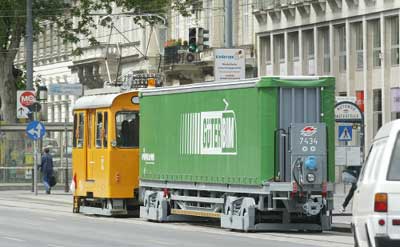
In Vienna, they've started running freight over the tram system. The Wiener Linien, the public transport authority, runs perhaps the best system I've ever met (especially as they haven't discovered the ticket barrier yet), including an intricate network of tramways carrying a variety of different trains that I'm not sick enough to detail. The plan, now, is to carry goods needed to maintain the system on goods trams like the one shown, and then perhaps also deliveries to businesses in the city, waste for disposal, and maybe also post. Link (in German) and more pics: here.

The trams are known as "bims" from the sound of the bell that invites the unwary to stand clear, as they go like a bat out of hell at the slightest provocation. For some reason, in my experience, the further east you go in Europe the faster the trams get - the Bratislava ones are quicker, and the huge ones in Budapest are a public menace rivalled only by the cars.

Read this now.

Richard Moderate, as opposed to Ken Moderate, has a brilliant post on liberalism and the Lib Dems. Needs reading.

A Blogged Election, and blogging on blogs

Time for a little masturblogging, I think.

I think it's fair to say that the general election has been a real step forward in British blogging. It was the first time, really, that the UK blogosphere really functioned as such rather than as a collection of blogs orientated either towards Europe, or towards the US high-traffic elite. It was also the first time UK blogs regularly threw out the kind of monster comments threads frequently achieved in the States - Anthony Wells deserves real credit for the UK Polling Report. (Although some more posts might be nice.) It also saw the birth of a number of good blogs. The Sharpener is an excellent example - which is also showing signs of a healthy comment community.

What didn't happen, or at least not enough, was much field blogging from the campaign trail. Perhaps, though, this reflected the reality of the most autistic election in the history of British democracy, when campaigning was targeted to a greater degree than ever on a smaller-than-ever group of swing voters who are themselves less representative than ever, in order to elect a parliament less representative than ever before. For the majority of Britons, the election was lived as a media experience. I recall knocking on one door shortly before election day to be told that, in 22 years, I was the first canvasser to pass that way.

It was also a blogged election with some curious bloggers. The Times ought to be ashamed for its scheme to get unpaid members of the public to contribute to its website. The Guardian imported none other than Kos to fill its blog, with mixed results. And when is Richard North of EU Referendum going to disclose in any signal way that both he and his lady coblogger Helen Szamuely are on the payroll of the Bruges Group, and that EURB is therefore a wholly owned subsidiary of the Conservative Party? I recognise that most visitors to EU Referendum probably follow the internal politics of Euroscepticism closely, but you cannot rule out on the internet that anyone may turn up, perhaps expecting to find disinterested information. In fact, isn't the choice of title deliberately intended to draw casual googlers? It is, after all, the no.1 Google result for "EU referendum", a title it contends for chiefly with the German quack doctor Matthias Rath's website (link withheld on moral grounds, eu-referendum.org if you're interested). Herr Rath combines campaigning against the EU with advocating herbs as a treatment for HIV/AIDS, something which would be merely ridiculous in Europe but which has achieved a deadly degree of influence in Southern Africa.

PS: The much-delayed Ranter Redesign, Project R, will happen, I promise. It will include a disclosure and policy statement.

Slight Return

The "Matador of Tumbledown" post from last weekend got quite a bit of attention, which is all good, and at least none of it came from bemedalled veteran Jocks claiming I'd misrepresented them completely and in fact it was a barrel of laughs. I'm just going to do a small return to it, and apply a little economics to the problem. Economic theory argues that for any given technology and business model, there is an optimal combination of labour and capital where productivity is maximised. The marginal productivity of capital curve, like its labour twin, displays first increasing and then diminishing returns to scale - once all the workers have shovels, adding more shovels will not dig a hole any quicker. At some point the two curves cross, and changing either of the two variables will only make things worse.

What is the point of all this? Recall the US soldiers who turned up at the petrol station brawl with a 155mm howitzer. Basically, the US Army and Marines in Iraq have a seriously non-optimal combination of capital and labour. The high technology, high intensity force built since the "big five" weapons projects of the late 1970s to smash back the Red Army's operational-manoeuvre groups from the Fulda Gap, and then repurposed as a world-wide intervention force, was conceived at least in part as a labour-saving exercise. NATO could never match the Red Army in numbers, especially after the end of US and British conscription, so it instead substituted capital for labour, and more intensive capital (attack helicopters, guided anti-tank weapons, complex ISTAR projects) for less intensive capital (more tanks), as well as human capital (investing in the training of professional soldiers) for numbers (conscripts).

The problem is that, in a world of messy small wars where almost all military activity has a political nature (peacekeeping, counter-insurgency, policing, special operations), not very much of this is useful, and the logistical requirements of the whizzies are a serious draw on the available labour. The AH-64 attack helicopter, as I blogged ages ago, needed the equivalent of one C-17 a day per aircraft during the invasion of Iraq. (Here - Helicopters are the new horses) The other problem is that although it's comparatively easy to move down the intensity scale, it's very hard to rebuild that capability - so we're committed to keeping on all the fancy stuff.

The British experience is salutary. Not that there is a radical difference in army structure, but the Northern Irish war meant that most of the army, not just the infantry, had to do duty in an infantry/military police role there - which means the option is open to rerole armour, artillery, signals and such as street patrollers once the high-tech battle is over. (However, it is worth noting that the UK order of battle in Iraq contains much less armour, aviation and artillery than the US divisions up north.) This isn't a real solution, though, as it's not enough to get the infantry overstretch down to tolerable levels. I suspect we're all going to be hunting back and forth along those marginal productivity curves for a while longer. After all, UN peacekeeping ops were taught several extremely bloody lessons about the danger of turning up with insufficient capital, in Rwanda (granted, the problem was more one of authority to act, but a few large and menacing tanks would have been deterrent) and Bosnia.

Is it time to think of how large formations might be re-organised for messy conflict? Granted there's no way of finding space for permanent "security" or "peacekeeping" brigades in the British Army at its current size, but it might be worth looking at how forces are composed for specific operations.

Wednesday, May 18, 2005

Update: Saving Tom Kelly

Information received from the boys at the Army Rumour Service suggests that we have an answer to exactly when Tony Blair found time to visit the wounded returned from Iraq. Apparently, he has done, once. That was in March, 2004, in Birmingham. He's not been back. Neither did he call on the joint services rehabilitation unit that looks after war amputees. Culture of respect, Tony, culture of respect...

Speaking of ARRSE, they've been the first victim of the "Show Me The Way to Amarillo" spoof video from Iraq. Posted to the forum gallery, it attracted a mob of downloaders who spread their CPG-Nuke server all over the Midlands, this after staff officers passing it on as an email killed the Defence Information Infrastructure for five hours. (52MBs attachment...ouch.)

Sunday, May 15, 2005

The Matador of Tumbledown

First, before doing anything else, go and read this Patrick Cockburn report for the Indy on Iraq. It's the stuff all right - you may especially enjoy the account of the Americans who turned up to deal with a fight in a petrol queue, equipped with a 155mm self-propelled howitzer. Never bring a knife to a gun fight, they say, but it's worth remembering that waving guns around near a knife fight isn't too wise either, especially if you know you can't shoot them.

A "Shorter" for that article, I think, could almost be "what TYR said" - about the failure of the coalition to get population security, the crisis on the roads, the Freikorps temptation, and much more Iraq stuff I've blogged here. But enough of the twaddle. What's with the bizarre headline?

The US Marines recently ended an operation, Operation MATADOR, up near the Syrian border. Naturally the official line was that it was a roaring success. Caches of weapons found (125 AKs, not many in a country where everyone has one), 125 "anti-Iraqi forces" killed, blah blah blah. Not that you'd think so from reports by those much-maligned embedded reporters. Ellen Knickmeyer of the Washington Post did the trip, and reported back on the unit she was with having to break up a platoon after it took two-thirds casualties, the enemy firing 12.7 and 14.5mm machine guns up through the concrete floors of houses where they set up in the crawl space above the foundations and waited for death. Nine Marines were killed and some 40 wounded.

This was in an operation given out as involving 1,000 men. From that, I deduce, we are looking at one Marine Expeditionary Unit, that is to say a battalion of Marines plus a company of tanks, a few engineer, medic, supply, gunner and FAC elements. Compare, if you will, the battle of Mount Tumbledown in the Falklands. In that action, a battalion of Scots Guards lost nine men and 43 wounded, too, in storming the hilltop held by the Argentine 5th Marines' N Company. At Tumbledown, there were fewer British soldiers - a battalion of 600-700 men compared to 1,000+ in an MEU - and no armour or air support. And no-one who took part would ever suggest it was anything less than tough, especially not (say) the UK's last senior officer in Iraq, Lt-Gen. John Kiszely, who as a major led a bayonet charge up Tumbledown and won the Military Cross.

My point? Things are not getting better in Iraq. With M1A1 tanks, Bradleys, LAV25s, constant attack aviation and F/A18s overhead, the US Marines' sweep in comparable strength through Qaim was as bad as Tumbledown, a battle that induced the Scots Guards' piper to write a new lament. Imagine, if you will, backing into that rathole under the concrete floor with the machine gun, a Soviet copy of the Browning .50 that will shoot through anywhere you happen to be reading this unless you're in a concrete bunker or a tank. Listening for steps above, and pulling the trigger into a whole world of noise like hammering your own head in that confined space and stone chips and dust and smoke. Then doing it again, and knowing that in the end, they'd either realise where those bullets were coming from and drop a grenade down one of the new holes in the floor, or call in the jets, or bring up a Caterpillar D9 bulldozer and crush the building down on you. And remaining serene and calm.

Now imagine walking into that building just as the floor erupts. This is not winning. So, what is happening? Some fool at the New York Times wrote this week that the insurgency was a "mystery", in that the enemy were killing too many civilians and this didn't fit somebody's preconceived plan. There is no mystery. Their first aim is to maintain a high level of generalised violence and prevent stability emerging. Their next aim is to make the occupation intolerable to the occupier. Once we go, there will be plenty of time to work anything else out.

People often don't realise that Iraq is urban. A mass of urbanisation spreads out from Baghdad down to the shrine cities and up towards Tikrit in the north, and west along the road to Fallujah and the Jordanian border. Although the plurality is Shia, the bulk of this urban core is Sunni, and this is crucial to know. That fraction of the insurgency aims, once having got rid of the Americans, to dominate this area, to seize power, and then, only then, to look elsewhere. Controlling this area gives them command of what there is of the state, the former defence establishment, and their own people, as well as the symbols of Iraqi nationalism. It also gives them key infrastructure and the trade route out to Jordan. All they need then is a share of the oil. South of Baghdad, they will find it harder to make progress, as they will be running up the demographic hillside and into both the Badr Corps and Sadrist heartlands. The Sunni insurgents are probably more militarily capable, but don't have the numbers. Somewhere along the demographic transition line, the front will halt.

And then, I fear, comes the ethnic cleansing of Baghdad. It will be the obvious next step, and anyway many will flee and save them the trouble. That leaves out the Kurdish issue. In the first instance, the Kurds will be the only party who can deter a Battle of Baghdad. But they would be amenable to compromise, so long as they can arm like hell in the meantime. In fact, all sides will do that - the Kurds and Sunnis from the world market, the Shia from Iranian help. Kurdish/Sunni differences are fierce, but they are the soluble kind - they involve compromisable wealth, and hatred. The Sunni/Shia conflict is less soluble because the two parties have a survival problem, facing each other within Baghdad itself.

That brings us to a state of virtual civil war, if you like: three unstable stateoids, at least two still contesting the claim to be the real Iraqi government, buying all the guns they can and cherishing their vendettas. Any factor could start the second war, that is, if the first even stopped.

For extra points: the UN Drug Control Program says Iraq has become a major transit point for Afghan heroin. What connection does this have with Antonov 26A ER-AFH, "July Morning"?

EDIT: "July Morning" is ER-AFH and a -26A. My whoops.

Saturday, May 14, 2005

Anyone Here Seen Kelly? Kelly From No. 10?

Tony Blair has frequently been accused of lacking empathy with the families of the dead and wounded in Iraq, not least by Reg Keys. Among other things, like not knowing how many of them there are, he has also been criticised for not visiting the wounded returned to the UK. Now, earlier this week, Blair's press secretary Tom Kelly wrote to The Guardian denying this. He claimed that Blair had in fact visited wounded servicemen returned from Iraq, but that "he has - he just didn't announce it to the media because he believes such visits should be private." (Link)

Curious, this insistence on privacy from the Five-Times-A-Night Man himself. But let that pass. What I'd like to know is when, where and how often these visits occurred. I don't particularly want any information on who he visited, as this indeed involves the privacy of those visited. Since the closure of the military hospitals after 1996, military patients are by and large treated in wards within the NHS, especially at Selly Oak hospital in Birmingham.

Now, I wouldn't want Mr. Kelly to accidentally give the impression his chief asked him to lie through his teeth. After all, he's not that good at spin doctoring: remember when he called Dr. David Kelly "a Walter Mitty figure"? So - can anyone help me to save Tom Kelly? People who are likely to know would include members of the Defence Medical Service, NHS staff at the hospitals concerned, and of course the patients themselves. It's time to find the missing PM.

Friday, May 13, 2005

Evening Standard Censored

Back on Monday, the London Evening Standard ran a long and sensational story by Andrew Gilligan regarding none other than my alter-ego, Viktor Bout, who it seems has been working for the MoD even after many of his companies were blacklisted by the US. Now, I intended to blog about it in a free moment during the week, but when I got around to I discovered that the Standard's website, www.thisislondon.com, contains no trace of the story. Nothing. Nada. Nitchevo. Down the memory hole, it seems.

You may recall that when, a few weeks ago, Duncan Campbell's report on the "ricin plot" that involved neither ricin nor a plot was scrubbed from The Guardian's site because the government invoked a Public Interest Immunity certificate on the names of some people involved, many bloggers including but not limited to Phil Hunt of Cabalamat Journal, Justin of Chicken Yoghurt, and Tim Worstall of, well, Tim Worstall reproduced the text of the article in order to preserve it. I am going to do exactly the same thing, and I would request that fellow-bloggers mirror the text as was done on that occasion. We could call it Operation Mirrorball.

Here goes:
Headline: HOW CAN BRITAIN STILL USE THE MERCHANT OF DEATH? Strapline: Today the UK will promise to curb arms traffickers. But the MoD is hiring planes from a dealer linked to Bin Laden.

By Andrew Gilligan. Evening Standard, Monday, 9th May 2005.

Victor Bout [sic] is the most notorious arms trafficker in the world. Linked to Osama bin Laden by the British government, linked to the Taliban by the US government, he was described by a New Labour minister as a "merchant of death" who must be shut down.

Yet an Evening Standard investigation has found that, just two months ago, a Victor Bout company was hired by that very same British government to operate military flights from a key RAF base.

Bout, a 38-year old Russian, owns or controls a constellation of airlines that have smuggled illegal weapons to conflict zones for the past 15 years. He has been named in countless official investigations and reports - the most recent only last month. The authorities in Belgium, where he used to work, have issued a warrant for his arrest. In 2004, the US froze his assets and put him on a terrorist watch list [not that they stopped him flying to and from Baghdad, TYR].

But between 6 and 9 March this year, according to official Civil Aviation Authority records, two Victor Bout charter flights took off from RAF Brize Norton in Oxfordshire. The cargo was armoured vehicles and a few British troops. The client was the Ministry of Defence.

The charters were operated by an airline called Trans Avia. It was named as one of Mr. Bout's front companies by the Government itself - in a Commons written answer on 2 May 2002. The Government cannot claim ignorance of Bout's dubious links. The Foreign Office minister Denis MacShane reassured MPs: "The UK has played a leading role in drawing international attention to Bout's activities, initially in Angola and Liberia and more recently relating to Osama bin Laden and al Qaeda".

A specialist aviation journal reported that the "al Qaeda link" was Bout's role in supplying bin Laden with a personal aeroplane - in the days before September 11, when he had a little more freedom of movement. Could Trans Avia have gone legit since then? Not according to the United States Treasury Department. Only two weeks ago, on 26 April, the Treasury "designated" Trans Avia as one of 30 companies linked to Bout, "an international arms dealer and war profiteer". Bout "controls what is reputed to be the largest private fleet of Soviet-era cargo aircraft in the world", says the Treasury press release. "The arms he has sold or brokered have helped fuel conflicts and support UN-sanctioned regimes in Afghanistan, Angola, the Democratic Republic of Congo, Liberia, Rwanda, Sierra Leone and Sudan. Notably, information available to the US government shows that Bout profited by $50 million by supplying the Taliban with military equipment when they ruled Afghanistan."

The story doesn't end there. Another two flights were made in the same three days of March by an airline called Jet Line International, also from RAF Brize Norton. A further three flights were made at the same time from another base, RAF Lyneham. The destination was Kosovo. The client, once again, was the Ministry of Defence.

Yet Jet Line, too, is a company that has been accused of close connections to Bout. According to the authoritative US newspaper, the Los Angeles Times, it appeared on a list of Bout companies circulated by the State Department to US diplomatic posts around the world.

"There is no doubt at all about the links between Jet Line and Bout," says Johan Peleman, the researcher who wrote the UN report. "It's one of his most important assets." Intelligence agencies say the same thing. Jet Line's office address in its base at Chisinau, Moldova, is the same as that of Aerocom, a company exposed by the United Nations as involved in sanctions-busting and arms-smuggling to the brutal rebels of Liberia. According to the UN, Aerocom was involved in the illegal smuggling or attempted smuggling of more than 6,000 automatic rifles and machine guns, 4,500 grenades, 350 missile launchers, 7,500 landmines, and millions of rounds of ammunition in breach of a UN arms embargo.

Tracking down the registration numbers of the sanctions-busting aircraft, it turns out that the Jet Line aircraft that flew the MoD flights in March were previously registered to Aerocom. They are in fact the same planes.

Bout's activities have helped cause quite literally thousands of deaths in many of the worst places in the world. Born in 1967, he served in the Soviet air force and then military intelligence, where he developed a gift for languages. When the USSR broke up, he "acquired" a large fleet of surplus or obsolete aircraft, which he used to deliver arms and ammunition also "acquired" from old Soviet stockpiles. That weaponry fuelled some of the most savage wars in Africa. Charles Taylor's insurgent guerrillas used Bout weapons to destroy Liberia. In Sierra Leone, the Revolutionary United Front (RUF) used Bout weapons to terrorise the country, seize the diamond mines, and chop off their opponents' hands.

None of our business? Well, the RUF's Bout-supplied weapons were almost certainly used to attack British troops engaged on the Sierra Leone peacekeeping mission in 2000.

Bout's planes would arrive at obscure African airstrips, loaded with weapons, then leave heaped with diamonds, coltan - vital for making mobile phones - and other precious minerals in return. "He was apolitical," said one UN official. "He would fly for anyone that paid." Bout's willingness to go places that no-one else would go made him the market leader in the arms-trafficking business. Little wonder, therefore, that the then Foreign Office minister Peter Hain said "The murder and mayhem of Unita in Angola, the RUF in Sierra Leone, and groups in Congo would not have been as terrible without Bout's operations." He was truly "a merchant of death", Hain said [and for a long time I respected Hain for it, too - TYR].

Bout used to operate from Ostend, in Belgium, where a shabby hotel in the city centre acted as his informal marketplace. There was a flight departures screen in the hotel bar, so he could keep track of his planes' movements. Then he was forced to retreat to Sharjah, in the United Arab Emirates - and after September 11, to Moscow, where he controls his empire through front companies such as Trans Avia. "You are not putting facts. You are putting allegations," he tells journalists on the rare occasions they manage to get through on his Russian phone number. [Actually, the quote comes from his surprise appearance on Ekho Moskhy radio in 2002 - TYR]

Britain has been embarrassed by dodgy airlines before. Last year, the Department for International Development promised a full investigation after the Standard exposed its use of Aerocom on an aid flight to Africa. The problem is that few reputable carriers want to fly to Kosovo, Iraq, Darfur or some of the places where the government needs transport. And the airline brokers used by Whitehall seem to have learned surprisingly few lessons from past embarrassments.

In a statement, the Ministry of Defence said the fact that its broker "seems to have used an aircraft in Jet Line International livery" was not the same as saying that the MoD itself had contracted Jet Line. But, whatever hairs the MoD may choose to split, the payout - for Mr. Bout - is the same.

Today and tomorrow, at the MoD's vast procurement headquarters in Bristol, defence officials are holding a special conference with human rights groups and arms trade campaigners. The purpose is to persuade them that the government is serious about cracking down on the scourge of arms trafficking.

One good way to start might, perhaps, be to stop putting British taxpayers' money into the pockets of the worst arms trafficker in the world."


Well, what can I say? TransAvia Export, of all firms, too. Perhaps the longest-standing and best-known of Boutcos. And it doesn't get any better for Andy G, either, does it? The Standard piece referred to in the text is still available on the paper's (badly designed and slow) site, but this one has been sanitised. Not any more.

Sunday, May 08, 2005

Blogroll Time

I've been extremely slack on updating the blogroll lately. But today, I've added all the recent linkers. Professor Mark Grimley's War Historian, the Current Outlook, Tim Worstall (our token conservative), Jarndyce's Pseudo Magazine, Steve Gilliard's Newsblog, What do I know?, new group blog project The Sharpener, the secret Dubai diarist's Secret Dubai Diary, Carlos W.'s No Such Blog (batshit rightwing, but very sound on Viktor Bout, Pan-Am nostalgia posts, and Friday tropical fishblogging), have some links. Also note that Susan of Suburban Guerrilla has a new address, and that should be it.

Saturday, May 07, 2005

They just won't stop it!

AFP via Le Monde reports on yet more Greek/Turkish sabrerattling and playing with high-performance jets. According to the Greeks, no less than fifty-six Turkish aircraft were involved in some 16 frontier violations (never mind the maths!), including 40 F-16s and 16 F-4 Phantoms, of which 8 aircraft (type not given) were armed. (The original report says 60 aircraft, 40 of one and 16 of the other, but as I said, never mind the maths!)

According to the Greek foreign ministry, relations between the two countries have improved in the last six years!

My editor is off to the Greek islands this week, so I must remind him to look up and take earplugs. But certainly not a camera. Nuh. Can anyone suggest to me a more wasteful and silly carrying on than this nonsense?

Congo Incident

I've been handed the report that an Antonov 26 belonging to something called "Kisangani Air List" has been crashed in the DRC by our esteemed colleague Soj. Rather, Soj handed me the report. She didn't crash the Antonov 26, or at least I don't think so. At the moment, I can offer little further information expect that "List" is a typo, it should be Kisangani Air Lift. This outfit was created sometime this year, and its only known aircraft was the one that crashed. Apparently it was leased from "Aeroworld", but I have yet to trace any company of that name. There is a World Aero Airways in Kisangani, though, started this year, which possesses one aircraft, an An-26B registered EK-26060, serial no. 17311107. Its past includes various small operators in the CIS and a period with "private users" in Kyrgyzstan.

Various media reports disagree on key points, some of them stating it was leased to, not from, "Aeroworld" which might anyway really be called "Euroworld". However, no operating airline of that name exists either - it is however the old (pre-1992) name for BA's subsidiary Cityflyer Express. I suspect the disagreement is down to mistranslation as there seems to be a majority of each version in different languages.

Everyone seems to agree it was an aeroplane, that it crashed, and that ten people were killed. Four of them are described as being Russian and making up the crew. One "Rayomon Mokeni" is quoted by all sources as the airline's president, however who he may be is a blank.

I don't think this helps any, but thar ye go.

What Is, In Fact, Going On in the Yemen

Back in January, I asked What's Up in the Yemen? after noticing regular flights by Irbis Air Co., a Kazakh-registered airline owned by Viktor Bout and now placed on the US Treasury seizure list, from Sharjah to Riyan-Mukalla airport in the eastern Yemen. Since then, we've seen confirmation of this with the crash there of Air Bas/Irbis's Antonov 12 UN-11007, which failed to take-off from Riyan and ran off the runway despite having 9,000 feet of concrete to stop on, suggesting overloading. Mysteriously, the firemen who responded to the crash would only speak to the Arab News on condition of anonymity.

This is a UN Expert Panel report on violations of the arms embargo on Somalia. Note Paragraph 90, which lists a number of sailing ships - sailing ships! - implicated in smuggling weapons into Somalia, and records their home ports. In all cases it is nowhere else than Mukalla. Not that smuggling is anything new around there, of course, a corner of the world where dhows (dhows!) have smuggled pretty much anything up to and including slaves since before Saint Paul took that route, supposedly, to India. Killer quote:
"Even though the security of the Yemeni ports — and in particular the Aden
Container Terminal — has markedly improved, the long Yemeni coastline remains
virtually unpoliced and continues to serve as a trans-shipment point for arms to
Somalia. Vessels, especially traditional dhows, can land and depart from the coast
unregistered and undetected. Weapons, machine spare parts, alcohol and fuel are
among the goods frequently smuggled out of Yemen. The fact that an estimated
1,000 refugees from Somalia arrive in Yemen each month proves how easy it is for
ships to land undetected."
Indeed. In 1916, some survivors of the sinking of a German raider at the Cocos Islands, where she was trying to cut the transoceanic telegraph cable to Australia, sailed out in a lifeboat and hijackeda fishing boat, which they later replaced with a more seaworthy schooner. They sailed right across the Indian Ocean and landed on the Yemeni coast, in fact only a few miles from the British colony of Aden; but nobody spotted them, and they succeeded in trekking across the desert as far as the railhead in Medina, from where it took them but days to reach Berlin and a heroes' welcome by Orient Express. Their main problem on landing wasn't avoiding detection by the British, but avoiding being murdered or betrayed by the locals, who were unimpressed by their argument that the distant Turkish overlord was Germany's ally.

Now, you may accuse me of taking the opportunity to tell a good story, and you'd be right. But, returning to seriousness, what about this?
"Upon departure from Boosaaso for the return flight to Sharjah (via Riyan airport in Yemen) this same aircraft changed its registration from Russian to Ukrainian."
Funny things, it seems, happen at Riyan, probably because of this:
"Riyan airport in Yemen does not provide any inspection for air cargo in transit. Most Somalia-bound operators justify their visits to Riyan as technical stops for refuelling, but it is unclear why they should choose to do so, given that there is no appreciable difference in the price of aviation fuel between Yemen and the United Arab Emirates."
How odd, eh. UN-11007, for example, officially carried out a "refuelling stop" on its fateful visit to Riyan although an An-12 should be able to do the trip from northern Somalia to the UAE direct. The only other reason to do so would be tankering - that is, the practice of taking on as much fuel as possible where it is cheap, in order not to buy where it is expensive. But if the fuel in Riyan is no cheaper, this would be pointless. It's at least plausible that the reason 007 didn't get off again is because it picked up more cargo there.

Why should we care? According to the report, the two SA-7B missiles used by al-Qa'ida in an attempt to shoot down an Israeli Boeing 757 in Mombasa on the 28th November 2002 originated in Bulgaria in 1993. This would be in-pattern with the source of much of the armaments distributed by Viktor Bout. It appears to be unclear whether the weapons reached Somalia, where they were bought by the terrorist cell, as part of assistance by the Eritrean government to one of the Somali warlords in 1998 (presumably to secure their flank during the war with Ethiopia) or whether they were obtained commercially. However, the missiles made it from Bulgaria to the Horn of Africa as part of a shipment to the Yemen in 1994. At this time, a civil war was raging there between the government of reunited Yemen and a Saudi-backed countergovernment based in - guess where? - Riyan. And none other than Viktor Bout's Phoenix Aviation was delivering supplies there, using a Boeing 707 piloted by British cocaine smuggler and fraudster Chris Barrett-Jolly. It is not stated whether the weapons in question were delivered to the government or the rebels, but perhaps, all things considered, it doesn't matter.

Now consider this. The oil tanker route from the Gulf to Europe and North America passes close by these shores, as does the shipping route through the Suez Canal. Al-Qa'ida destroyed a US destroyer in Aden harbour in 1998, and blew up a French oil tanker off - guess where? - Mukalla in 2002. Can you guess why the US Marines paid the good people of the Puntland shore a visit last week?

Thursday, May 05, 2005

Admin notice

Right. I've been a split-brain blogger for the last month, putting all my election stuff over at General Election '05. After tonight, there will be more TYR. There is some interesting news to come on what, exactly, is going on in the Yemen.

On that theme, you will probably be pleased to know that our occasional reader and long-term enemy Richard Chichakli's house was raided by the FBI this week. They yanked the hard drives from his computers to study, seized a safe full of diamonds (you can't make these guys up), and were very surprised when Viktor Bout's brother Sergei phoned Dick up during the raid to find out how things were going. (Hi! I...can't really talk just at the moment..yeah, I'll get back to you when I have a moment..please not the taser again!..click, brrr)

And - here's interesting - someone at The Times paid a visit to this site searching for "asterias commercial sa trouble". AC is, readers will recall, the Greek-flag, Ukraine-based shellco opened up late last year to receive the aircraft from Aerocom.

Tonight, I will probably be posting to GE05 fairly frequently. I won't promise formal liveblogging, but expect reports once I get away from watching the poll for my local Lib Dems sometime after 2200.

It's Time

(With apologies to Gough Whitlam)

It's time to do a final election post. If you haven't voted yet, kindly take a moment to read through the archives. We've had masses of Iraq and secret detention, mass surveillance, any amount of stupidity, cash-burning PFIs, schools controlled by anyone who will stump up one-tenth of their cost, blah blah blah. Please do not vote Labour. Voting for this government is a negation of voting itself, because they have constantly and repeatedly flouted the terms of our democracy. What matters for Tony Blair is not parliamentary or electoral sanction, but the approval of the powerful, whether they are the US Republicans, the British state's control bureaucracy, the rulers of Russia, China or Saudi Arabia, or any one of several press barons.

But don't go thinking that voting Conservative is at all a sensible option. The Conservative Party has never been sufficiently committed to resist this government's worst excesses. The two main parties have become a cartel, operating a tacit understanding not to broach any important issue. Did you spot the debates on Europe, energy, defence policy (other than "Save the Scottish Regiments" and like flagwaving), regional development, the constitution? I thought not. What is needed is a wedge driven between them.

Even if they were to make the cartel manifest, forming a coalition of self-interest in the event of a hung parliament, this would at least make fully clear that the political choice is now between the Party of Incumbency and the Party of...well, everyone else.

And finally, consider this:
CB: Oh come on Tony, strip off. Let's see that fit body we've been talking about.
TB: You can keep your hands to yourself, Cherie!
Sun: So how fit are you Tony?
CB: Very!
Sun: What, at least five times a night?
TB: At least, I can do it more depending on how I feel.
Sun: Are you always up to it?
CB: He always is!
TB: Right that's enough - interview over. And I'm not doing any kissing pictures!
Well, everyone else and their dog in the blogosphere quoted this from the Sun's eve-of-poll front-page interview with Tony and Cherie. So I may as well. Interestingly, the Sun voice in the quote is that of their specialist royal photographer, Arthur Edwards. It says something that he was sent to Downing Street. Edwards, tiresomely described by the paper as "Our Arfur" (Remember, you are too stupid to spell! Obey!) and constantly played up as "close" to the royal family, was once insulted whilst photographing a royal occasion. The Sun predictably erupted in a storm of fake proletarian outrage, before he was predictably given a CBE. If this sick relationship is to typify the approach they will now have to politics, I dread the next four years. Now, ask yourself this: what on earth did Blair promise Rupert Murdoch in return for that?

Vote Liberal.

Sunday, May 01, 2005

Blair's Cover Blown

It's all over the press that various killer documents have been leaked: including the Foreign Office's legal advice on the admissibility or otherwise of a war with Iraq, and the detail that contrary to his repeated denials, Tony Blair read it, and even further that Sir Richard Dearlove, the head of MI6, told the government in the spring of 2002 that President Bush was determined on war and that "the intelligence and facts are being fixed around the policy".

Ten out of ten for policy analysis, C.

This shouldn't be surprising. In the official US Army lessons learnt report, On Point: The United States Army in Operation Iraqi Freedom, it is stated that base development in Kuwait was underway at the time Blair flew to see Bush in March, 2002. In the House of Commons Select Committee on Defence's report on Operation TELIC, which I blogged on here (you can get a copy from the links provided), it became clear that the Ministry of Defence was in talks with industry regarding Urgent Operational Requirements (UORs, purchases under a special procedure to obtain immediately needed equipment) as early as May, 2002. This was the same time that PJHQ operations chief Lieutenant-General John Reith told the committee that he became "aware" of planning going on. However, the UK Component commander, Air Marshal Brian Burridge, met General Tommy Franks of CENTCOM in April, 2002. And the UK Defence Logistic Organisation (DLO) was apparently involved from "day one of the strategic planning options".

Surely the DLO must also have been involved in the UORs, which would put "day one" somewhere before May, 2002? General Applegate of the DLO stated that
"there was an impact of when we could start doing the planning… We had to wait to get the approval to go forward with the AS90 work… actually, we were planning for the end of March / beginning of April for that work to be conducted…"
That it was the AS90 job - work on the army's self-propelled guns to stop them overheating is significant. Other UORs, such as minesweeping gear for the Navy, were of limited relevance before the January 2003 decision to shift the British axis of effort from Kurdistan to southeastern Iraq and to launch an amphibious landing there.

Traffic Burst

We've just had a surge of traffic, for once not entirely associated with Viktor Bout. Metafilter linked to a story, from some time ago, regarding Shanaz Rashid, the grateful Iraqi woman who appeared on stage with Blair at the Labour conference. She had every reason to be grateful, because her husband had been named Minister of Waterways by the IGC. He's the new president's brother-in-law. She had also had only limited opportunities to reconsider, having been in London since 1968 and only having returned once for a flying visit to the Green Zone. I flagged this and pointed out the curious similarity of George Bush also appearing with a grateful Iraqi woman who had, ah, other reasons to be grateful.

Interestingly, she has also now appointed herself Permanent Representative of the Patriotic Union of Kurdistan in the UK, so I take it she won't be going anywhere near Iraq any time soon.

There's also been extra traffic from Bout googlers. People seem to be searching pretty constantly for Richard Chichakli...not an unusual statement all things considered, but searches include the Bank of America, American Express, HSBC, a lot of people in Texas, the Spanish Ministry of Defence and the US Department of Justice. "Sir, we're sorry, but your card has been, ah, declined. In fact, it's been placed on a trap watchlist lookup table that requires us to cut it up and hold one of your legs as security until the FBI get here.." Yeah, but no doubt he's in the UAE by now, or some hellridden African state where he married the warlord's daughter.

kostenloser Counter